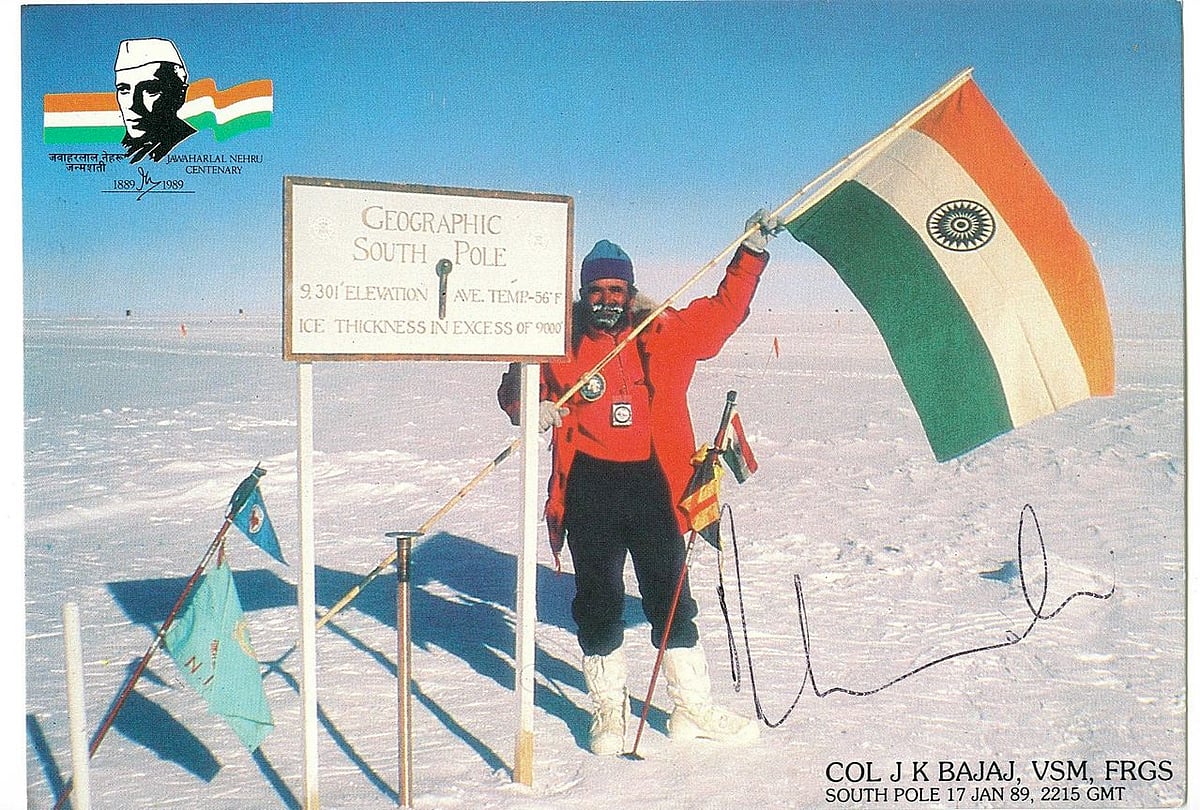
Amid protests by Opposition members seeking a debate on price rise, Lok Sabha on Friday passed the Indian Antarctic Bill, 2022, which seeks to extend the application of domestic laws to research stations set up by India in the Antarctic region.
This was the first bill passed this session.
As soon as the House reassembled at 2 pm on Friday following the second adjournment of the day, the Indian Antarctic Bill, 2022, was taken up for consideration after Earth Sciences Minister Jitendra Singh moved it for consideration.
Replying to the brief debate on the bill, Singh said the Antarctic Treaty was signed in 1959 and India became a signatory in 1983.
“The main objective of the treaty was that Antarctica is not used for military activity or there is no other misuse, to ensure the demilitarisation of the area. The other objective was to prevent nations from indulging in mining activity or any other illegal activity,” the minister said.
What is the bill about?
• The Bill seeks to give effect to the Antarctic Treaty, the Convention on the Conservation of Antarctic Marine Living Resources, and the Protocol on Environmental Protection to the Antarctic Treaty. It also seeks to protect the Antarctic environment and regulate activities in the region.
• Earth Sciences Minister, Jitendra Singh, said that such a law was necessary under India’s obligations as a signatory to the Antarctic Treaty of 1963.
• The key objectives of the Treaty are to demilitarise Antarctica, establish it as a zone free of nuclear tests and the disposal of radioactive waste, and to ensure that it is used for peaceful purposes only; to promote international scientific cooperation in Antarctica and to set aside disputes over territorial sovereignty.
• India has been sending expeditions to Antarctica for the past 40 years. However, these expeditions have been circumscribed by international law.
• The Bill will bring Indian research stations in the Antarctic region under domestic laws. It mandates for expeditions and individual visitors to carry a permit from the government. Flouting any rules prescribed in the Bill can attract a fine of up to Rs 50 lakh and imprisonment up to seven years
• The Bill now puts into place a comprehensive list of regulations related to Antarctica, for such scientific expeditions, as well as for individuals, companies and tourists.
• The Bill proposes to prohibit Indian expedition to Antarctica without a permit or written authorisation of another party to the Antarctic Treaty, provide for inspection by an officer appointed by the government and for penalty for contravention of certain provisions of the legislation.
• It also seeks to constitute a fund for the welfare of Antarctic research work and protection of the environment of the icy continent.
• The Antarctic Bill will also extend the jurisdiction of Indian courts to Antarctica, for crimes on the continent by Indian citizens, or foreign citizens who are a part of Indian expeditions. So far there was no recourse for crimes committed during an expedition, including crimes against the environment.
History of Indian Antarctic exploration
The origin of the Indian missions to the Antarctic are traced to the joint Indian Space Research Organisation – Hydrometeorological Centre of Russia agreements, which led to Indians, such as Dr. Paramjit Singh Sehra, joining the 17th Soviet Antarctic expedition of 1971–1973.
India officially acceded to the Antarctic Treaty System on 1 August 1983. On 12 September 1983, the country became the fifteenth Consultative Member of the Antarctic Treaty.
In 1981 the Indian flag unfurled for the first time in Antarctica, marking the start of Southern Ocean expeditions under the environmental protocol of the Antarctic Treaty (1959).
The first permanent settlement was built in 1983 and named Dakshin Gangotri. In 1989 it was excavated and is being used again as supply base and transit camp. Dakshin Gangotri was decommissioned in the year 1990 after half of it got buried under the ice. It used to double up as a place for multiple support systems, including the presence of an ice-melting plant, laboratories, storage, accommodation, recreation facilities, a clinic and also a bank counter.
The second permanent settlement, Maitri, was put up in 1989 on the Schirmacher Oasis and has been conducting experiments in geology, geography and medicine. India built this station close to a freshwater lake around Maitri known as Lake Priyadarshini.
Located beside Larsmann Hill at 69°S, 76°E, Bharati was established in 2015. This newest research station for oceanographic research will collect evidence of continental break-up to reveal the 120-million-year-old ancient history of the Indian subcontinent.
(with inputs from agencies)


