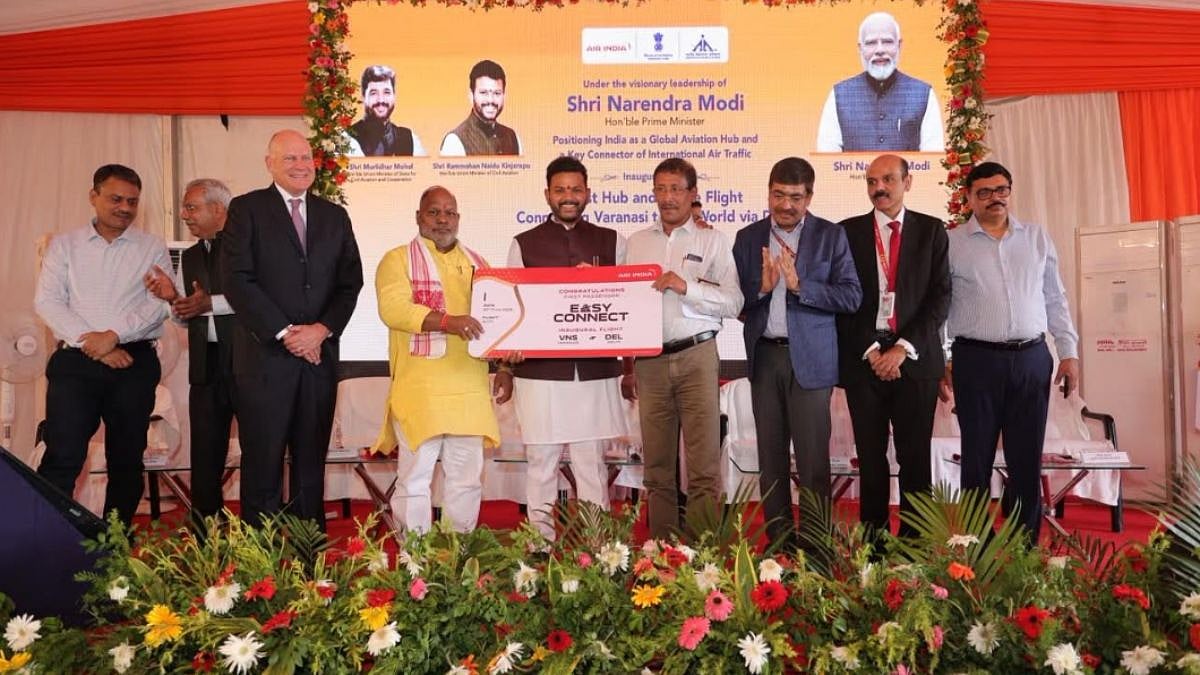
Mumbai: Air India commenced operations under the Ministry of Civil Aviation’s (MoCA)’s ambitious Hub and Spoke model, with the first flight from Varanasi to various international destinations via Delhi. The model aims to position India’s major metropolitan gateways as global transit hubs, rivalling established international aviation centres in the Middle East and Southeast Asia.
On Thursday, Air India operated the inaugural international flight under this new framework, connecting Varanasi to an overseas destination via its primary hub at Delhi’s Indira Gandhi International (IGI) Airport with total decentralisation of international transit protocols. Passengers boarding the flight AI-1111 at Lal Bahadur Shastri International Airport in Varanasi – acting as the spoke airport – underwent all international check-in, baggage tagging, and customs procedures before ever leaving the ground in Uttar Pradesh.
Passengers received their international boarding passes at Varanasi and their luggage was securely tagged through to their final overseas destination. Upon landing in Delhi, travellers bypassed the traditional, time-consuming transit check-in bottlenecks and transferred seamlessly through the domestic-to-international wing for nine destinations like Dubai, Colombo, Jeddah, Riyadh, Kathmandu, Phuket.

This systemic overhaul effectively minimised the minimum connection time required at Delhi's Terminal 3, transforming what used to be a stressful multi-step transfer into a smooth, streamlined connection. The flight will offer seamless connections to 17 international destinations within four hours of arrival at Delhi, including London, Rome, Milan, Frankfurt, Zurich, Dubai, Riyadh, Jeddah, among others.
Union civil aviation minister Ram Mohan Naidu Kinjarapu inaugurated the first Easy Connect flight and presented the first passenger to check-in with a commemorative boarding pass. Bureaucrats from the civil aviation ministry and Air India officials, including managing director Campbell Wilson, also attended the ceremony.
“Today we take a major step forward towards realising our vision of making air travel more accessible and building a future-ready, self-reliant Indian aviation industry that is efficient, inclusive, and globally competitive. Our new hub-and-spoke model paves the way for a monumental shift in how our citizens travel – regardless of the city one lives in India, one can begin their international journey from their home city and travel across the globe with ease and confidence, on India’s own wings,” Kinjarapu said.
Over the next few months, Air India aims to introduce Easy Connect services from several other Indian cities, including Ahmedabad, Amritsar, Chennai, Goa, Guwahati, Hyderabad, Kochi, Mumbai, Patna, Vadodara, and Visakhapatnam.
According to Air India, nearly 25 million passengers travel long-haul to and from India annually, of which close to 20 million are connecting travellers and around 85% – approximately 17 million – of whom currently transit through overseas hubs rather than Indian airports.
For years, the Indian government has aimed to retain the international passenger traffic that is frequently funnelled through foreign hubs. By utilising regional airports like Varanasi to aggregate international demand and routing them efficiently through megacity hubs like Delhi, the framework aims to fill wide-body international flights out of major gateways and opens global corridors to Tier-2 and Tier-3 cities without requiring financially risky point-to-point international routes.
While the Varanasi-Delhi corridor is merely a pilot phase, plans are already underway to scale the framework across other regional airports, with customs and immigration infrastructure being upgraded in several spoke locations. Apart from Delhi, three other major Indian airports, including Mumbai, Bengaluru and Rajkot, have been identified as hub airports and are expected to see operations under the model.

