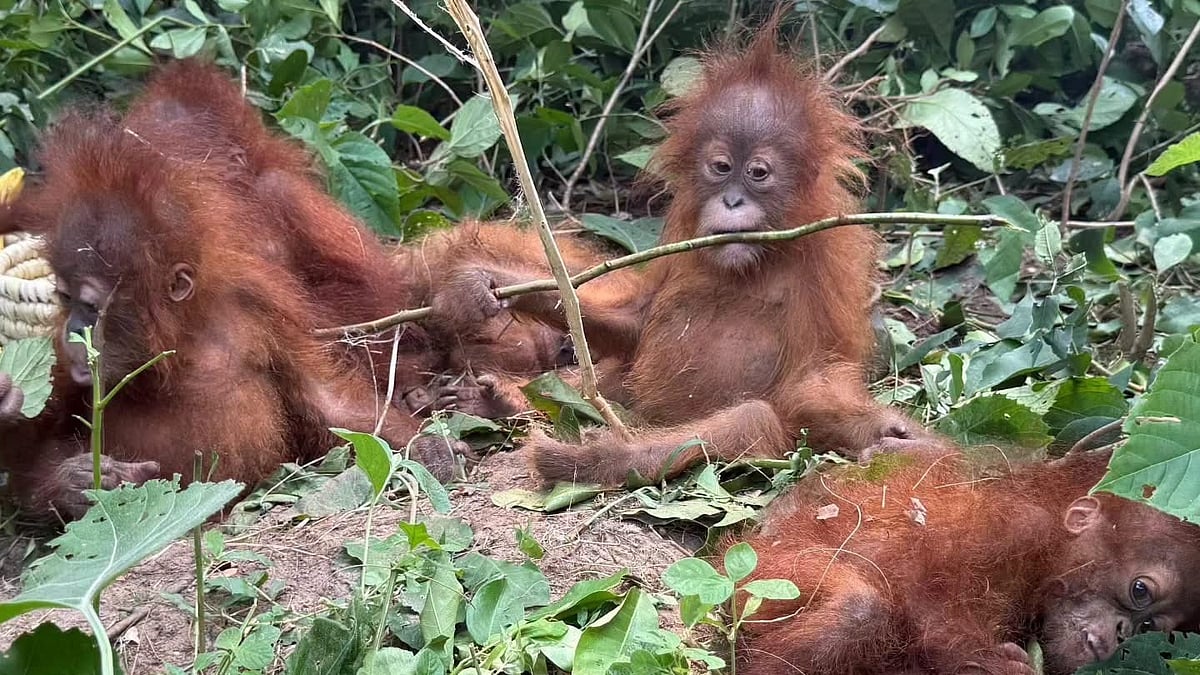
The discovery of five baby orangutans in a forest in Odisha’s Balasore district on Tuesday has triggered concerns over possible international wildlife trafficking, with forest officials saying the primates could not have reached the area through natural migration.
Local residents spotted the five juvenile orangutans near the Badapai village forest in the Bhograi area of the coastal district at around 6 am. News of the unusual sighting spread quickly and thousands of people gathered at the spot within an hour, prompting the Forest Department to rescue the animals.
Five Rescued, One Under Treatment
“We have rescued five baby orangutans and brought them to the forest office. Four of the five babies are healthy and eating food and drinking ORS. Veterinary doctors are examining and treating them and they are under the care and observation of the forest officials,” Balasore Divisional Forest Officer Pratik Prakash Indalkar said.
Officials have not yet established the exact age of the orangutans. However, judging by their size, between one foot and one-and-a-half feet in height, they believe the animals are juveniles, the Indian Express reports.
The discovery is particularly unusual because orangutans are not native to India. They are found in the wild only in the rainforests of Borneo and Sumatra in Southeast Asia, thousands of kilometres from Odisha.
No Natural Route To Odisha
“Chances of their natural migration to the Balasore forest is less as there is no corridor link. It must be a human-induced act. We have launched an investigation through field officials to ascertain how the primates arrived in the Odisha jungle,” Indalkar said.
That geographical reality makes the episode more than an unusual wildlife sighting. With no natural corridor connecting the orangutans’ native habitat to Odisha, their presence in Balasore raises serious questions about how they were transported and whether they were abandoned during an illegal trafficking operation.
The Forest Department has lodged a formal complaint under relevant wildlife laws and is taking the help of police to determine whether an individual or an organised racket was involved.
International Smuggling Angle Under Scanner
Odisha Forest and Environment Minister Ganesh Ram Singh Khuntia said the Wildlife Crime Control Bureau (WCCB), a multidisciplinary agency of the Centre, would investigate the matter as the state government suspects the involvement of an international smuggling racket.
Cases involving the trafficking of orangutans are linked to a multi-million-dollar criminal industry, according to officials.
The discovery of five juveniles together adds to the concern. While officials have yet to establish exactly how they reached Balasore, the absence of any natural migration route has put possible human involvement at the centre of the investigation.
Search For More Animals
The Forest Department has also launched a combing operation in nearby forest areas to determine whether any other wild animals are present or whether evidence linked to possible smuggling can be found.
“The details, as to whether there is involvement of any individual or a racket, would only be known after a thorough investigation,” an official said.
The operation is significant because investigators now have to establish whether the five orangutans were the only animals transported to the area or part of a larger suspected trafficking operation.
Why Orangutans Are So Important
Orangutans are Asia’s only great apes and the world’s largest tree-dwelling mammals. They spend most of their lives in trees and use their long arms and strong grip to move through the forest canopy.
Adults can have an arm span of around 2.2 metres. Orangutans are also highly intelligent primates known for tool use, problem-solving and complex social learning. Their shaggy reddish-brown hair distinguishes them from other great apes.
Their conservation status makes the Balasore discovery even more concerning. All three orangutan species, the Bornean, Sumatran and Tapanuli orangutans, are classified as Critically Endangered on the International Union for Conservation of Nature (IUCN) Red List.

Three Species Facing Survival Crisis
Bornean orangutans are found across Borneo and are the most numerous of the three species, though their population continues to decline. Sumatran orangutans are restricted to northern Sumatra and are among the rarest great apes.
The Tapanuli orangutan was identified only in 2017, with fewer than 800 individuals remaining in a single forest patch. Habitat loss, poaching and illegal trafficking have pushed all three species towards a severe survival crisis.
Orangutans live for an average of up to 40 years in the wild, while those in captivity can live for more than 50 years and sometimes up to 55 years, according to forest officials.
Nandankanan Likely To Be Their New Home
Forest officials said the five orangutans would most likely be shifted to Nandankanan Zoological Park in Bhubaneswar after the necessary procedures are completed.
A team from Nandankanan Zoo has left for Balasore to coordinate their transfer.
Also Watch:
“Once shifted, they will be put in quarantine for some days at the zoo,” Principal Chief Conservator of Forests, Wildlife, PK Jha said.
Nandankanan previously housed an orangutan named Binny, which died in February 2019 at the age of 41 due to respiratory problems. At the time, Binny was the only orangutan in India.
Binny was brought to Nandankanan from Pune in 2003. Before Pune, the orangutan had been brought from Singapore.
Rare Sighting, Troubling Questions
For residents of Balasore, the appearance of five baby orangutans was an extraordinary sight. For wildlife authorities, however, it presents a potentially troubling case.
The animals were found thousands of kilometres from their natural habitat, with no wildlife corridor that could explain their arrival. Until investigators establish how they reached the Odisha forest, the five juveniles remain both an extraordinary wildlife discovery and a possible sign of the international illegal wildlife trade reaching far beyond the animals’ native forests.

