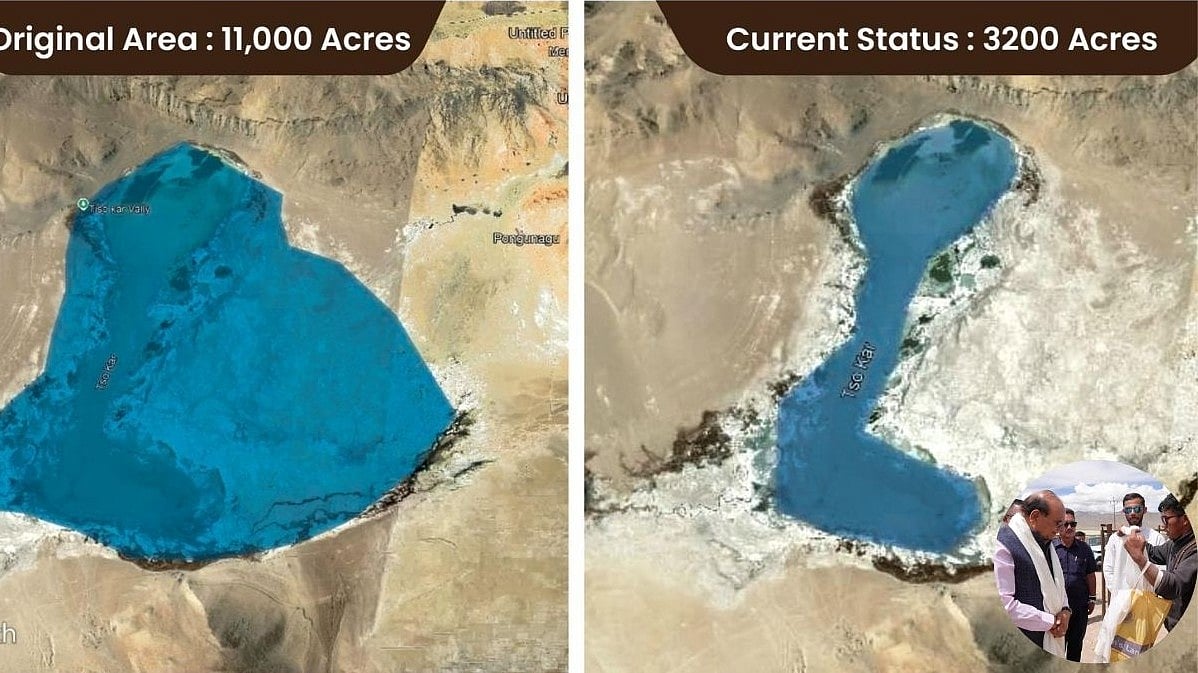
Ladakh Lieutenant Governor VK Saxena has outlined an ambitious plan to restore the ecological health of Tso Kar Lake, one of the region’s important high-altitude wetlands. The initiative focuses on improving the lake’s water availability by channelling glacier-fed water into the shrinking water body.
According to the plan, around 320 million litres of water per day from Rupsho Kharnak glacier could be diverted towards Tso Kar every day during the relevant flow period. The proposed intervention is aimed at addressing the lake’s declining water levels and supporting its fragile ecosystem. The 18,000-feet-altitude glacier channelised into Lake Tso Kar has desiccated by nearly 70 per cent in the last one decade.
LG VK Saxena launches Tso Kar Lake project to revive
Lieutenant Governor of Ladakh, VK Saxena, launches mega project to revive dying Tso Lake in Ladakh using untapped glacier water. Having successfully channelised 90 million litres of Stok Glacier water into Igoo-Phey and Chuchot village canals to irrigate parched land near Leh, the Ladakh administration has now taken up a larger project of channelising another glacier stream – Rupsho Kharnak in Changthang District – to revive and rejuvenate the dying Tso Kar Lake, at a high altitude of nearly 15,000 feet. The project envisages channelising an average of 132 cusecs or 320 million litres of untapped glacier water per day, from the Rupsho Kharnak stream to the Tso Kar Lake, which has drastically reduced by almost 70 per cent in the last one decade.
Lake’s ecological importance
Located in the Rupshu plateau of Ladakh, Tso Kar is a high-altitude wetland known for its distinctive landscape and biodiversity. The lake and its surrounding wetlands provide habitat for several species of birds and other wildlife. The region is particularly significant for migratory birds, including the black-necked crane.
Concerns over wetland decline
The restoration proposal comes amid growing concerns over changes in water availability and the ecological condition of high-altitude wetlands in the Himalayan region. Tso Kar, whose name means “White Lake”, is part of a sensitive cold-desert ecosystem where water resources are limited and seasonal variations can have a major impact on wildlife and local communities.
The proposed water diversion is expected to strengthen the lake’s hydrological system while helping preserve the surrounding wetland habitat. Officials have also highlighted the broader environmental importance of protecting Ladakh’s natural water bodies. These new water bodies will serve as new tourist destinations and additionally, much-needed habitats for migratory birds.
Reviving crane habitat
This project is the first and only attempt to revive a dying lake at this high altitude and in such harsh conditions, where most of the time, the temperature remains below 10 degrees Celsius in summers and goes down to minus 20 to 30 degrees in winter. Consequently, the lake, once a thriving habitat of migratory birds and the famed Black-Necked Crane, is also rapidly vanishing, with only a small number of birds arriving at the site now.
The Black-Necked Crane is a rare migratory bird found across the high-altitude regions of the Tibetan Plateau, with Ladakh being one of its important breeding grounds in India. The birds arrive in the region during summer and are mainly spotted in areas such as the Changthang plateau, particularly around wetlands and marshes. The world’s only alpine crane species has also been declared as the state bird of Ladakh and a symbol of peace.

