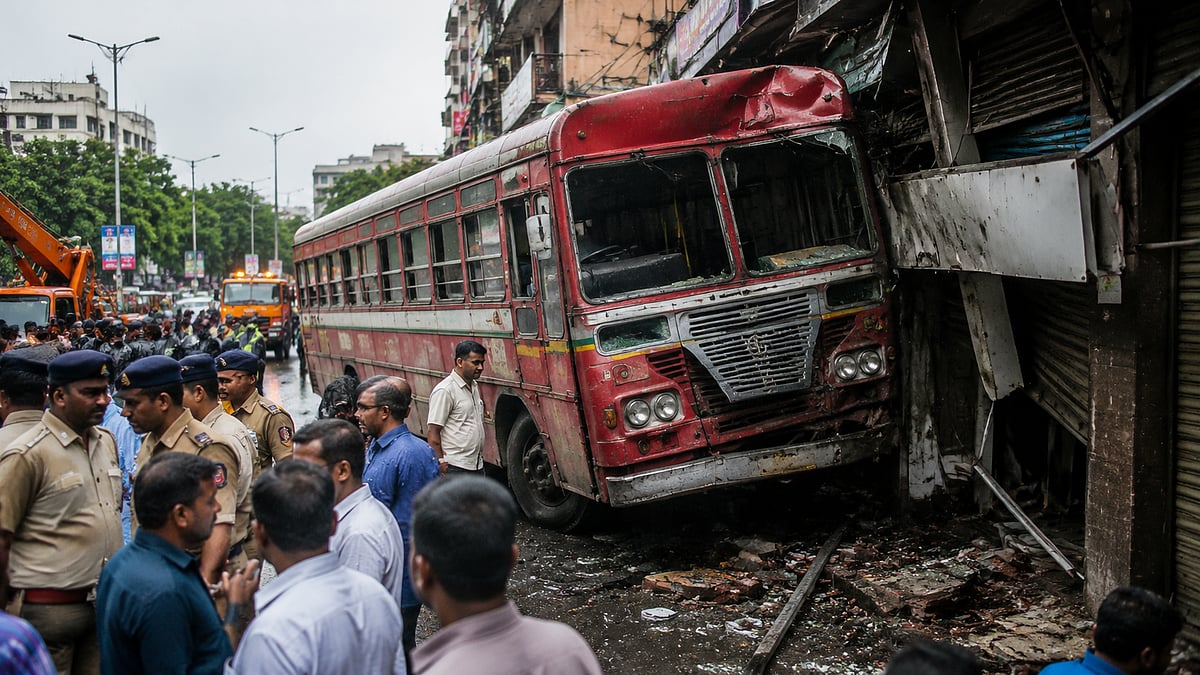
Mumbai: Preliminary findings into Monday's fatal BEST bus crash in Dadar (West) have pointed towards human error, with investigators examining whether the driver may have accidentally pressed the accelerator instead of the brake after restarting the vehicle. The accident claimed the life of a 30-year-old delivery executive and left five others injured, raising fresh concerns about safety standards and driver training in BEST's wet-lease fleet.
Accident details
According to officials familiar with the inquiry, the electric AC bus operating on Route A-463 was moving at around 15-16 kmph before suddenly accelerating. Data from the Intelligent Traffic Management System (ITMS) installed in the bus showed that the vehicle reached a peak speed of about 24 kmph when it struck a stationary crane near Tilak Bridge in Dadar. Sources said the bus may have been left in "Drive" mode instead of "Neutral" or "Parking" mode when the driver restarted it after completing a trip near Veer Kotwal Udyan.
"The speed recorded by ITMS before the loss of control was around 15-16 kmph, while the peak speed at the point of impact was about 24 kmph," a BEST official said. Investigators are also examining claims that the braking system may not have functioned properly. A technical inspection of the Olectra-manufactured electric bus has already been carried out, and a four-member inquiry committee has been constituted to determine the exact sequence of events.
Investigation status
The crash has once again brought attention to the growing dependence on privately operated wet-lease buses. Data released by BEST shows that between August 2025 and May 2026, Mumbai recorded 907 bus accidents, of which 887 involved wet-lease buses. During the same period, 23 fatal bus accidents were reported, with 22 involving wet-lease vehicles and only one linked to a BEST-owned bus. Of BEST's active fleet of 2,801 buses, as many as 2,553 are operated through private contractors.
BEST union leader Shashank Rao questioned the quality of training provided to drivers hired by private operators. "Every heavy vehicle operates differently. Drivers need proper induction and hands-on training, especially for electric buses," he said. BEST has made a four-week e-bus training programme mandatory, though officials say some operators have expressed concerns over its impact on business.
The tragedy has devastated the family of victim Niyaz Sheikh, a Swiggy delivery executive originally from Uttar Pradesh. Living in Mumbai for the past five years, Sheikh was scheduled to return to his village on June 17 and was expected to get married within the next few months. His sudden death has left his family shattered and turned a future filled with hope into one marked by grief.
To get details on exclusive and budget-friendly property deals in Mumbai & surrounding regions, do visit: https://budgetproperties.in/

