
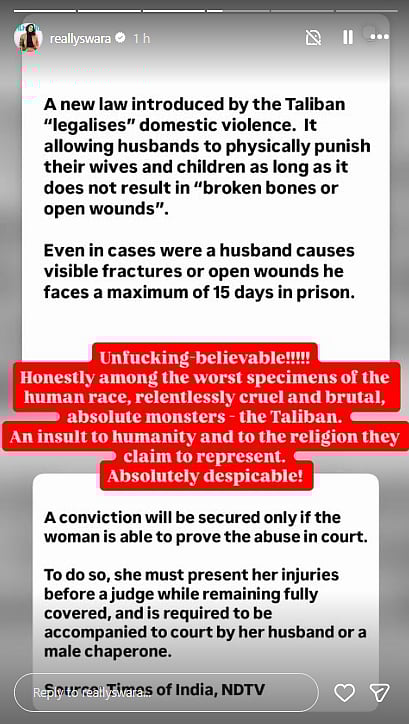
Actress Swara Bhasker strongly condemned the Taliban’s newly introduced penal code in Afghanistan, which has drawn criticism from human rights organisations. Sharing reports about the development on her Instagram story, Swara did not hold back.
Reacting to the provisions in the new law, she wrote on Friday (February 20), "Unfucking-believable!!!!! Honestly among the worst specimens of the human race, relentlessly cruel and brutal, absolute monsters the Taliban. An insult to humanity and to the religion they claim to represent. Absolutely despicable."
Reacting to the news, actress and host Gauahar Khan commented, "Disgusting." Actor Nandish Sandhu wrote, "What sense does this make?"
Their reactions come after the Taliban formalised a new 90-page penal code, signed by its supreme leader Hibatullah Akhundzada. The code reportedly consolidates several of the regime’s most restrictive policies and has raised serious concerns over the rights of women and children.
According to reports, the law permits husbands to physically discipline their wives and children, as long as the punishment does not result in broken bones or open wounds. Human rights groups argue that this provision effectively legalises domestic violence. The code also differentiates punishments based on whether a person is considered free or a slave, embedding inequality within the justice framework.
Notably, the new legislation does not explicitly prohibit psychological or sexual violence. The maximum punishment for abuse is capped at 15 days in prison, and only in cases described as involving “obscene force,” such as visible fractures or serious injury. Even then, a conviction depends on the wife presenting proof of injury before a judge.
Reports further state that women must appear fully covered and be accompanied by a husband or male guardian in court - even if the accused is the husband himself.
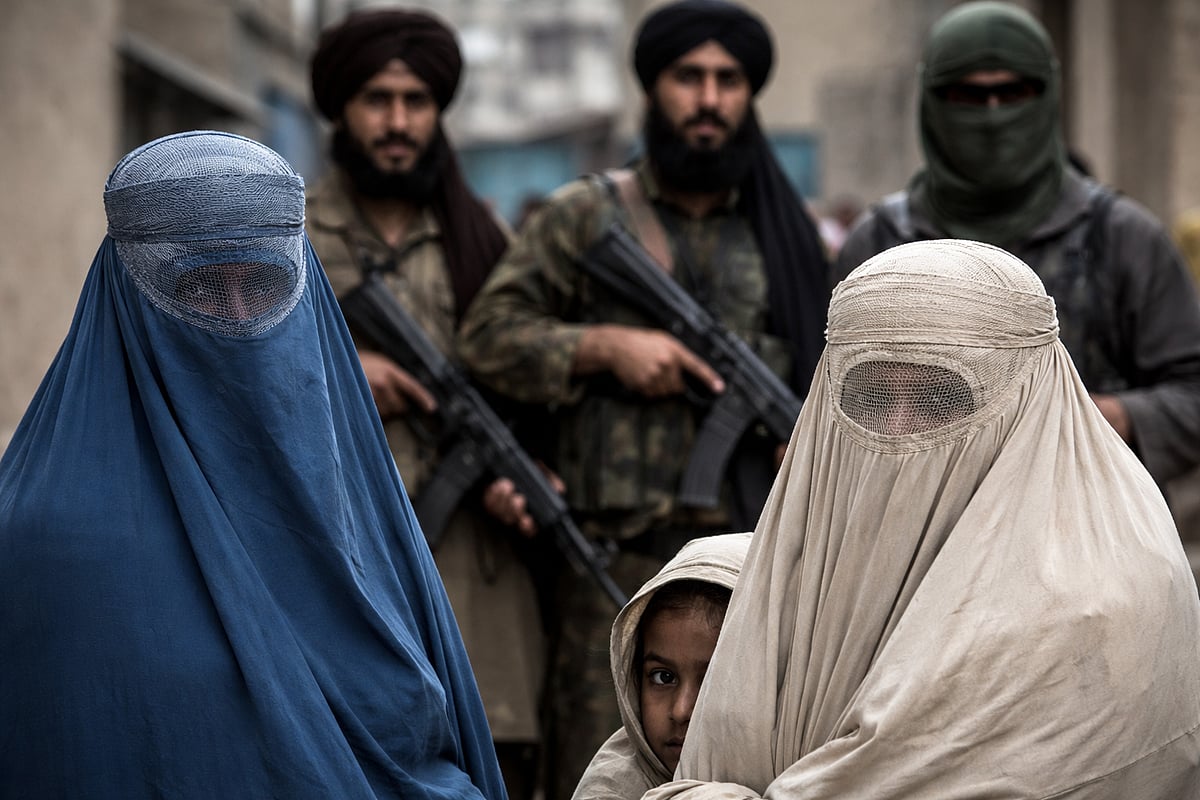
Additionally, a married woman can face up to three months in jail for visiting relatives without her husband’s permission, including in situations where she may be seeking refuge from abuse.
