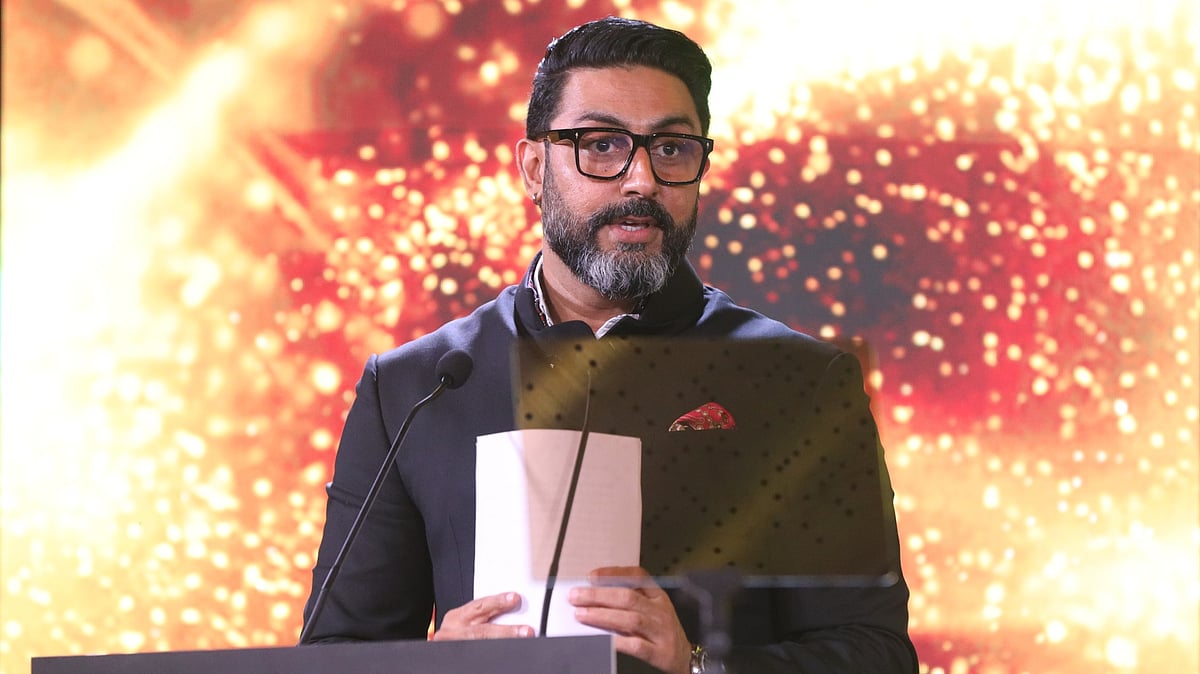
At the Critics Choice Awards on Wednesday evening, there was a surprise entry right at the end. Abhishek Bachchan, we were told, shall be delivering the keynote speech.
Now, the number of keynote speeches we have heard are a dime a dozen, however, this one took me by surprise. What started off innocently as Abhishek simply spelling out the meaning of a critic, morphed into his interactions and thoughts about critics over the years. He spoke about the brutal statements that had been said about his acting, how critics actually helped him to become a better actor and also how critics themselves have a responsibility, and sometimes their attitude can also end someone's career.
Here are some of the highlights from his speech:
Abhishek Bachchan's definition of a critic
"What is a critic? A critic is a person who evaluates, analyzes and judges the merits or faults of creativity, art, film, literature, or more generally, someone who expresses disapproval or a reasoned opinion, often publicly. They function as arbiters of taste, offering professional commentary to help audiences understand the strengths and weaknesses on a subject. Well, that's one dictionary definition. Something for all of us to think about. Merits and faults of creative works. Is this even possible? Is it fair? Who is to judge? Isn't art subjective? Shouldn't it be? But wait. I work in a commercial art school.
I expect people to purchase a ticket to see my students. Doesn't that mean that now I owe them? Surely I have to give them their money's worth. Now, with this new equation in play, am I not answerable to their likes and dislikes? Am I not up for judgment? Open to scrutiny, open to criticism? But wait, let's rewind a bit. Why do we consider criticism a negative word? Is that always the case? It shouldn't be. It hasn't been for me. Okay, okay, I admit I didn't always think like this."
Abhishek Bachchan on his initial years
"In my initial years, I expected it all to be a bed of fragrant roses. All my films were going to be giant successes. The critics would write gloriously about this fresh new talent who was going to be path breaking and rewrite the very definition of a great actor. Then he would grow into the most in demand actor who would have the midas touch, would be loved by all. And he too would love to have throngs of people waiting outside his house just to get a glimpse of him as they had and he had witnessed for his father. The dream had been dreamt. The roadmap was made for the next 10 years. And then life, as it almost always certainly does, gives you a reality check.
Abhishek Bachchan's reality check
As the great Mike Tyson said, everybody has a plan until they get punched in the face. Oh, boy. Truer words haven't been said. Punched in the face? No, no, I got punched all over, literally. And each one felt like a knockout punch. Human survival instinct kicks in. First you brave it, man up and take it on the chin. Then you read the next Friday's review and you feel like those combination of punches hurt just that little more. And then on a subsequent Friday, a bit more than that. Now the punches are bone breaking. You hang in there. Grappling at anything or anyone you can find to stay on your feet. You do whatever you can to survive. That's when the next phase kicks in. It's called denial.
These guys don't know what they're talking about. After all, I'm a trained actor. I've grown up in this industry surrounded by the greats, watched, studied and learnt from them. How can a piece of wood be more expressive than me? Yes, that was written about me by one of your fraternity. In retrospect, no ill feelings. That was actually one of the more complimentary things they said about me back then. It's true. So mean. So I was like, 'Hey, why are you getting personal. Talk about my work, my craft. Since when does my physical appearance, or lack thereof as another critic accused, qualify as a critique of my film?' So what should I conclude from all this? This is when the denial kicks in. They don't even know what they're talking about. Wait, are these people even qualified to write a critique? I mean, I was taught about criticism and how to write it in my English class in school, so I know it's taught. These guys don't even buy a ticket to see my film, so why should I give so much importance to what they say? I don't even owe them. They are not my audience.
Yep, I said all of that. And to a journalist, no less. One who actually happens to be sitting here. And don't go by her diminutive appearance and gentle manner. Madam Somaaya didn't spare even a millisecond to correct me and put me in my place with the swiftness and ferocity of a veteran MMA fighter. Ladies and gentlemen, do not be fooled by her prowess in Bharatanatyam. The Bharatanatyam very easily morphs into Kalaripayattu when required, as it did to me on that day. I deserve it. The English critic Kenneth Tynan said, a critic is someone who knows the way. They just don't know how to drive. Those lines gave me a bit of solace in those days of my career during my denial phase.
Then one day, after some severe bouts in the ring, broken bones, bruises, came the eureka moment. Hold up. Just think, they know the way. And I believe I know how to drive. Why am I making them my opponent? Take them in. Make them part of your corner. Learn the directions from them. You'll figure out how to get there. They don't Even buy a ticket to see my films- but they're giving me advice on how to better myself from my films for free. Only a fool wouldn't even consider what they have to say. That's when the next phase started. The flip of the switch. I started trying to implement all the things the critics were criticizing about me and my films and improving on them. I used their suggestions and pointers to build my roadmap. Remember, you know the way. Yuva, Dhoom, Sarkar, Bluffmaster, KANK, Guru, Sarkar... All followed. Yes. Thank you. Yes, you all had a hand in that.
Abhishek Bachchan criticises the critics
Your direction, advice and encouragement helped me give those performances. But all might not have the majority ability or circumstances to be able to pivot like that. What you write or say can and will probably be the reason an actor might not want to get out of bed the next day and have the strength to be able to face the camera. You do have that much power. I had said this to an esteemed colleague of yours once post me seeing one of their reviews of a film for which they gave a big anda as a rating and then proceeded to throw that egg on the camera. Sacrilege, in my opinion. But the actor in question, whose performance that critic evidently did not like, never acted again or didn't have the courage to be able to face the camera again and put herself up for judgment. That cannot be the outcome of what you do. You must be and do better. I started with a question. What is a critic? Today we find ourselves at a juncture where we need to ask not what is a critic? But who is a critic? Just like if today you have a phone, you can easily call yourself a photographer. Does that mean that if I have a phone and access to social media, that qualifies me as a critic too, many would argue, keeping the spirit of fairness and equality in mind that it would. Some, I suspect possibly most in this hall would want to argue against how do we differentiate? Who are we to differentiate?
After all, the innumerable amount of people that post their reactions, views and emotions about a film on the social media absolutely qualify as the ticket buying audience that has the right to express their views. And today they have a platform too. Their very own personal soapbox, so to speak. Actors are facing a similar predicament. Anybody and everybody can make a reel today and put it out on the Internet. In those reels they perform. They perform our dialogues, our dances, our action, our comedy. Many a time as good, if not better than the original. They are empowered enough today to think they are as good as their heroes, their idols. So where does that leave us? Previously we had our audience and you, your readers. Is that relationship the same today? Why should a newspaper editor or a channel executive employ you as their in house critic? What do we need to do or be in order to stand out from the crowd? How to ensure that we are the most deserving candidate to be chosen to act in the film or to be the in house film critic?
In conclusion
Bachchan went on to elaborate on his points, before ending his speech and giving over the mike to the host, Kalki Koechlin.
But one thing was for sure for anyone who heard or has read his entire talk, without a doubt, the most heartfelt, frank, and no holds barred speech Abhishek has made, both on his career and the role that a critic should play.

