
New Delhi: The Centre has clarified that it does not have a direct role in regulating the fee structures of schools that are not established, owned or controlled by the central government. Since education is a subject under the Concurrent List of the Constitution, schools other than those under the central government come under the jurisdiction of the respective state governments and union territory administrations.
The clarification was given by Minister of State for Education Jayant Chaudhary in a written reply to question no 2765 in the Rajya Sabha on August 12, 2026.
Who Decides Private School Fees?
The government said that schools which are not established, owned or controlled by the central government are under the jurisdiction of the respective state governments or UT administrations.
The official reply states, “Education is a subject in the Concurrent List of the Constitution. Schools, other than those established, owned or controlled by the central government, are under the jurisdiction of the respective state governments/UT administrations."
It further added that matters “related to the management of schools that are not established, owned or controlled by the Central Government are regulated in accordance with the rules and instructions of the respective State Government/UT administrations."
The center further clarified that, "In view of the above, matters relating to fees charged by private schools, the rules/regulations for safeguarding the interests of students and their parents; and action against violating schools comes under the jurisdiction of the respective State Governments/UT administrations".
Matters Under State Governments/UT Administrations
The Centre, in its written reply, stated that matters relating to the following come under the jurisdiction of the respective state governments and UT administrations:
Fees charged by private schools
Rules/regulations for safeguarding the interests of students and their parents
Action against schools violating applicable rules
RTE Provisions on Free Education and Capitation Fee
Under the Right of Children to Free and Compulsory Education (RTE) Act, 2009, every child aged six to fourteen has the right to free and compulsory elementary education in a neighbourhood school.
Section 12(1)(c) of the RTE Act, 2009, mandates reservation in private unaided schools for children belonging to weaker sections and disadvantaged groups to the extent of at least 25% seats at the entry level. It also provides for free and compulsory elementary education to such children till its completion.
Section 13 of the RTE Act, 2009, prohibits the collection of any capitation fee.
UGC Regulations for Deemed Universities
Institutions deemed to be universities are regulated by the UGC (Institutions Deemed to be Universities) Regulations, 2023. Regulation 24.B.(2) mandates that these institutions follow rules on fee structure and seat numbers set by the relevant statutory bodies.
Fee Regulation in Private Universities
Private universities are established by an act of the concerned state legislature and are governed by the provisions of their respective acts and the norms, rules and regulations framed by the respective state governments, including those related to fees.
CBSE Bye-Laws on Fee Revision
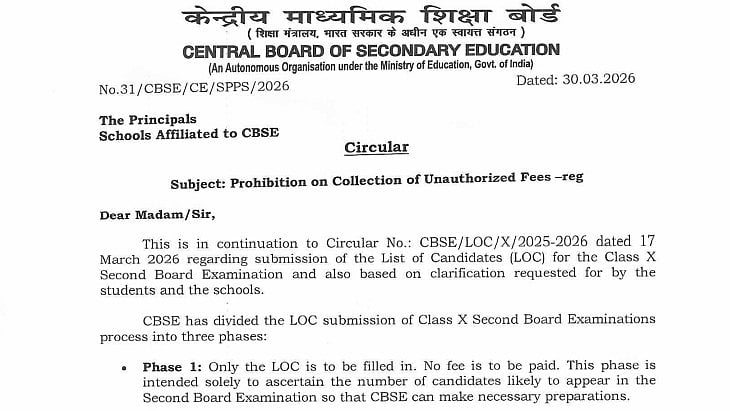
The Central Board of Secondary Education (CBSE) has established bye-laws that govern various aspects of school administration, including fee structures for private schools affiliated with the board, the centre further stated in its written reply.
The bye-laws also stipulate that any fee revision must be approved explicitly by the School Management Committee or follow the procedure set forth by the relevant government.
CBSE Guidelines on Books, Uniforms and Stationery
CBSE guidelines prohibit schools from requiring students to purchase books, uniforms, or stationery from specific vendors. These guidelines aim to reduce the financial burden on parents while also promoting fair competition.

