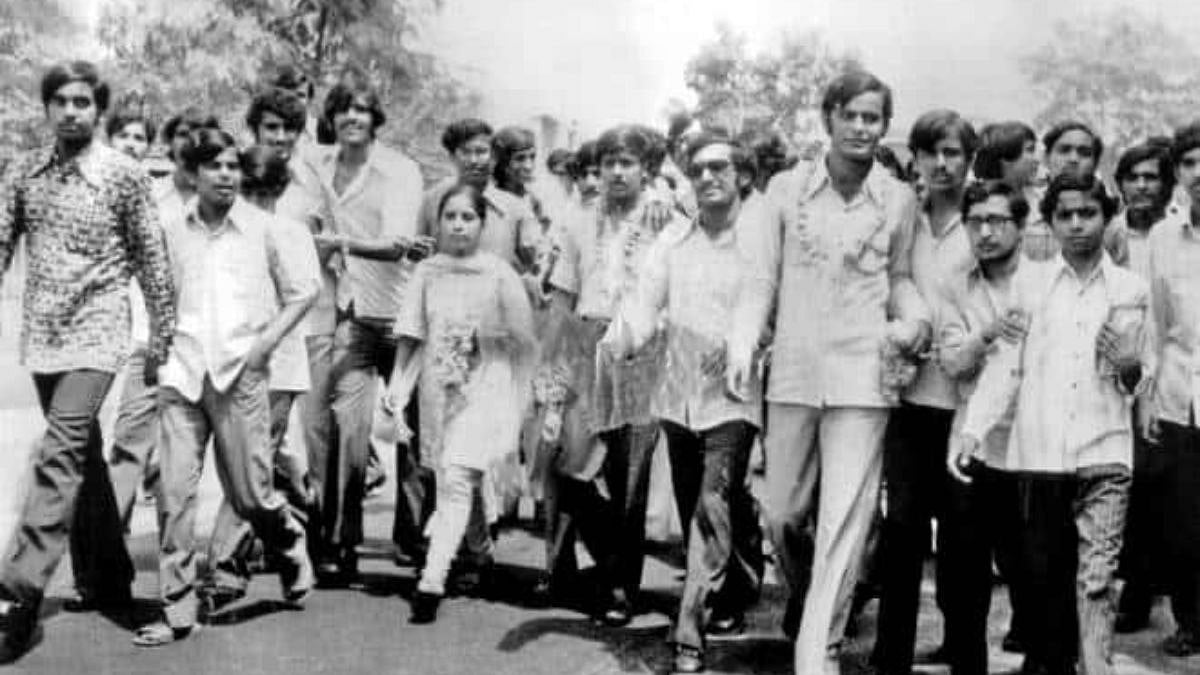
New Delhi: Just days before India became independent, Delhi University was considering an idea that would eventually pave the way for one of the country's most prominent platforms for student representation -- a student union.
The Delhi University Students Union (DUSU) traces its origins to August 6, 1947, when the university first considered a proposal to create a representative body for its students, just days before India awoke to "life and freedom" at the the stroke of the midnight.
University records show that on August 6, 1947, the vice-chancellor informed the Executive Council that a representative body of students desired to establish a university students' union.
According to the official university document, quoting the minutes of the EC meeting on August 6, 1947, "The Vice-Chancellor informed the Council that a representative body of students desired to establish a University Union of students. A Committee was to be formed to draw up the necessary constitution and procedure; and he hoped that the Council would be willing to give a small grant of Rs 150 to the Union when formally constituted, for its preliminary expenses."
That proposal marked the beginning of an institutional journey that would eventually turn DUSU into the representative body of students from most colleges and faculties of Delhi University and an important feature of campus life and politics.

The early years, however, were marked by questions over how the union would function and finance itself.
On March 27, 1953, the university's Executive Committee considered an application from the University Students' Union for a grant-in-aid. The university had said that they felt the union should make efforts to become self-sufficient, noting that Rs 500 had already been given to it that year.
The financial difficulties became more apparent the following year. On March 14, 1954, the university noted that the union had incurred expenditure of Rs 1,995 against an income of only Rs 815.
Incidentally, in the same meeting, the VC had noted that the DUSU had been given a Constitution and elections had been held for the first time.
The vice-chancellor proposed that a caretaker committee run the union until the next academic year and that it incur no fresh expenditure until August 1954. A grant of up to Rs 1,100 was also proposed to meet expenditure already incurred, subject to approval of the bills by Dr B N Ganguly, treasurer of the union.
The university's records from this period offer an early glimpse into the effort to give the students' body an institutional footing -- from financial accountability to questions of its administration.
The constitutional structure of DUSU came under consideration again nearly two decades later.
On August 2, 1973, the Executive Council considered the "abrogation of the existing constitution and promulgation of an interim constitution" for DUSU.
The interim constitution also imposed financial controls, with expenditure above Rs 100 initially requiring due authorisation by the union's Executive Committee, a DU official told PTI.
Another marker of the union's evolution is its subscription fee.
Students paid Rs 5 as DUSU subscription until 2012-13. The fee was revised to Rs 20 in 2013-14 and was subsequently increased to Rs 40 on June 21, 2024, the official added.
The interim constitution also laid down a detailed administrative structure for the students' body.
It designated the vice-chancellor of Delhi University as the patron of the DUSU, responsible for ensuring that the union functioned in accordance with the constitution. A staff adviser, appointed by the patron from among the teaching faculty, and a treasurer appointed by the patron were also made part of the union's structure.
The constitution provided for four elected office-bearers- the president, vice-president, secretary and assistant secretary- who were to be directly elected by DUSU members through a simple majority vote.
While the president was designated the chief executive head of the union, the vice-president was to perform the president's functions in his or her absence.
"The Secretary of the DUSU will act in consultation with the President and will function in all matters relating to the Union in accordance with this Constitution," the 1973 document mentioned.
The union's supreme authority, however, was vested in its Central Council, comprising presidents of students' unions of affiliated colleges, directly elected representatives from member institutions, the office-bearers, staff adviser, treasurer and outgoing president.
The constitution also provided for an Executive Committee, which was to include the four office-bearers and 11 members elected from the Central Council through proportional representation, with at least two of them required to be women.
The Central Council and Executive Committee were given oversight over the functioning of the office-bearers, reflecting a system intended to combine direct student representation with institutional checks.
Nearly eight decades after that first proposal was placed before the Executive Council, DUSU has grown into one of the country's most prominent student representative bodies, with its elections drawing national political attention and producing leaders who have gone on to play significant roles in public life.
Yet, its story began quietly in the final days of colonial India, with a group of students seeking a collective voice within their university.
With this year's DUSU election set to take place on September 18, the evolution of DUSU mirrors the changing nature of student politics and representation at Delhi University.
(Except for the headline, this article has not been edited by FPJ's editorial team and is auto-generated from an agency feed.)

