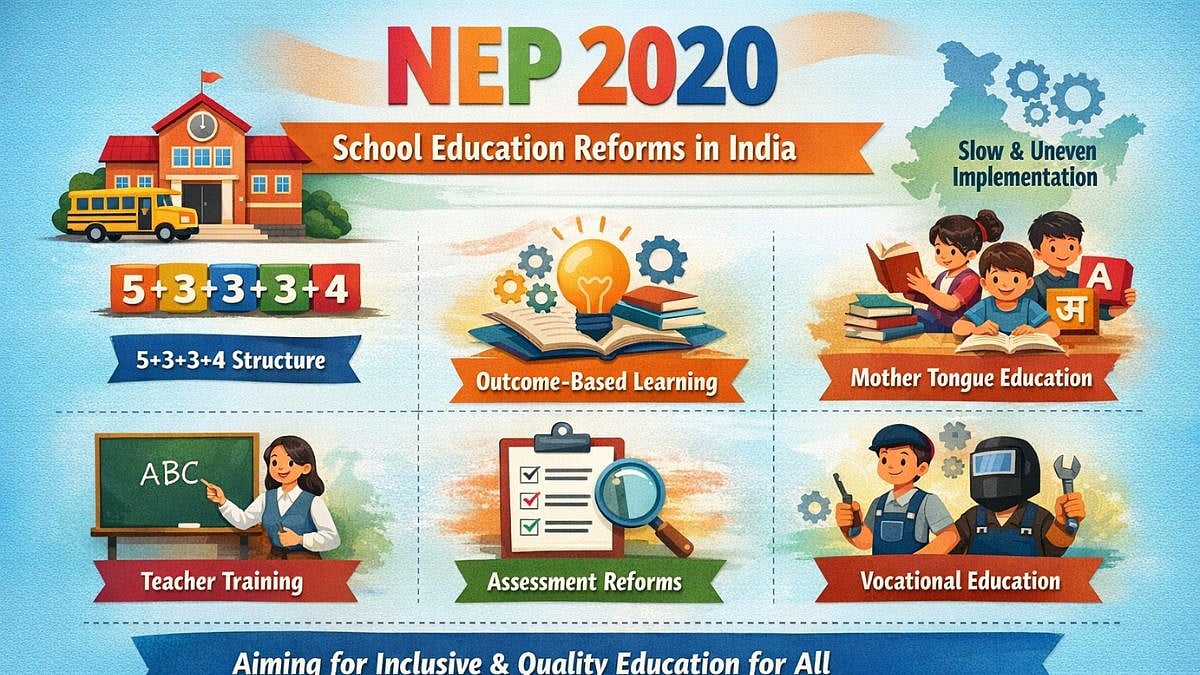
The recommendations of NEP 2020 in India in the context of school education are in the background of several problems facing it. These include multiplicity of boards, unequal curriculum, lack of standardization & quality, over-emphasis on memory-based education, undefined outcomes and competencies, substantial dropouts at various levels, lack of access in remote parts of the country, as well as socially / economically disadvantaged sections. Recommendations of NEP 2020 were aimed at eradicating some of these problems and aligning Indian school education in alignment with the global standards.
Major Recommendations
Structural: Proposed structure at school level including the Early Childhood Care and Education (ECCE) is segmented in four (4) broad components “(5 + 3 +3 +4)”. Entry age of a child in school will be 3, total duration 15 years and children will graduate from school by age of 18. This means that existing nursery and primary education, which is, sometimes, in the unorganized sector, will form part of the organized set up.
Definitive Milestones: Three definite milestones are prescribed as under:
a. Basic foundational literacy and numeracy by all students at the end of 5th standard to be achieved by 2025.
b. All children between ages of 3 to 18 to be provided “free and quality education” to be achieved by 2030.
c. Gross enrolment ratio (GER) of 100 per cent to be achieved by 2035.
Education in Mother Tongue: Education up to standard 5th should be in “mother tongue” or “regional language”. However, since children are more adaptable to learning different languages, 3 language formula existing today may continue.
Moving Towards Outcome-Based System: School education should move away from traditional method of input-based to the new outcome-based approach. The focus, therefore, is on “understanding / comprehending / thinking ability” and “practical applications”. National Curriculum Framework (NCF) will take upon task to make this transformation.
No Specializations: Other major recommendation is that there will be no further demarcation between “arts”, “science” or “commerce” in school education. The system is aimed to develop “holistic individuals” who know something of everything and on coming out of schools would be capable to think “as a whole and not in parts”.
New Methodology of Assessment: The traditional method of assessment is too much dependent on “summative assessment” (end of the year examination) and too stressful for many school children. Examination pattern will migrate from “memory” to “analysis” based mechanism enabling students to “think and respond” rather than “memorise and answer”.
Teachers and Academic Ambience: Central role in transformation of school education rests with teachers. Hence teachers must be motivated, well-trained and inspirational. The target pupil-to-teacher ratio at each school will be 30:1 whereas for socio-economically disadvantaged areas, the number is targeted to be 25:1 so that proper developmental interventions can be implemented. There will be efforts to ensure that learning becomes meaningful through intervention of technology. The committee recommends various means like conveyance, hostels, upgrading existing schools / creating new infrastructure, adequate nutrition, expanding scope of National Institute of Open Schooling (NIOS) for promoting open / distance education, etc. so that all children up to grade 12 can avail of quality education.
Focus on Indian Languages: India has several rich and diverse languages and students need to be encouraged to learn and understand them. The committee specifically talks about importance of “Sanskrit” in Indian culture and heritage. The committee also recommends all students taking up a project on an “Indian language” between the grades 6 to 8 where they can understand its richness.
Curriculum Transformation: Since the primary goal of school education as per NEP 2020 is to develop individuals who can think and possess “life problem solving skills” across disciplines, there is a need for total shift in curriculum and teaching pedagogues. Holistic development of students is the key objective. The National Curricular Framework (NCF) 2005 is to be modified to achieve the goals of the Policy.
Inclusive Education: The committee has made specific recommendations for making school education inclusive by having specific focus on “socio-economic disadvantaged groups (SEDGs)”. The idea is to create an “inclusive educational culture” all through the system.
Improving Employability: Integration of vocational studies with mainstream education from 6th standard onwards is recommended with a view to improve employability. Similarly, improving “entrepreneurship culture” among school students is another important recommendation.
Regulations: The regulatory system needs to be effective as well as an enabler for growth of educational climate. The most important among them is the setting up of “State School Standards Authority (SSSA)” for each state that will ensure minimum quality standards.
Teacher Education: Launch of a new “4-year integrated program” for teacher education after 12th standard in lieu of the current BEd program which is purely education pedagogy driven. The teaching process is intended to make the teacher-students learn “subjects” as well as “teaching pedagogy” thereof. For example, the integrated BA-BEd program will discuss nuances of subjects of arts from perspective of school education and teaching methodology thereof. Besides, teacher eligibility test (TET) is recommended to strengthen quality of school teachers.
Specialist Teachers: Formal restructuring of teacher education may not be adequate for the large number of teachers India needs. To bridge the gap, the committee has suggested having specialists or “master tutors” who are in the local community and specialized in a given area (say carpentry or dance or music) and they may be involved in teaching.
Current Stage of Implementation
Success of any Policy depends on its proper implementation. The progress of implementation on the ground appears to be slow at this stage. There are many reasons for the same. First, awareness among various stakeholders is quite less. Students and parents who are the biggest beneficiaries are not aware of the Policy. Second, any change meets with resistance from stakeholders; it needs to be met with constant dialogue and communication which appears to be lacking at this stage. Third, the country is too big and complex.
Diversity in the education system itself is too huge and difficult to manage. For example, each state has a separate school board besides the CBSE / ICSE / IB, etc. Thus one needs lots of drive and enthusiasm to drive the change and that does not seem to be happening at this stage. And finally, the concurrent nature of listing of education has its own problems as some states are opposing implementation on several grounds.
However, it is not that nothing has moved and there has been some progress in the process of implementation. Some major among them are as under:
Nipun Bharat Mission: It has been launched. This is aimed at reducing dropouts at all levels of school education and improving foundational skills of children at an early age.
Jadui Pitara (new innovative means of teaching pedagogies for the age of school children between 3 to 8 years): It is a commendable achievement. Some schools in different parts of the country have adopted these innovations and started using them.
Policy on School Bag 2020: It has come out with good recommendations like capping the weight of school bags and towards providing quality “mid-day meals and water” to school children. This is a welcome step.
National Mission for Mentoring (NMM): It is the other good step aimed to develop good teachers through process of mentoring. The initial launch has already been done in 2022 by National Council for Teacher Education (NCTE) for 30 central government schools.
National Curriculum Framework (NCF) is in the process of being framed. Many state governments have set up the “State Council of Educational Research and Training (SCERT)” in line with the NCERT. Some of them are proceeding well in terms of curricular framework as well as teaching pedagogies at the state level. The National Initiative for Proficiency in Reading with Understanding and Numeracy is the other good step aimed for students of standard 5.
Vidyanjali Portal Scheme: It is another good initiative aimed towards involving community volunteers and young professionals / retired teachers for helping local schools.
Integrated Teacher Training of 4 years duration is being implemented from next year onwards and is likely to improve the quality of schoolteachers in days to come. The style of change in the Board Examination from next year onwards (twice a year) in CBSE is expected reduce the stress level of students and parents.
Moving Ahead
The speed of reforms, however, is quite slow and we are lagging in almost all the milestones targeted in the committee’s recommendations. There is lot of confusion at various levels and different states are at different stages of implementation. This creates more uncertainty. It is time that the central government sets up a coordinating body to oversee the implementation in a concerted and coherent manner so that the goals are achieved at the earliest. Further the delay, more remote the goals will be and more will be the confusion. The policy is good in its intent but needs to be implemented as early as possible despite the huge size of the country and complexity of our educational system. NEP 2020 implementation, in full, is anyway a long-term process as it covers entire spectrum of school education. Further delay will only add to the problems. Earlier we realize it, better it will be for all of us.
The author is Founder and Convener of Higher Education Forum (HEF)

