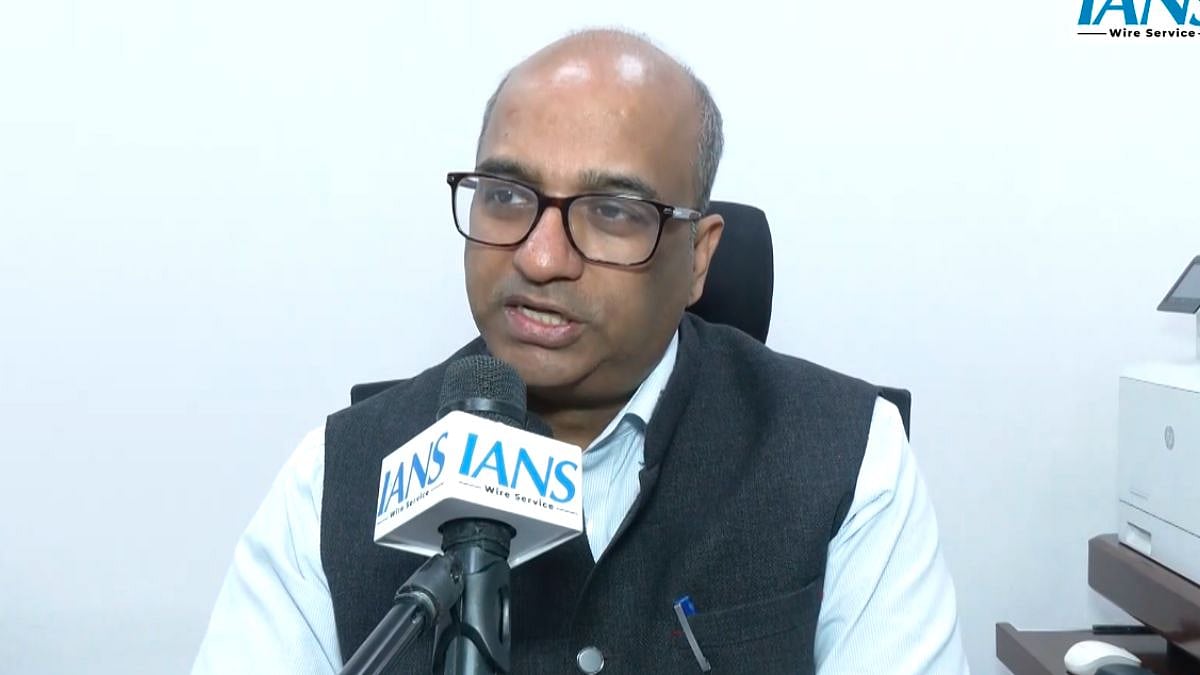
New Delhi, Jun 16: The National Testing Agency (NTA) and IIT Madras on Tuesday justified the temporary restriction on Telegram ahead of the re-NEET examination, citing instances where the platform was allegedly used to fabricate evidence of question paper leaks through edited messages carrying old timestamps.
The Internet Freedom Foundation, however, criticised the government's curbs on Telegram, calling the move a band-aid solution and a "disproportionate" response to exam fraud.
Google has removed messaging app Telegram from the Play Store and Apple is likely to follow suit in compliance with a government order, sources aware of the development said.
Explaining the rationale behind the restrictions on Telegram, NTA Director General Abhishek Singh said the step was taken to safeguard the integrity of the re-NEET examination following the cancellation of the May 3 exam over malpractice allegations.
"The primary reason for cancelling the exam and ordering a re-exam and CBI inquiry was to ensure that nobody violates the sanctity, the integrity of the NTA examination, the NEET examinations, and nobody should be able to take away the rights of hard-working students," Singh said in a video message on X.
He acknowledged the burden on candidates who have been asked to appear again.
"This is a big hardship for the students who had to appear at the exam again. We fully understand that and that's why we are not leaving any stone unturned for ensuring that examinations are conducted in a safe, secure, trustworthy manner," he said.
According to Singh, one of the major concerns was the misuse of Telegram channels claiming to sell question papers.
"Social media is flooded with such stories about Telegram channels claiming to sell re-examination papers. We have verified every claim and what we have found is that they are all fake," he said, adding, "None of them has access to the actual papers." He said those behind such channels exploit students and parents by taking money on false promises.
"Anyone claiming to sell you any paper is lying, scamming and fooling you...," he said.
Singh also alleged that Telegram channels use message-editing features to create a false impression that question papers were available before the examination.
"What Telegram channels have been doing for long is that they show videos and screenshots of Telegram chats that appear to contain question papers with dates which are before the examination," he said.
Singh cited an instance from the May 3 NEET examination to explain how the alleged misuse worked. "On May 3, when the examination was conducted, we got a similar complaint wherein a video was circulated by several handles after the examination was conducted, which showed a question paper that was shared on that Telegram channel on May 1, that is, two days before the examination," he said.
According to Singh, the NTA investigated the matter and found that the question paper shown in the video carried a unique identifier. "Every question paper in the NEET examination has a unique identifier. So we are able to track it," he said.
Elaborating on the probe, Singh said the NTA was able to trace the question paper shown in the viral video to a specific candidate through its unique identifier.
"We identified that question paper which was shown in that video. It was given to one candidate at Government Higher Secondary School, Sagam Anantnag in J-K. This question paper was given to that student on May 3 under the magistrate's supervision.
"We verified the entire CCTV content. We also identified the student to whom it was given. We even got his attendance sheet verified. That student had appeared in the May 3 examination," he said.
"The student's OMR sheet also was received back to NTA after the conduct of the examination. So it was clear that this Telegram chat was fabricated," he said.
According to him, the probe found that Telegram allows channel administrators to edit previously posted messages while retaining the original timestamp.
"Telegram has a vulnerability in which it allows the admins of a Telegram channel to edit a chat in the past date... When they do that, the timestamp remains the same," Singh said.
Explaining the issue, IIT Madras Director V. Kamakoti said Telegram allows users to edit messages without altering the original timestamp.

"The Telegram platform has a vulnerability. You can send a message today at 3 pm and you can edit the message tomorrow or some other day later without changing the timestamp. So, for people who look at the message tomorrow or later, it will look as if he had sent the message at 3 pm today," Kamakoti said.
"Using this vulnerability, there's been an attempt in the past too," he said.
Kamakoti said similar instances had been observed in other competitive examinations. "There's been an attempt in the past to create confusion and panic among candidates who appeared for multiple competitive examinations. At least two instances, to the best of my knowledge -- one in the case of JEE Advanced and another in the case of IISER Aptitude Test," he said.
Kamakoti also demonstrated the Telegram trick live. A student sends "pdf1.pdf" at 3:39 PM. A minute later, the message is edited and the file is silently replaced with "pdf2.pdf". The timestamp still reads 3:39 PM and nothing indicates that anything changed.
"Telegram allows this for up to 48 hours after a message is sent," the NTA post said.
"This is exactly how fake 'leak' videos are made," it added.
(Except for the headline, this article has not been edited by FPJ's editorial team and auto-generated from an agency feed.)

