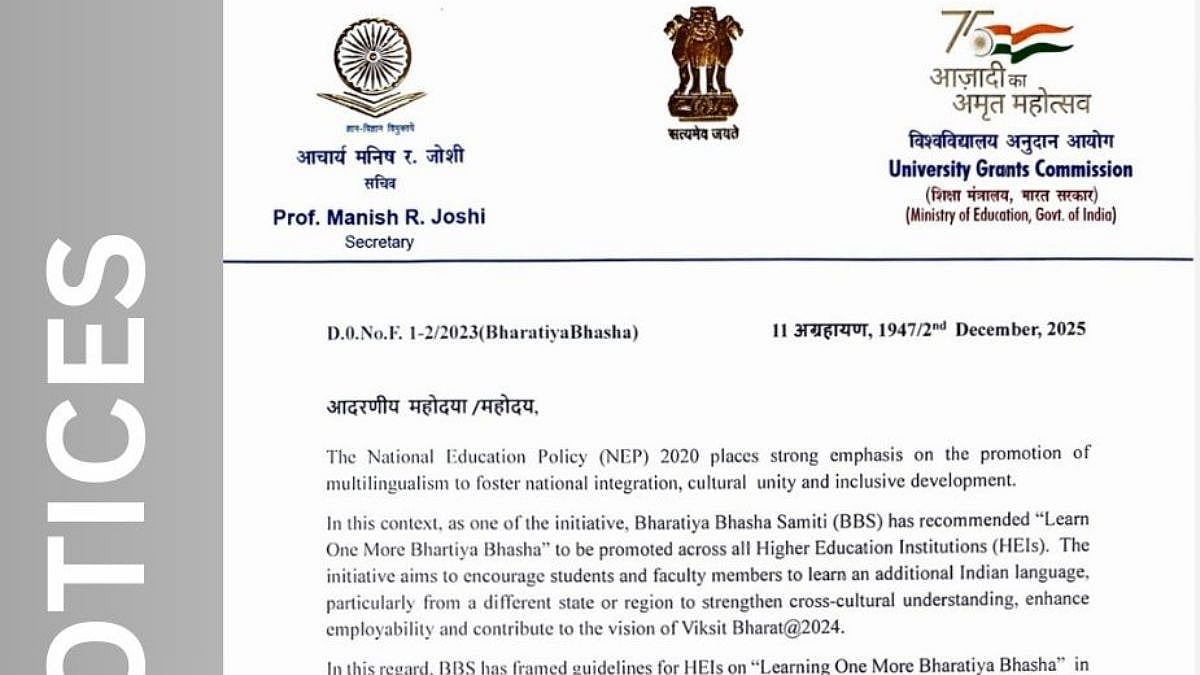
In a major move to promote linguistic diversity and strengthen India’s cultural fabric, the Ministry of Education has instructed Higher Education Institutions (HEIs) across the country to roll out the newly formulated guidelines for the “Learn One More Bharatiya Bhasha” initiative. The directive aligns with the National Education Policy (NEP) 2020, which stresses the importance of Indian languages for national integration, employability, and holistic development.
The initiative, developed by the Bharatiya Bhasha Samiti (BBS), encourages students, teachers, administrative staff, and even local communities to learn an additional Indian language besides their mother tongue. The Ministry believes that multilingual youth will be better prepared for India’s expanding economic and social opportunities, especially as the country moves toward the vision of Viksit Bharat@2047.
"In this context, as one of the initiatives, Bharatiya Bhasha Samiti (BBS) has recommended "Learn One More Bhartiya Bhasha" to be promoted across all Higher Education Institutions (HEIs). The initiative aims to encourage students and faculty members to learn an additional Indian language, particularly from a different state or region to strengthen cross-cultural understanding, enhance employability and contribute to the vision of Viksit Bharat@2024," reads the notification.
According to the guidelines, the BBS has issued broad guidelines outlining academic structures, learning levels, teaching methodologies, and evaluation systems. HEIs have been advised to introduce Ability Enhancement Courses (AEC), credit courses, or audit courses in at least three Indian languages—one regional language and two others from the 22 languages listed in the Eighth Schedule of the Constitution. These courses can be offered at Basic, Intermediate, and Advanced levels with flexible entry–exit options, focusing primarily on developing communicative skills.

To ensure wider participation, the initiative extends beyond students to faculty members, non-teaching staff, and community learners. Institutions may also adopt online and hybrid models to provide nationwide access without age restrictions.
For effective rollout, HEIs must appoint nodal officers, set up implementation committees, conduct pilot classes, and establish Bhasha Clubs to encourage informal learning. They must also maintain dashboards to track enrolment, progress, and completion rates.
Emphasising the linguistic similarities among Indian languages, the Ministry stated that learning an additional Bharatiya Bhasha will be an enjoyable process. The initiative aims to build a language-inclusive education ecosystem and prepare multilingual citizens capable of contributing to India’s growth story.

