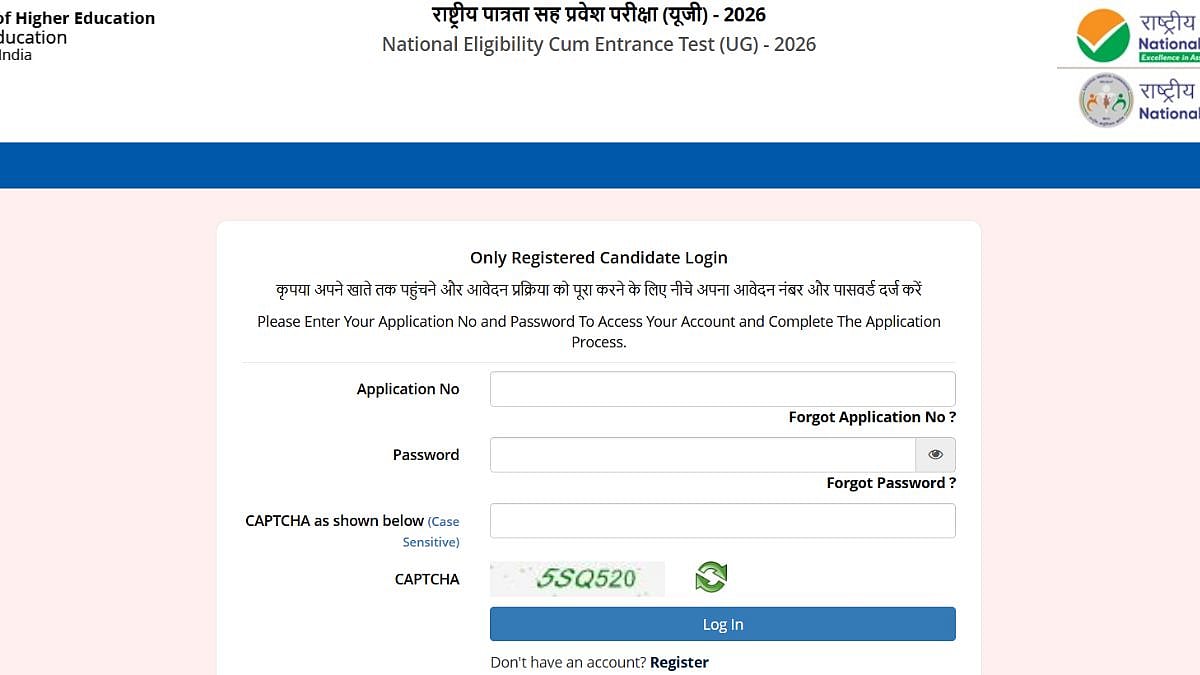
NEET UG Registration 2026: The online registration process for the National Eligibility cum Entrance Test- Undergraduate (NEET UG) has started by the National Testing Agency (NTA) today, i.e., on February 8. Candidates can apply on the official website of NEET UG at neet.nta.nic.in.
NEET UG 2026: Important dates
The online application process begins on February 8, 2026, and candidates can submit their forms until March 8, 2026, up to 9:00 PM, with the fee payment window remaining open till 11:50 PM the same day. The application correction facility will be available from March 10 to March 12, 2026. NEET UG 2026 is scheduled to be conducted on May 3, 2026, from 2:00 PM to 5:00 PM (IST).
Read the information bulletin here
NEET UG 2026: Application fees
As for the application fee, candidates in India from the General category will have to pay ₹1700, while General-EWS and OBC-NCL candidates will be charged ₹1600. Applicants belonging to SC, ST, PwBD, PwD, and Third Gender categories will need to pay ₹1000. For candidates applying from outside India, the fee is ₹9500 irrespective of category. The OBC-NCL category will be applicable as per the Central List issued by the National Commission for Backwards Classes.
NEET UG 2026: How to apply?
To submit the application form, aspirants need to follow the steps given below:
Step 1: Visit the official websites of NTA NEET at nta.ac.in or neet.nta.nic.in.
Step 2: After this, registered candidates need to login using the information such as application no, password, Captcha, and then submit.
Step 3: Next, aspirants need to fill out the form, upload the necessary documents, make the payment, and then submit.
Step 4: Download the confirmation page and take a printout of the same for further reference.
NEET UG 2026: Exam pattern
The NEET (UG) 2026 examination will follow a multiple-choice question (MCQ) format. The paper will cover three subjects: Physics, Chemistry, and Biology (Botany and Zoology). Physics and Chemistry will have 45 questions each, carrying 180 marks per subject, while Biology will have 90 questions for a total of 360 marks. Overall, the exam will comprise 180 questions carrying a maximum of 720 marks, with each question having four options and one correct answer.

