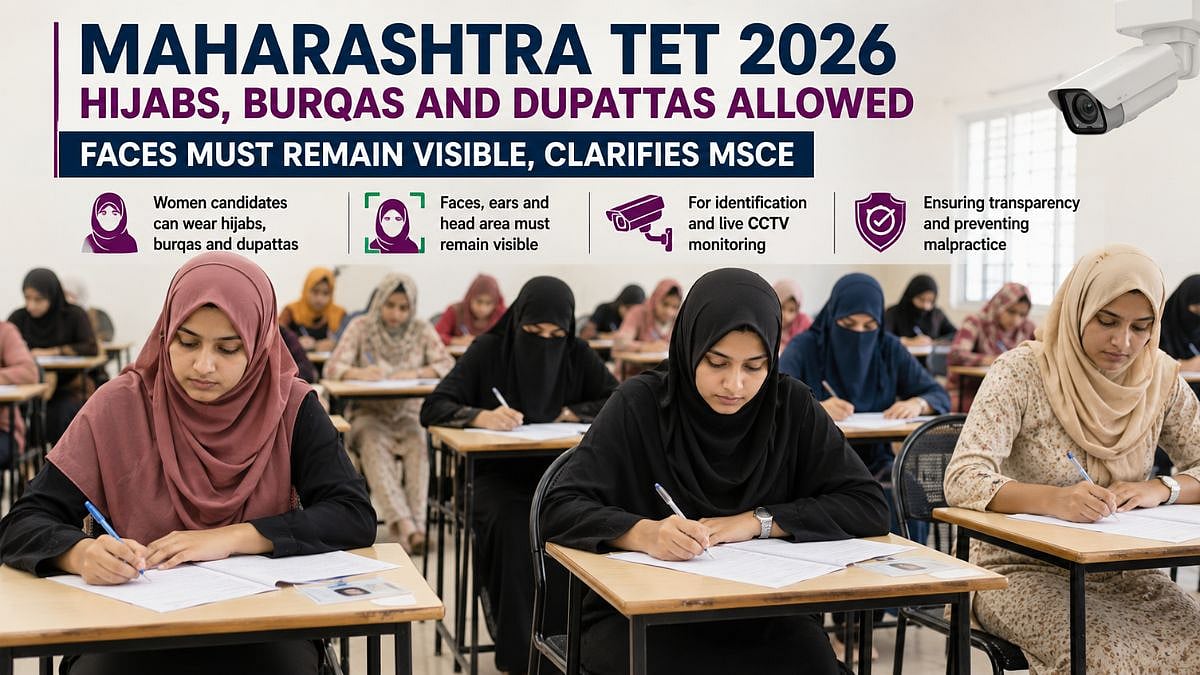
Mumbai, June 22: Amid restrictions on wearing burqas for the Teachers Eligibility Test (TET), student Islamic organisations and several teachers challenged the blanket ban.
Following this, the Maharashtra State Examination Council (MSCE), Pune, clarified that women candidates appearing for the TET scheduled on June 28 will be allowed to wear hijabs, burqas and dupattas, provided that their faces remain clearly visible during the examination for identification and CCTV monitoring purposes.
The clarification was issued following concerns and representations received by the council after instructions regarding dress code restrictions at examination centres led to confusion among candidates.
The Students Islamic Organisation (SIO) Maharashtra demanded that instead of an outright ban, private frisking booths with female staff should be set up and that authorities follow the national standard model used in NEET examinations, which allows customary attire through early reporting.
MSCE Issues Clarification
In an official circular, the MSCE stated that live CCTV surveillance would be operational in all examination halls during the TET. To ensure effective candidate verification and maintain transparency in the examination process, candidates' faces must remain visible throughout the examination.
The council noted that several national-level competitive examinations, including UPSC, SSC, IBPS, SBI, RRB, GATE, CLAT, CA, CS and CMA, as well as state public service commission examinations such as MPSC, GPSC, BPSC and UPPSC, require candidates' faces to be visible for identity verification, biometric checks and CCTV monitoring.
According to the council, the primary objective behind the rule is to prevent malpractice and ensure transparency. Authorities cited increasing instances of cheating through mobile phones, Bluetooth devices, AI-assisted gadgets and other electronic equipment concealed within clothing or accessories.
The council also referred to recent incidents in examinations conducted by the state where candidates were allegedly found using mobile phones hidden inside dupattas or burqas.
Court Judgment Cited
The clarification follows references to a 2024 judgment of the Bombay High Court in the case of Zainab Abdul Qayyum Choudhary and Others vs Chembur Trombay Education Society and Others. The court had upheld a college dress code that restricted hijabs, burqas, niqabs and other visible religious identifiers on campus.
The council quoted portions of the judgment stating that sufficient material had not been placed before the court to establish that wearing a hijab or niqab constituted an essential religious practice.
However, the council emphasised that the examination guidelines do not prohibit women candidates from wearing hijabs, burqas, dupattas or other attire. Instead, candidates must ensure that their faces, ears and head area are clearly visible during the examination and on CCTV footage.
"The intent is not to restrict clothing or religious practices, but to ensure that no part of the face is concealed during the examination," the circular stated.
Guidelines Ahead Of TET
The council further clarified that no type of clothing or covering is banned outright. Women candidates may continue to wear hijabs, burqas or dupattas, but they must cooperate with examination authorities during identity verification and remain identifiable throughout the examination period.
Also Watch:

The clarification comes days before the state-level TET examination, which is expected to be attended by nearly six lakh candidates across Maharashtra. Officials said the measures are aimed at ensuring a fair, transparent and malpractice-free examination process while accommodating candidates' clothing preferences and religious practices.
To get details on exclusive and budget-friendly property deals in Mumbai & surrounding regions, do visit: https://budgetproperties.in/
