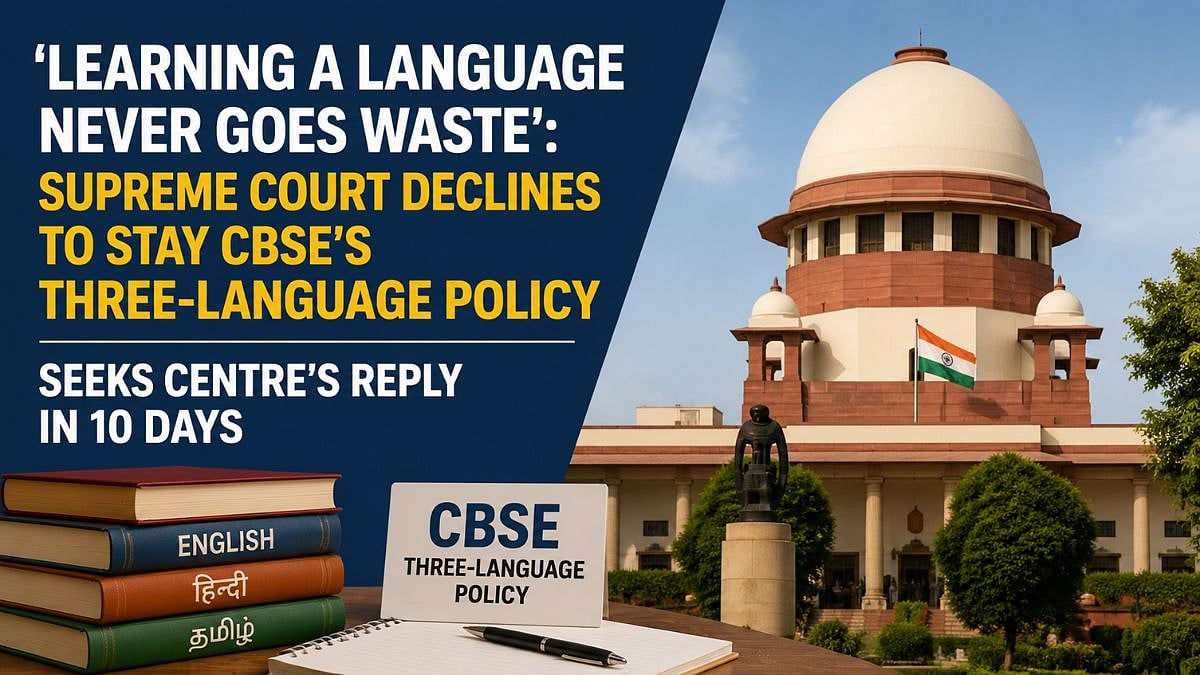
New Delhi, July 14, 2026: The Supreme Court on Tuesday (July 14) refused to stay the Central Board of Secondary Education's (CBSE) three-language policy, introduced for the 2026-27 academic year, and deferred the hearing on petitions challenging the policy to next week.
A bench comprising Chief Justice of India Surya Kant, Justice Joymalya Bagchi and Justice V. Mohana Prasad issued notice on the fresh petitions and fixed the matter for a detailed hearing next Wednesday, Live Law reported.
The Court did not grant any interim relief. Earlier, in May, it had issued notice to the Union government, the National Council of Educational Research and Training (NCERT) and the CBSE on a separate batch of petitions.
Petitioners Raise Concerns
The petitioners argued that under the revised policy, students from Class 9 would have to study two Indian languages, forcing them to discontinue languages they had been learning since Class 5. They also contended that English had been classified as a non-native language and raised concerns over the lack of teachers and textbooks for several Indian languages.
Senior Advocate Anand Grover submitted that the CBSE circulars had no statutory backing and argued that only the NCERT was authorised to frame such academic requirements.
"The circulars are without authority of law. Only NCERT has authority, not CBSE. They are imposing languages without giving options. No teachers, no books are available if I want to learn Punjabi instead of Sanskrit. As a child, I must have the opportunity to learn a language which will give me employment," Grover contended.
Senior Advocate Gopal Sankaranarayanan argued that although the CBSE had relaxed certain requirements for senior classes through a subsequent circular, major issues remained unresolved. He submitted that the policy treated English as a "non-native" language while making Indian languages compulsory.
"They have taken a 300-year-old language and treated English as a non-native language," he submitted.
Senior Advocate Shyam Divan argued that despite the June 29, 2026 circular easing some requirements, significant concerns remained. He also submitted that while the National Education Policy envisaged implementation by 2030, the CBSE had advanced it to the current academic year.
Senior Advocate Mukul Rohatgi highlighted the practical challenges for students already studying foreign languages.
"A student of Class 9 who is studying French till date is told to take up a third language and give the examination in April. Unless you get a pass in internal assessment, you can't... How can anyone in Class 9 be told to start learning, say, Tamil? Which school in Delhi can provide a teacher who can teach?" Rohatgi submitted.
Court Seeks Centre's Reply
Seeking interim relief, Sankaranarayanan argued that the policy should not be implemented until schools had adequate teachers and textbooks. He informed the Court that only three textbooks were available on the NCERT website despite the requirement to facilitate multiple Indian languages.
"We went to the NCERT website a few minutes ago. Only three books, not 22. Children are being told to drop English and other foreign languages and take up native languages. They had said that by July 1 textbooks would be ready. Teachers have to be ready for 22 languages. This is damaging the status quo," he argued.
He also expressed concern that teachers could lose their jobs if schools were forced to change language offerings abruptly.
Responding to the submissions, the Chief Justice remarked, "Learning a language never goes waste."
When Sankaranarayanan argued that teachers could be dismissed because of the policy, the Chief Justice responded, "If dismissed, we can reinstate."
Additional Solicitor General Aishwarya Bhati, appearing for the Union government, sought two weeks to file a response. The Court, however, directed the Centre to file its reply within 10 days.
Also Watch:

The bench also heard submissions on behalf of intervenor Fauzia Khan, former Maharashtra minister, represented by advocates Rahul Shyam Bhandari and G. Priyadharshini. They argued that the policy had adversely affected the mental health of children, particularly those from economically weaker sections.
To get details on exclusive and budget-friendly property deals in Mumbai & surrounding regions, do visit: https://budgetproperties.in/

