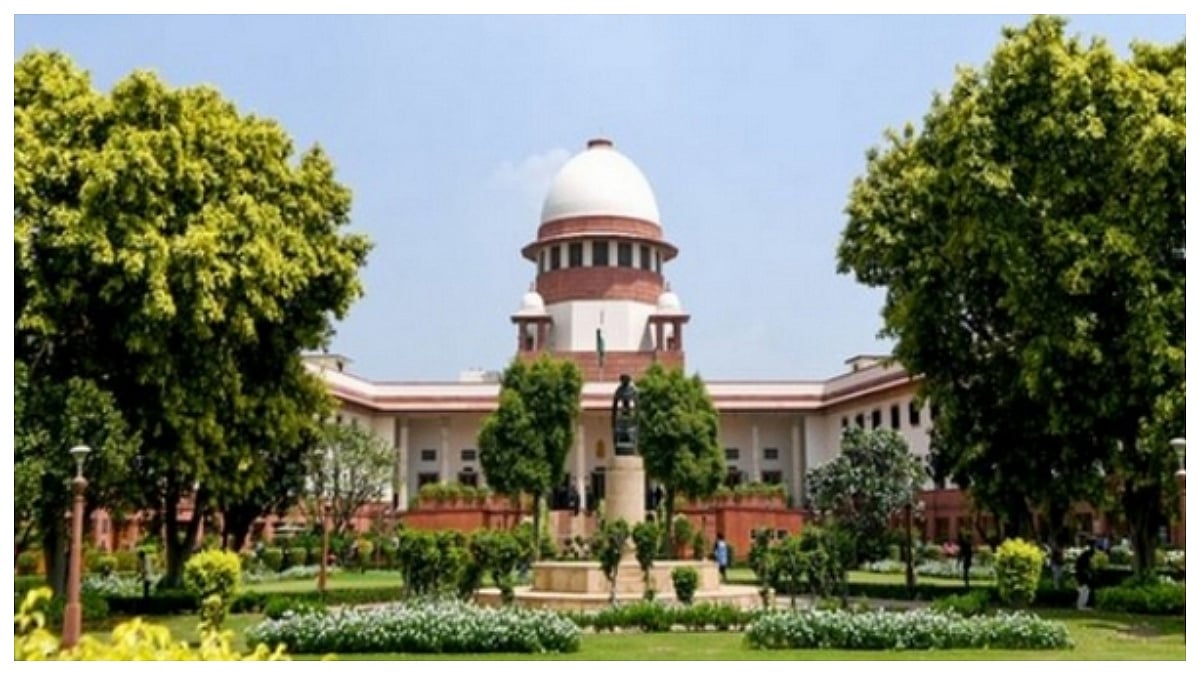
The Supreme Court on Tuesday assured teachers that it would step in if any action is taken against them for not implementing the Central Board of Secondary Education's (CBSE) three-language policy for Class IX students, according to the Bar and Bench reports. While directing the Board to file its response to a petition challenging the policy's rollout.
Hearing the matter, a Bench comprising Chief Justice of India Surya Kant, Justice Joymalya Bagchi and Justice V Mohana was considering petitions that question the implementation of the CBSE's revised three-language policy, citing a shortage of textbooks, inadequate teaching staff and the sudden introduction of the new language requirement in the middle of the academic session.
Responding to concerns that teachers could face disciplinary action if they were unable to teach the newly introduced languages, Chief Justice Kant assured the petitioners that the court would protect them.
"Come to us, we will stay those dismissals," the CJI remarked during the hearing, as reported by Bar and Bench.
The court then issued notice to the CBSE and directed it to file its response. Additional Solicitor General Aishwarya Bhati, appearing for the Centre, informed the Bench that the Board would submit its reply within two weeks. However, the court decided to list the matter for further hearing on July 22.
Concerns over books, teachers and mid-session implementation
According to the Bar and Bench reports, during the hearing, senior advocates appearing for the petitioners argued that schools are struggling to implement the policy because the required infrastructure is not yet in place.
Senior Advocate Gopal Sankaranarayanan told the court that only textbooks for three of the 22 recognised Indian languages are currently available, making implementation difficult.
"We are here for Class 6 and 9 students. The most practical problem is that one State has said that by July 1 all books have to be available. Now only books of three out of 22 languages are available. This also creates a manpower issue because there are not enough teachers," he argued.
Senior Advocate Mukul Rohatgi also questioned how schools could realistically implement the policy at short notice.
"A child studying English and French is suddenly told in Class 9 to learn Tamil. Where will the teachers and infrastructure come from?" he submitted before the court.
Senior Advocate Anand Grover argued that the CBSE circular violates provisions of the Right to Education Act by imposing additional language requirements without offering meaningful alternatives.
Justice Bagchi highlights constitutional objective
While hearing the matter, Justice Joymalya Bagchi observed that the policy seeks to promote Indian languages in line with constitutional objectives.
He noted that the expression "native Indian language" may require reconsideration but said the spirit behind the notification was to encourage the learning of Hindi and other Indian languages.
He also questioned whether English could be regarded as an indigenous Indian language, recalling that Persian was once the language of courts but is no longer included in the Eighth Schedule of the Constitution.
Background of the case
The petitions challenge a May 15 CBSE circular, which aligns the Board's scheme of studies with the National Education Policy (NEP) 2020 and the National Curriculum Framework for School Education (NCFSE) 2023.
Under the revised framework, students in Classes VI to IX from the 2026-27 academic session are required to study three languages, with at least two being Indian languages.
Parents and teachers from several cities have approached the Supreme Court, arguing that introducing the policy midway through the academic session places an additional academic burden on students preparing for Class X board examinations. They have also pointed to the lack of trained teachers, textbooks, clarity on assessment patterns and the uneven impact across different states.

