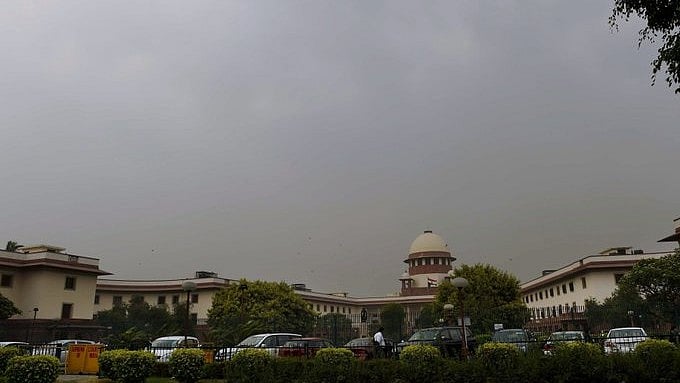
The Supreme Court has been urged to urgently hear petitions challenging the Central Board of Secondary Education’s (CBSE) decision to introduce a three-language requirement for Class 9 students.
The petitions raise concerns over the implementation of the revised language framework and its potential impact on students. The petitioners have argued that making the study of a third language compulsory at the secondary level could increase the academic workload of students and create difficulties for those who had already planned their subjects under the existing curriculum.
Also Watch:
The challenge also focuses on the timing of the policy’s implementation. The petitioners have sought clarity on the decision to introduce the revised language requirement for students entering Class 9 and have called for an early hearing, citing the immediate impact on students, parents and schools.
Under the revised framework, Class 9 students are required to study three languages, including at least two Indian languages. The third language will be assessed internally by schools and will not form part of the Class 10 board examination.
The Supreme Court had earlier issued notices to the Union government, CBSE and the National Council of Educational Research and Training (NCERT), seeking their responses to the petitions.
The three-language framework is part of the broader reforms proposed under the National Education Policy (NEP) 2020 and the National Curriculum Framework for School Education. However, the move has led to concerns among some parents, teachers and education groups regarding the academic burden and practical challenges associated with its implementation.
The petitioners have sought an early hearing, maintaining that a timely decision is necessary to address the uncertainty surrounding the policy and its implementation for the current academic year.

