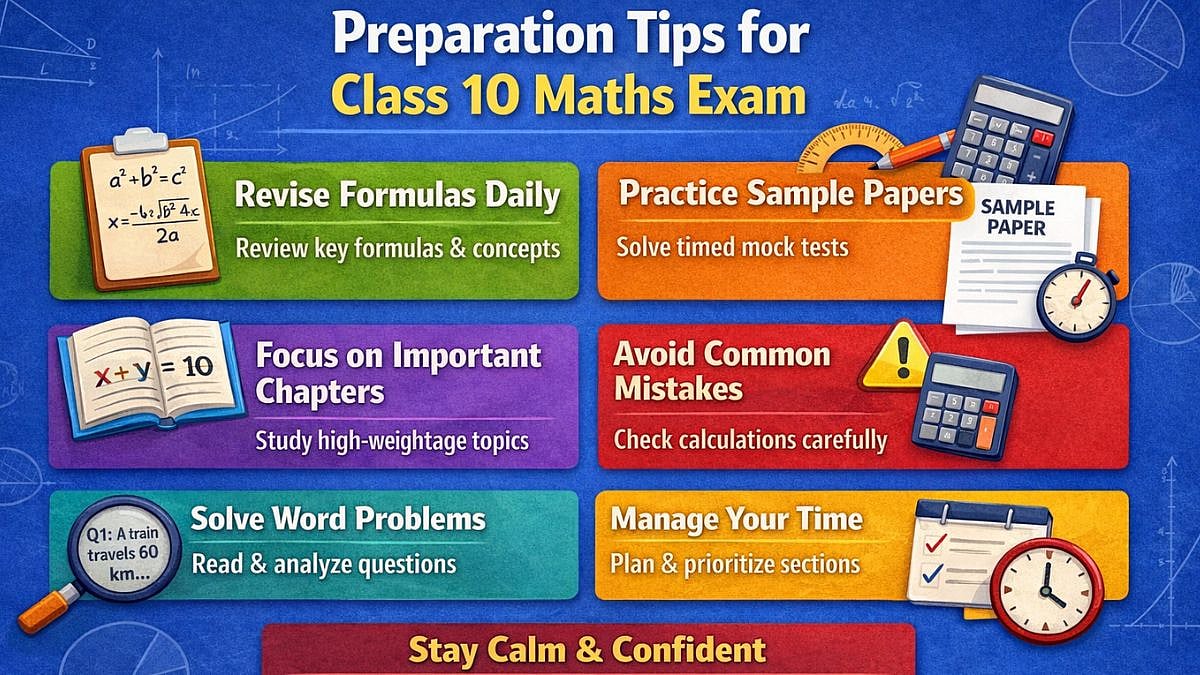
CBSE Class 10 Maths Board Exams 2025-26: As the Central Board of Secondary Education (CBSE) Class 10 Mathematics Board Exam, scheduled for February 17, 2026, approaches, according to the date sheet issued by the CBSE, planning and hard work are the best ways to attain good marks. According to Anu Samson, Mathematics Faculty, Gopi Birla Memorial School, a balanced daily routine consisting of revision, practice, and self-evaluation is a must for students. According to her, daily revision of formulas and important concepts, along with the practice of different questions, particularly from heavily marked topics, is the best way to consolidate learning and increase confidence. Timing the practice through sample papers is also a must for improving the speed aspect.
While illustrating the scoring points in the questions, Samson discusses how "chapters like Polynomials, Pair of Linear Equations in Two Variables, Quadratic Equations, Arithmetic Progressions, Surface Areas and Volumes, and Probability are comparatively easier." Algebra alone contributes 20 marks, so it is an extremely important section if the goal is to score well. Yet, she warns: "Most commonly, errors like misinterpretation of questions, poor conceptual understanding, errors in calculation, and poor time management result in the loss of valuable marks."
The NCERT books, she emphasises, are non-negotiable while preparing for Class 10 Maths. The CBSE question papers are designed strictly in accordance with the concepts, examples, and exercise set in the NCERT books. Although reference books will help reinforce concepts, one needs to be thoroughly conversant with the NCERT books first. While dealing with word problems and case study-based questions, Samson suggests that one should carefully read the questions, highlight relevant information, and answer the questions step by step to fetch maximum marks.
For average or low-performing students, concentrating on high-weightage chapters that are simpler in nature, daily formula work correction, and selecting important problems from a variety of topics could be very beneficial. She further emphasises stress management in exams by remaining calm, answering simpler questions first, having neat rough work sheets, and not rushing through them.
Lastly, Samson emphasises the role of the parents, encouraging them to foster an environment that promotes consistency, emotional support, and healthy living practices, especially in the challenging period of exams.

