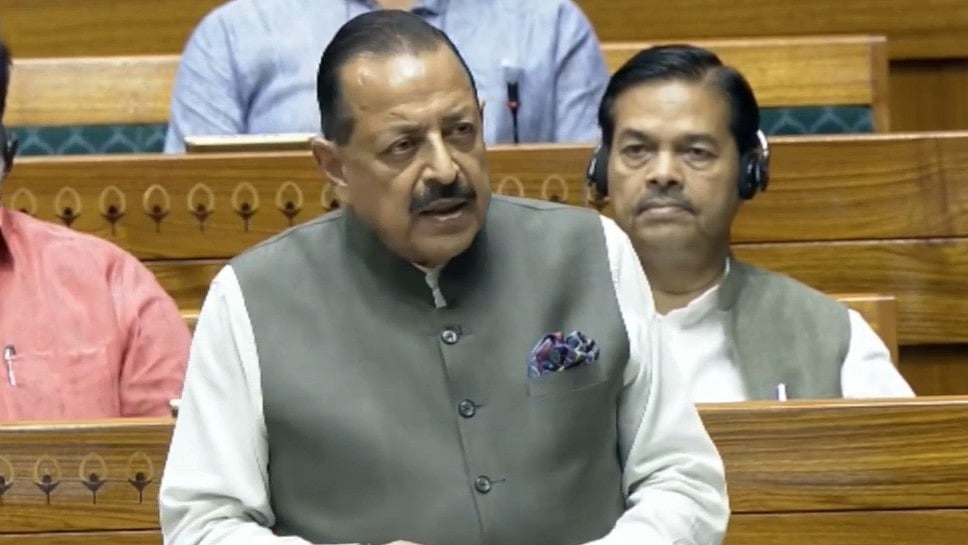
New Delhi: Union Minister of State Jitendra Singh on Tuesday initiated the discussion on the Public Examinations (Prevention of Unfair Means) Amendment Bill, 2026 in the Lok Sabha, stating that the legislation reinforces the government's commitment to protecting students and ensuring fairness and transparency in public examinations.
Moving the Bill for consideration, Singh said the proposed legislation amends the Public Examinations (Prevention of Unfair Means) Act, 2024, which he described as the first comprehensive law of its kind enacted in independent India to curb examination malpractices.
"The earlier Act and this amendment are a reaffirmation of this government's deep commitment to safeguard the welfare of students and youth. It also reiterates Prime Minister Narendra Modi's resolve not to allow anyone to compromise with the future of the children of Mother India," Singh said.
Calling it a "milestone legislation" in the history of Parliament, the minister said previous governments had failed to enact a comprehensive law despite recommendations made as early as 2010. He credited the Modi government with completing what he termed an "unfinished task" by introducing the legislation in January 2024, securing its passage in February, implementing it in June, and notifying it the same month.
Singh said the primary objectives of the 2024 Act were to enhance the credibility and transparency of public examinations, assure students that genuine merit would be rewarded, and protect their academic future. He noted that before the enactment of the law, there was no comprehensive legal framework to deal with large-scale examination fraud.
Highlighting the need for the amendment, the minister said recent incidents of paper leaks and examination-related fraud prompted the government to further strengthen the law.
"The Act brought in 2024 made offences non-bailable, non-compoundable, and cognizable, with stringent punishment. However, considering recent events, Prime Minister Modi decided that the law needed to be strengthened to ensure speedy justice and further enhance the credibility of examinations," he said.
Among the key provisions of the amendment, Singh said the penalty for service providers, including agencies, organisations, companies, or firms engaged in conducting public examinations, has been significantly enhanced. The maximum fine has been increased from ₹1 crore to ₹5 crore, while the period during which such entities can be barred from conducting examinations has been doubled from four years to eight years.
The amendment also proposes stricter punishment for organised crime involving examination authorities, service providers, or examination mafias. Under the existing law, such offences attract imprisonment ranging from five to ten years. The amendment seeks to increase the minimum sentence to seven years, while retaining the maximum imprisonment of 10 years. The maximum fine for such offences is also proposed to be raised from ₹1 crore to ₹10 crore.
For organised crime involving examination authorities or service providers, "the earlier punishment was imprisonment of five to ten years. It is now proposed to be increased to seven to ten years. Likewise, the maximum fine, which was ₹1 crore earlier, is proposed to be increased to ₹10 crore."
Addressing concerns over political blame, Singh said examination fraud is a nationwide issue that cuts across party lines.
"I am not accusing any particular government. This is a widespread problem faced by almost every state and Union Territory, irrespective of which party is in power. It is happening in Punjab, it is happening in Karnataka, whether we name those states or not."
Earlier, Rajya Sabha member Swati Maliwal accused the Aam Aadmi Party (AAP) government of six major paper leaks in the state over the last five years.
The amendment, he added, aims to further strengthen the legal framework against paper leaks and examination fraud while ensuring swift justice and restoring public confidence in the country's examination system.
Section 12A Mandates Investigations By Police
He also added that the newly inserted Section 12A mandates that investigations by the police, a Special Task Force, or any central agency be completed within two months, while trials in designated fast-track courts must conclude within the next three months, ensuring a final decision within five months of the incident being reported. Appeals, he added, can only be filed before a Division Bench of a High Court within 30 days on justifiable grounds. Singh said related offences would also be dealt with under the provisions of the Bharatiya Nyaya Sanhita.
Highlighting the government's commitment, he said the process of setting up fast-track courts had already begun, and also referred to the Prime Minister's announcement of a high-level task force comprising experts such as Nandan Nilekani, former ISRO chief S. Somanath, IB Director Tapan Deka, IIT Madras Director V. Kamakoti, a former Education Secretary, and a technology expert to recommend reforms for making examinations leak-proof.
35 out of 46 key recommendations implemented
Singh further said that "Out of the major 46 key recommendations made by the Radhakrishnan Committee constituted on June 22, 2024, nearly 76 percent, that is, 35 recommendations, have already been implemented. So, in summary, without taking much time, the government’s intent is very honest, and this amendment is being brought forward as part of a very honest effort. I am confident that no leader of any party or any honorable member of any party will have any objection to this. If anyone does have an objection, the people of this country will have an objection to them".

