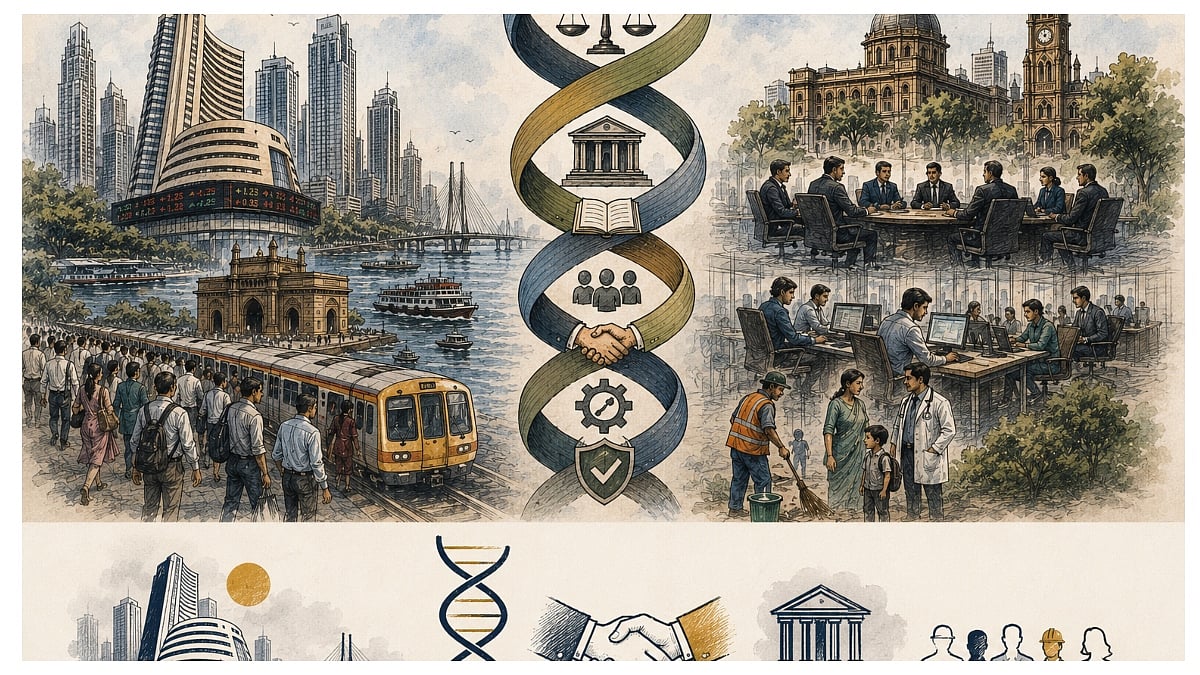
Mumbai: “The end of the state is not merely to live, but to live well.” — Aristotle
Every great city possesses two forms of DNA. One is biological, inherited at birth. The other is civic, quietly expressed through its institutions, workplaces, boardrooms, governments and everyday conduct. The first is beyond our control. The second is rewritten every day.
Mumbai’s civic DNA built India’s financial capital.
Every morning, before millions finish their first cup of tea, billions of rupees change hands. Markets open. Entrepreneurs pursue opportunity. Banks finance ambition. Wealth is created at remarkable speed. By almost every economic measure, Mumbai succeeds.

Yet another form of wealth often escapes attention.
It is trust.
Civic DNA is the invisible code that determines whether merit prevails over patronage, integrity over expediency and public purpose over private advantage. It is the foundation upon which lasting prosperity is built.

Yet prosperity alone cannot guarantee institutional health. Millions endure exhausting commutes. Housing costs continue to strain households. Workplace pressure has become routine. Organisational politics is no longer confined to legislatures. It frequently appears in boardrooms, public institutions, universities and private enterprises of every size. Owners, chairmen, chief executives, managers and employees alike encounter rivalries, competing ambitions and relentless expectations. The frustrations may differ, but few escape them entirely.
Modern neuroscience reminds us that stress hormones can influence judgement, trust, fear and conflict. Biology may shape human impulses, but it does not dictate outcomes. Ethical leadership, institutional culture, professional discipline and shared values ultimately decide whether organisations become centres of innovation or arenas of division.

More than two centuries ago, Adam Smith observed: “No society can surely be flourishing and happy, of which the far greater part of the members are poor and miserable." Today, that wisdom deserves a broader reading. A society cannot truly flourish if trust erodes, merit weakens and institutions lose public confidence.
History offers a consistent lesson. London, Singapore, New York and Tokyo earned global stature not through capital alone, but through institutions that inspired confidence. Investors finance prosperity. Trust sustains it.
Mumbai's next chapter should therefore be measured not only by market capitalisation, skyscrapers or billionaire rankings, but by stronger institutions, healthier workplaces, transparent governance and renewed public trust.
Markets build wealth. Civic DNA determines whether that wealth endures.

