
Mumbai: The Indian rupee slipped to its weakest level ever on Wednesday, touching 91.50 against the US dollar. The fall came amid rising global uncertainty linked to the Greenland issue and a clear shift by investors towards safer assets. Growing nervousness in global markets has increased pressure on emerging market currencies, including the rupee.
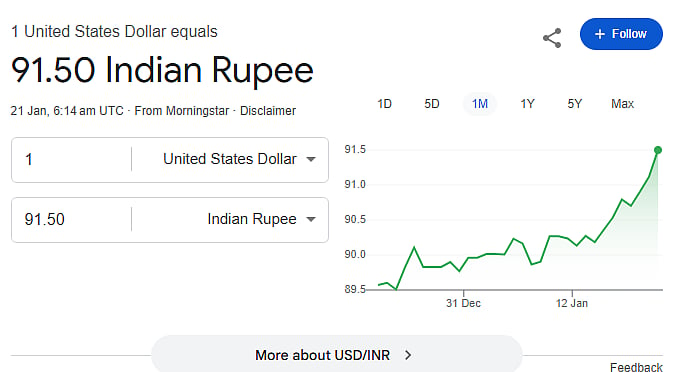
The rupee broke its previous record low of around 91.07 seen in mid-December. So far this month, the currency has weakened by about 1.5 percent. In the full year 2025, the rupee has already fallen nearly 5 percent, reflecting sustained pressure.

Risk Aversion and Capital Outflows
Analysts say the main reason behind the rupee’s weakness is strong risk aversion. Foreign investors continue to pull money out of Indian assets, adding to dollar demand. At the same time, importers are increasing their hedging to protect against further falls in the rupee, while exporters are less active in selling dollars.
This imbalance between dollar demand and supply is keeping the rupee under stress. Forward premium levels are also not fully reflecting the risk of further weakness.
Capital Side Is the Key Challenge?
Experts believe India’s current account deficit remains manageable. However, the lack of strong capital inflows has left the rupee exposed. According to market analysts, the pressure on the rupee is coming more from capital flows than from weak economic fundamentals.
Equity Outflows Add to Pressure
Foreign portfolio flows remain weak. In January alone, foreign investors have pulled out around USD 3 billion from Indian markets. In 2025 so far, total outflows have reached a record USD 18.9 billion. Analysts note that the rupee’s movement is driven more by demand-supply factors than by a worsening domestic situation.
Trade Deal Uncertainty and RBI Stance
The absence of clear progress on an India-US trade agreement has removed a potential trigger for fresh inflows. The central bank has maintained a steady approach, stepping in occasionally to smooth volatility rather than defending any specific level.

