Mumbai: Indian equity markets closed lower on Friday as investors reacted to the Reserve Bank of India’s monetary policy decision and remained cautious about global economic uncertainties.
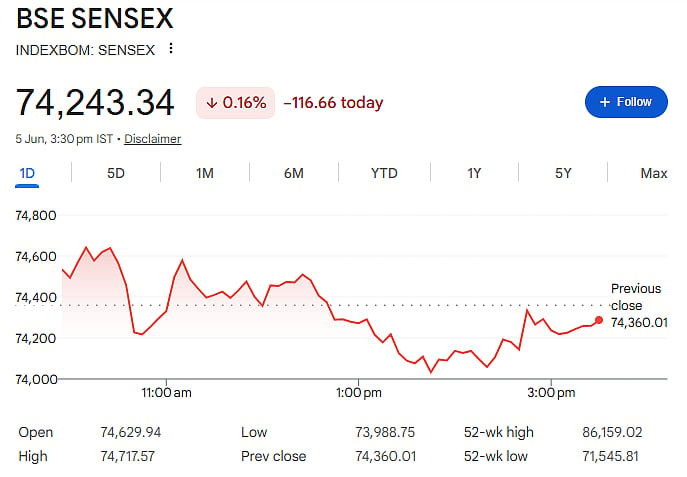
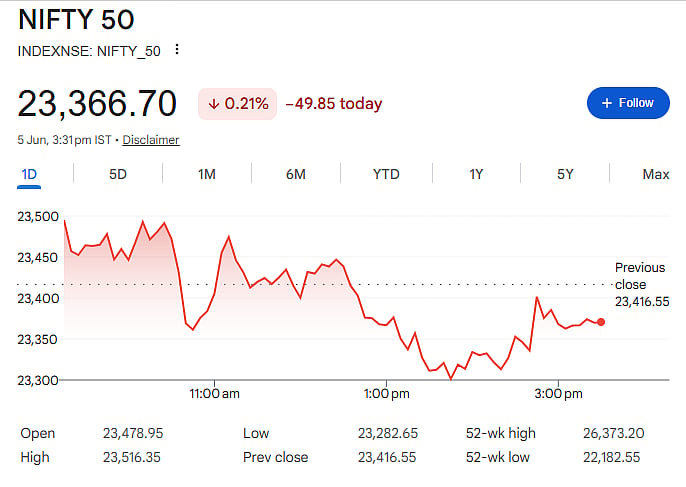
The Sensex fell 116.67 points, or 0.16 percent, to close at 74,243.34. The Nifty declined 49.85 points, or 0.21 percent, and settled at 23,366.70.
Market participants remained focused on the RBI’s policy announcement and its impact on growth, inflation and interest rates.

RBI Keeps Rates Unchanged
The Monetary Policy Committee (MPC) unanimously decided to keep the policy repo rate unchanged at 5.25 percent.
The central bank also retained its neutral stance, indicating a balanced approach amid rising global risks, geopolitical tensions and inflation concerns.
In addition, the RBI announced measures to encourage foreign investment in Indian financial markets. These included higher investment limits for Non-Resident Indians (NRIs) and Overseas Citizens of India (OCIs), along with an expansion of government securities available under the Fully Accessible Route (FAR).

IT and Metal Stocks Drag Markets Lower
Selling pressure was visible across several sectors, especially information technology and metal stocks.
Among Nifty companies, Hindalco Industries, Wipro and Trent were the biggest losers during the session.
The broader market also witnessed weakness. The Nifty MidCap index declined 0.35 percent, while the Nifty SmallCap index slipped 0.06 percent.

However, the media sector managed to outperform and ended in positive territory.
Key Levels to Watch
Market experts said the 23,450-23,550 zone remains an important resistance area for the Nifty.
A sustained move above this range could improve sentiment and help the index move towards 23,750-23,800 levels.
On the downside, 23,250 remains a crucial support level. Analysts believe the market structure will remain stable as long as the Nifty stays above this mark.
Experts added that Friday’s trading reflected investor caution, with markets balancing growth expectations against inflation risks and global economic challenges.

