Mumbai: Indian stock markets closed sharply higher on Thursday, October 15, as buying in technology, private banking and telecom heavyweights outweighed weakness in smaller companies.
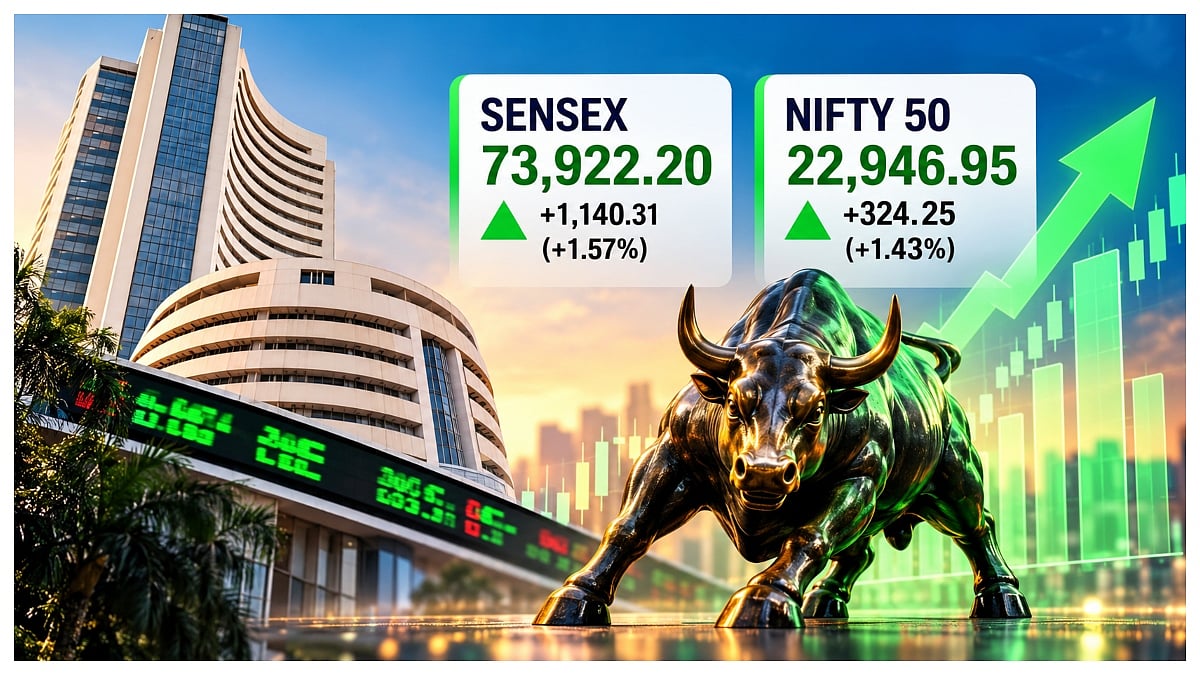
The Sensex surged 1,533.72 points, or 2.11 per cent, to settle at 74,315.61. The Nifty gained 374.65 points, or 1.66 per cent, to close at 22,997.35, narrowly missing the 23,000 mark.
During the session, Sensex reached 74,330.29, while Nifty touched 23,056.40.
IT And Banks Power Recovery
Tech Mahindra, ICICI Bank, Reliance Industries, HCLTech, Bharti Airtel and Eternal were among the leading Sensex gainers, advancing up to 5 per cent.
Only three Sensex constituents, Bharat Electronics, Hindustan Unilever and Trent, ended lower.
Technology stocks extended their recovery, supported by earnings optimism following HCLTech’s results. Private lenders and automobile stocks also attracted buying.
Small-Caps Fall Despite Benchmark Rally
The broader market failed to match the headline gains. Nifty Midcap 100 declined around half a per cent, while Nifty Smallcap 100 fell more than 1 per cent.
The combined market capitalisation of BSE-listed companies decreased by ₹38,004.27 crore to ₹4,70,95,769.77 crore, highlighting the divergence between heavyweight gains and wider market performance.
Nifty IT gained around 2 per cent, Private Bank rose nearly 2 per cent and Auto advanced more than 1.5 per cent. PSU Bank declined over 1.5 per cent, while FMCG lost more than 1 per cent.

Oil Retreat And Rupee Support Sentiment
Easing crude prices and a stronger rupee supported sentiment. Brent traded around $103.50 a barrel in later reporting, while the rupee closed near 95.0550 against the dollar.
India VIX fell around 5 per cent to 13.95, signalling reduced market anxiety.
Global Risks Remain
India’s rally contrasted with steep Asian losses, with South Korea’s Kospi falling nearly 8 per cent and Japan’s Nikkei dropping 5 per cent.
Higher US inflation and interest-rate concerns remained external risks. Investors will next assess earnings delivery and whether buying spreads beyond heavyweight stocks. Broader participation remains an important test.

