
Mumbai: Shares of IT services company LTIMindtree fell sharply on Tuesday after the company reported weak financial results for the October-December quarter (Q3 FY26). The stock dropped more than 7 percent on both stock exchanges, as investors reacted negatively to a decline in profits.
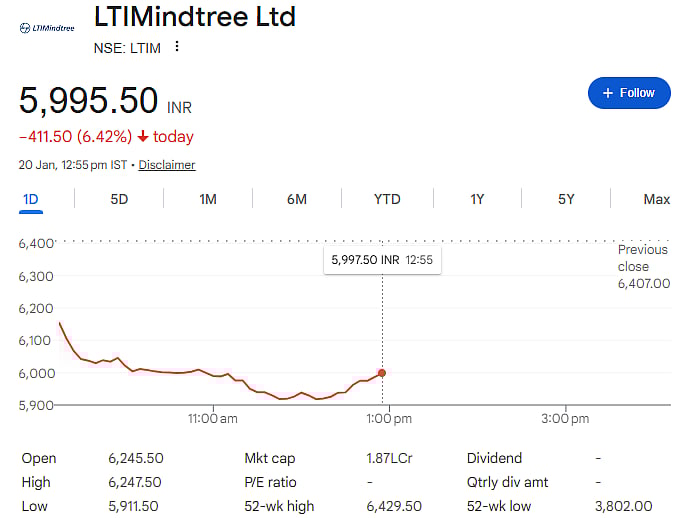
On the Bombay Stock Exchange (BSE), LTIMindtree shares fell 7.26 percent to Rs 5,940.15. On the National Stock Exchange (NSE), the stock declined 7.31 percent to Rs 5,938.50. The sharp fall made LTIMindtree one of the top losers in the IT sector for the day.
The company reported a 10.5 percent year-on-year fall in consolidated net profit for the quarter ended December 2025. Net profit stood at Rs 970.6 crore, compared to Rs 1,085 crore in the same quarter last year. The decline was mainly due to a one-time expense linked to the implementation of new Labour Codes announced by the government.

LTIMindtree said it had taken a one-time provision of Rs 590 crore related to these new Labour Codes. Because this cost is large and not expected to recur, the company classified it as an 'exceptional item' in its financial statements. The total exceptional charge for the quarter and the nine-month period ended December 31, 2025, amounted to Rs 5,903 million.
The company added that once the government notifies detailed rules under the new Labour Codes and provides more clarity, it will review whether any further financial impact needs to be recorded in future quarters.

Despite the fall in profits, LTIMindtree reported healthy revenue growth. Revenue from operations rose 11.6 percent year-on-year to Rs 10,781 crore in Q3 FY26, compared to Rs 9,661 crore in the same quarter last year. This shows that demand for the company’s IT services remains strong.
However, on a quarter-on-quarter basis, profits declined sharply by 30.7 percent, even as revenue grew by 3.7 percent. This gap between revenue growth and profit decline raised concerns among investors, leading to the sharp fall in the stock price.
Overall, while LTIMindtree’s core business continues to grow, the one-time cost and weaker sequential profit performance weighed heavily on investor sentiment in Tuesday’s trade.
Disclaimer: This article is for informational purposes only and does not constitute investment advice. Readers should consult financial advisors before making any investment decisions based on market movements or company performance.

