
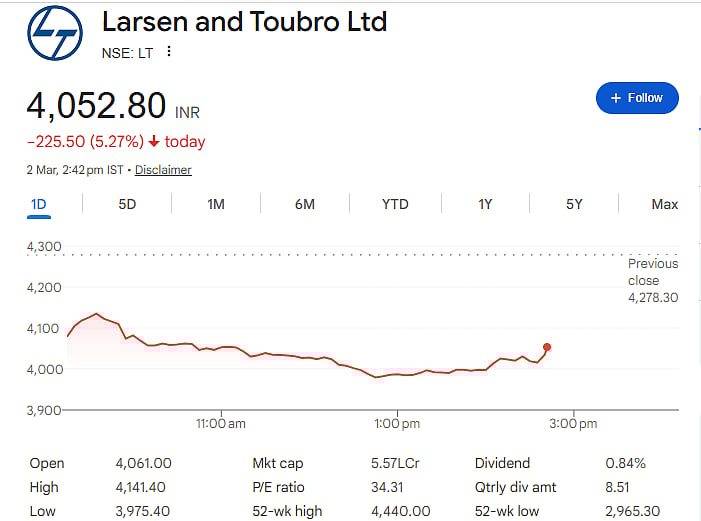
Mumbai: Shares of Larsen & Toubro (L&T) saw a sharp fall on Monday, marking the biggest drop of the year. The stock slipped from its previous close of Rs 4,278.30 to Rs 4,061 and fell nearly 7 percent during the day to touch Rs 3,975.40.
This is the first time since October 2025 that the stock has fallen below the Rs 4,000 mark. The sudden fall has made investors cautious.
Macquarie Report Raises Concerns
The main reason behind the decline is a report by global brokerage Macquarie. The report highlighted risks linked to rising geopolitical tensions in the Middle East.
According to the report, about 37 percent of L&T’s total order book is linked to the Middle East. During the first nine months of FY26 (9MFY26), nearly 33 percent of the company’s order inflow came from this region. This means the company has strong exposure to Gulf countries.
If tensions in the region increase, projects could be affected.
Three Key Risks Highlighted
The report pointed out three major risks:
First, if conflict in the Gulf region worsens, infrastructure and hydrocarbon project sites may suffer physical damage. This could lead to project delays or even cancellations.
Second, worker safety could become a concern. Employees may need to be relocated, which could slow down project execution.

Third, rising geopolitical tensions may put pressure on margins, which could affect company earnings.
Because of these risks, investors chose to book profits and reduce exposure, leading to heavy selling in the stock.
Long-Term Track Record Still Strong
Despite the recent fall, L&T has delivered strong returns over the long term. The stock has risen about 26 percent in the past year and was once as low as Rs 15.97 in its early years.
As of December 2025, Foreign Institutional Investors (FIIs) held a 19.85 percent stake in the company, while Domestic Institutional Investors (DIIs) held 42.78 percent. This shows that domestic investors continue to have strong confidence in the company.
For now, markets are closely watching how long Middle East tensions continue. A quick resolution could support recovery, but prolonged conflict may keep short-term pressure on the stock.

