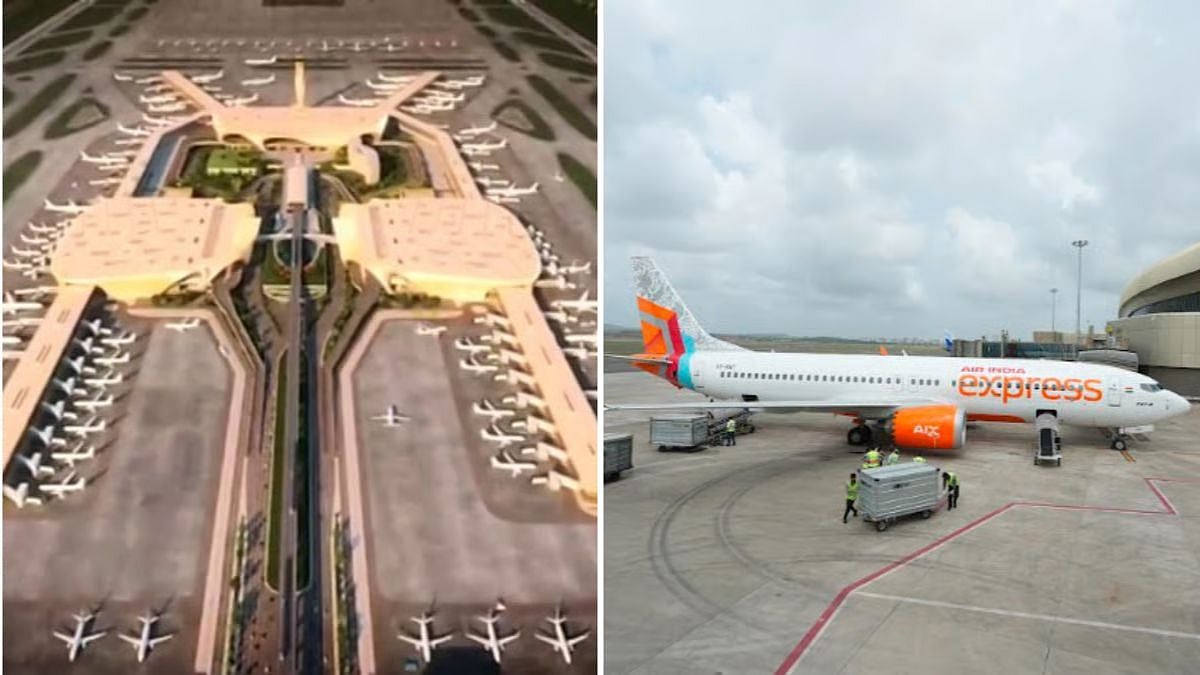
Mumbai: India’s leading airlines – IndiGo and the Air India Group – announced a coordinated, phased transition of select international and domestic flight operations from Chhatrapati Shivaji Maharaj International Airport (CSMIA) to the newly operational Navi Mumbai International Airport (NMIA). The announcement made on Sunday breaks months of stalemate between major carriers and airport operator Adani Airport Holdings Limited (AAHL).
Transition To Begin In December
The transition, scheduled to commence in December 2026 and wrap up by the Northern Summer 2027 season (March–July 2027), is designed to clear operational capacity at CSMIA. This will allow the airport operator to proceed with a long-delayed, complete redevelopment of Mumbai’s aging 60-year-old Terminal 1 (T1).
According to the joint plan released on Sunday, IndiGo will shift all its 12 international routes and a few domestic flights. Beginning from February 2027, the country's largest airline will progressively transfer flights to Bahrain, Riyadh, Dammam, Jeddah, Madinah, Kuwait, Ras Al Khaimah, Fujairah, Muscat, Dhaka and Jakarta. Moreover, it will also add a new daily international service to Kathmandu from NMIA, bringing its international destination count at the new airport to 12 by July 2027.
Domestic Flights To Support Connections
From the domestic front – which is widely occupied by IndiGo, the carrier has announced to transition a proportionate share of domestic services from CSMIA to NMIA to build seamless hub connections for onward international travelers. According to industry experts, the transfer will free up vital capacity at CSMIA's T2, allowing IndiGo to launch long-haul and regional routes in 2027 across Europe, Asia and Africa using its incoming fleet of Airbus A320, 321 and A321XLR aircraft. Meanwhile, domestic adjustments at T1 will be absorbed into T2 as required.
Simultaneously, Air India Group will realign the schedule of its West Asia flights while preserving its historic slot portfolio at CSMIA. According to the plan, the group's low-cost subsidiary, Air India Express, will kick-off operations at NMIA with four daily domestic flights. From January 2027, Air India Express will introduce planned services to Kuwait and transition existing routes to Oman. The group will progressively migrate services to key West Asian hubs, including Jeddah, Riyadh, Dammam, Doha, Muscat and Sharjah, to NMIA and will wrap up the migration by the start of the Northern Summer 2027 season.
Negotiations Lead To Agreement
The announcement comes on the heels of intense negotiations between AAHL, Mumbai International Airport Ltd (MIAL), the Airline Operators Committee (AOC) and the Ministry of Civil Aviation (MoCA).
According to sources from MIAL, the shift of nearly 3.6 million to 5 million passengers to NMIA will create the necessary operational breathing space for T1’s redevelopment. Currently processing 15 million passengers per annum (mppa), the redeveloped, digitally enabled T1 will feature an expanded capacity of 20 mppa upon its targeted completion by 2030.

AAHL welcomed the commitments from both carriers, noting that the phased migration paves the way for a true dual-airport system for the Mumbai Metropolitan Region (MMR). “Together, the two airports can facilitate more seamless domestic-international connections, attract greater participation from international airlines and enable India to capture a larger share of global transit traffic. This would strengthen India's position in the global aviation network and support its ambition to emerge as an international aviation hub,” said a spokesperson.
Earlier this month, carriers had pushed back against an initial plan by MIAL to shift or curtail up to 265 international flights out of CSMIA’s Terminal-2 (T2) during the upcoming Winter Schedule. Airlines expressed serious concern over potential chaos for passengers who had already booked travel.
Following a crucial intervention by MoCA and a high-level meeting chaired by top Adani leadership on October 13, a consensus was reached that scheduled international operations out of T2 will remain untouched through the winter schedule ending March 27, 2027. However, the airport had asked the airlines to shift around 5 million domestic passengers out of T1’s current annual traffic of 15 million to facilitate the partial demolition and reconstruction of T1-B starting January 2027.
To get details on exclusive and budget-friendly property deals in Mumbai & surrounding regions, do visit: https://budgetproperties.in/

