
Mumbai, April 1: India’s flexible workspace market has witnessed exponential growth over the past eight years, with annual transaction volumes rising from 2.2 million sq ft in 2017 to 18.6 million sq ft in 2025, according to the latest Flex Space Occupier Intelligence report by Knight Frank India.
This eightfold increase represents a robust CAGR of 30%, significantly outpacing the broader office market, which grew at 9% during the same period. Flex space penetration has also jumped from 5% in 2017 to 21% in 2025.
City-wise flex market dynamics
Bengaluru continues to be India’s largest flex market in absolute terms, recording 5.3 million sq ft of absorption in 2025. Pune leads in flex adoption depth, with 31% of total office absorption coming from flexible spaces. The Mumbai Metropolitan Region (MMR) has seen steady growth, reaching its highest-ever flex absorption of 2.7 million sq ft in 2025, accounting for 28% of total office absorption.
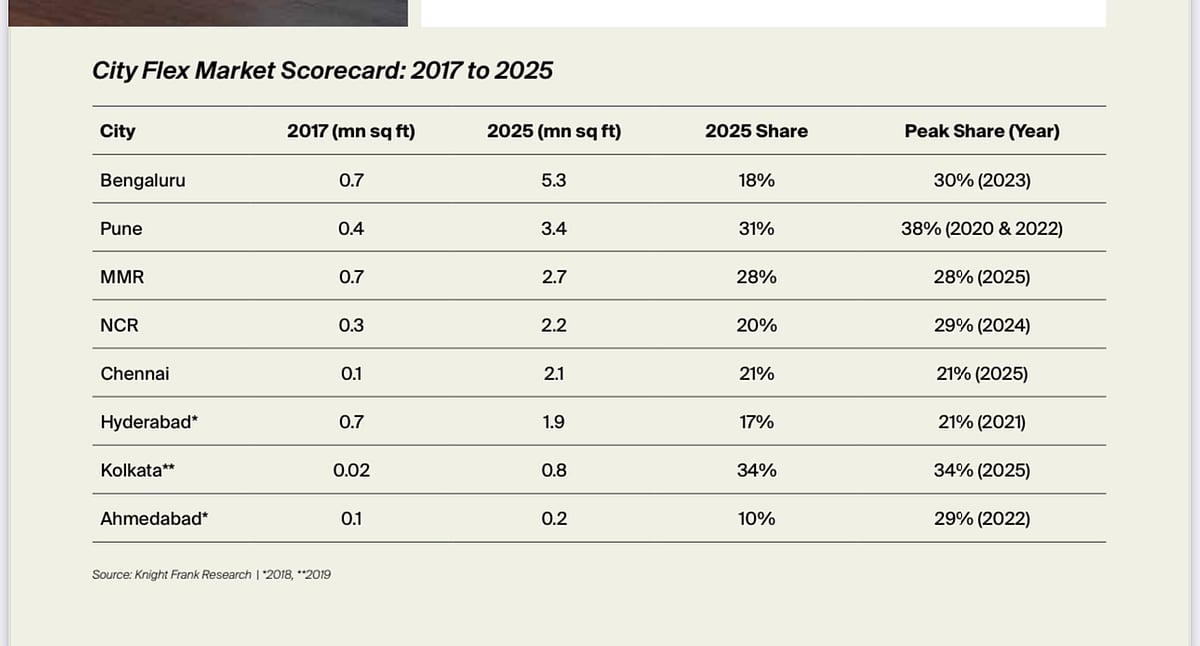
In MMR, the flex office market has matured into a scaled segment with high corporate uptake. Large-format offices and IT-led demand are key drivers, with enterprises leveraging flex spaces for scalability, operational agility, and faster deployment.
The region’s strong connectivity, access to talent, and concentration of corporate hubs make it a preferred location for global and domestic IT firms, BFSI players, and consulting services.
The report underscores that flex office adoption is no longer a temporary trend but a strategic, long-term solution for enterprises seeking scalable, cost-efficient, and location-flexible office solutions across India.
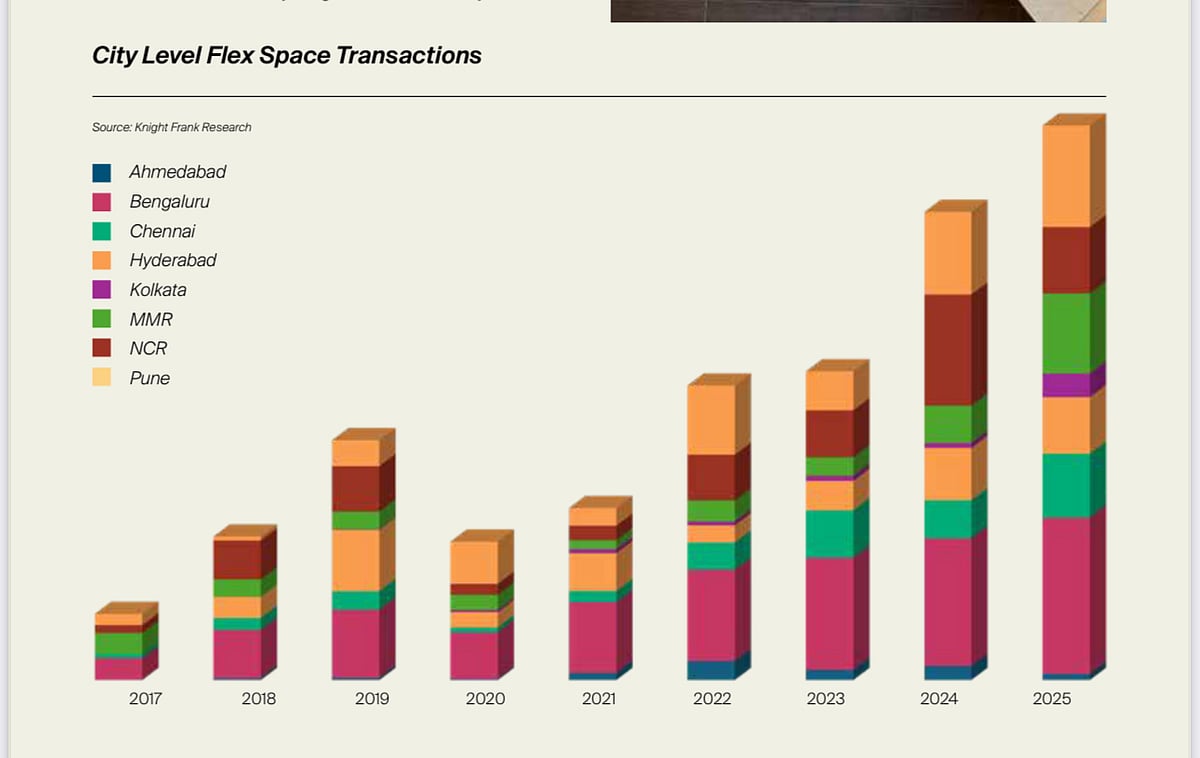
Other cities show varied trends
● NCR’s flex market saw breakout growth in 2024 before stabilising in 2025.
● Chennai grew from a negligible base in 2017 to a meaningful scale by 2025.
● Hyderabad’s market has been cyclical but is now on a steady recovery path.
● Kolkata achieved the highest flex penetration in India at 34% despite modest absolute volumes.
● Ahmedabad remains a developing flex market with episodic absorption spikes.
Enterprise demand and industry trends
While flex offices were initially preferred by startups, the sector has evolved into a core enterprise solution. Large enterprises now account for 72% of total flex absorption, dwarfing SMEs (18%) and startups (10%). Within this segment, 81% of enterprise seats are held by global MNCs, followed by Indian large enterprises (11%) and scaled startups (8%).
Global Capability Centres (GCCs) lead demand, representing 52% of absorption, followed by third-party IT firms (26%) and India-facing businesses (22%). By industry, Information Technology dominates with a 43% share, followed by BFSI at 25%, other services at 24%, and manufacturing at 8%.
Expert insights
Shishir Baijal, International Partner, Chairman & Managing Director, Knight Frank India, said, “India’s flexible workspace sector has evolved beyond its early startup-led image to become a core element of enterprise real estate strategy. The 30% CAGR in flex adoption reflects a structural shift in occupier priorities—agility, speed, and capital efficiency now drive workspace decisions.”
Also Watch:
He added, “Looking forward, flex spaces will play a critical role in supporting GCC expansions, distributed workforce strategies, and portfolio optimisation for large corporates. The next phase of growth will focus on deeper enterprise integration, city-specific demand strategies, and flex operators evolving into full-service workspace partners.”
To get details on exclusive and budget-friendly property deals in Mumbai & surrounding regions, do visit: https://budgetproperties.in/

