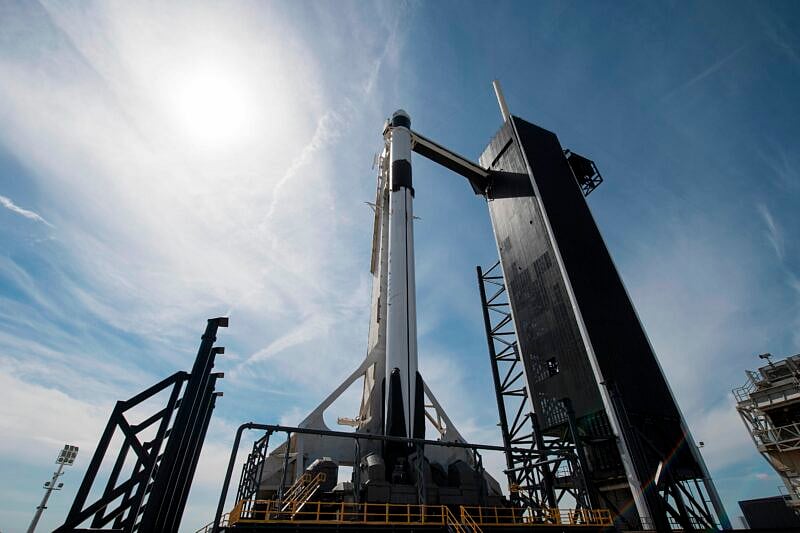
Hyderabad-based space technology company TakeMe2Space is preparing to launch India’s first networked orbital data centre mission aboard SpaceX’s Falcon 9 rocket in 2028. The company plans to develop a six-satellite constellation aimed at enabling computing infrastructure in space.
As part of the Waymaker 2 rideshare mission, TakeMe2Space will deploy two 100-kg MOI (My Orbital Infrastructure) constellation satellites under a launch service agreement with RIDE! space, which secured the launch opportunity. The mission is scheduled for a launch window in late 2028.
“Everything we have flown so far has been about proving that compute belongs in orbit. These two satellites are about proving it at a scale that pays. One and a half kilowatt (kW) of power, a 1-metre imager and a laser link between spacecraft are the smallest unit of an orbital data centre that actually behaves like one,” said Ronak Kumar Samantray, founder and CEO, was quoted as saying in a report by Business Standard.
Testing connected computing in orbit
The mission places an Indian company among global efforts to shift computing operations beyond Earth. While several international companies are developing space-based computing systems, TakeMe2Space’s focus is on testing whether multiple satellites can operate as a connected computing network.
The two spacecraft will each generate about 1.5 kW of power and will carry 10 Nvidia Thor GPUs along with 100 terabytes of storage. Optical inter-satellite links will allow the satellites to share workloads and data, making it India’s first planned mission designed to network computing capabilities across multiple spacecraft.
Building towards orbital data centres
TakeMe2Space’s earlier MOI-TD technology demonstrator mission launched in December 2024 and conducted more than 20 experiments in low Earth orbit. The company’s MOI-1 satellite was lost during the PSLV-C62 launch failure in January 2026.
The upcoming satellites are designed to demonstrate high-performance computing in orbit by processing data closer to where it is generated. This could reduce dependence on transmitting large volumes of raw satellite data to ground stations, where limited downlink capacity often restricts data usage.
The company’s upcoming missions are expected to serve as technology demonstrations for future orbital data centre platforms.

