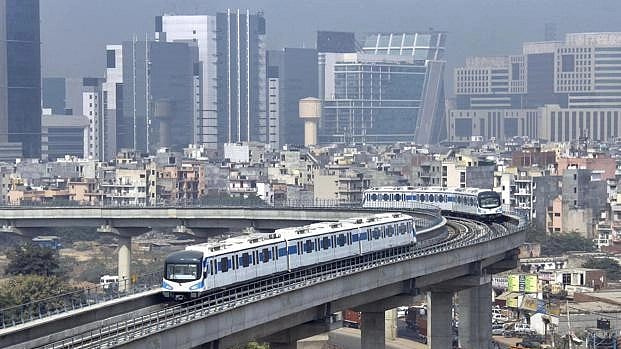
The Haryana government has called on private companies to adopt work-from-home (WFH) policies and staggered office schedules as part of a broader strategy to reduce traffic congestion, fuel consumption, and energy usage.
The initiative comes amid concerns over rising fuel prices and global supply chain disruptions that are adding pressure on the economy.
The proposal is expected to significantly impact Gurgaon, one of India’s major corporate hubs, where daily commuting by employees contributes heavily to traffic congestion across the city and the National Capital Region (NCR).
The city, which houses offices of several Fortune 500 companies and leading Indian firms, sees nearly five lakh vehicles entering daily from Delhi, Faridabad, and surrounding NCR areas, resulting in persistent traffic bottlenecks.
According to a report by the Times of India, the state government has directed its industries department to coordinate with major industry bodies such as Nasscom, CII, and FICCI to implement the initiative.
Companies are being encouraged to allow employees to work remotely wherever feasible and introduce flexible working hours to distribute peak-hour traffic more evenly.
The move extends existing austerity measures already implemented in government departments, including restrictions on official vehicle usage, reduced fuel consumption, and promotion of virtual meetings instead of physical gatherings.
Chief Secretary Anurag Rastogi has also issued an advisory highlighting ongoing global supply chain disruptions linked to geopolitical tensions in West Asia, which have contributed to rising fuel prices and import pressures.
Industry representatives have largely welcomed the proposal. Experts say that hybrid and remote work models have already proven effective in maintaining productivity while reducing travel time and operational costs.
Such measures also help lower fuel consumption, ease congestion, and improve air quality.
Employees have also expressed support, noting that work-from-home arrangements proved effective during the Covid-19 pandemic without harming productivity, while also reducing commuting and office expenses.
Alongside the advisory for private companies, the Haryana government has introduced internal cost-control measures, including a 20% reduction in fuel expenditure, a 10% monthly cut in vehicle usage, and a monitoring system to track compliance.
A 50% reduction in VIP convoy vehicles has also been ordered, along with a temporary ban on non-electric vehicle purchases by government bodies.
Citizens are being encouraged to adopt fuel-efficient practices, use public transport, carpool, and shift towards electric mobility while avoiding unnecessary travel and large gatherings.
