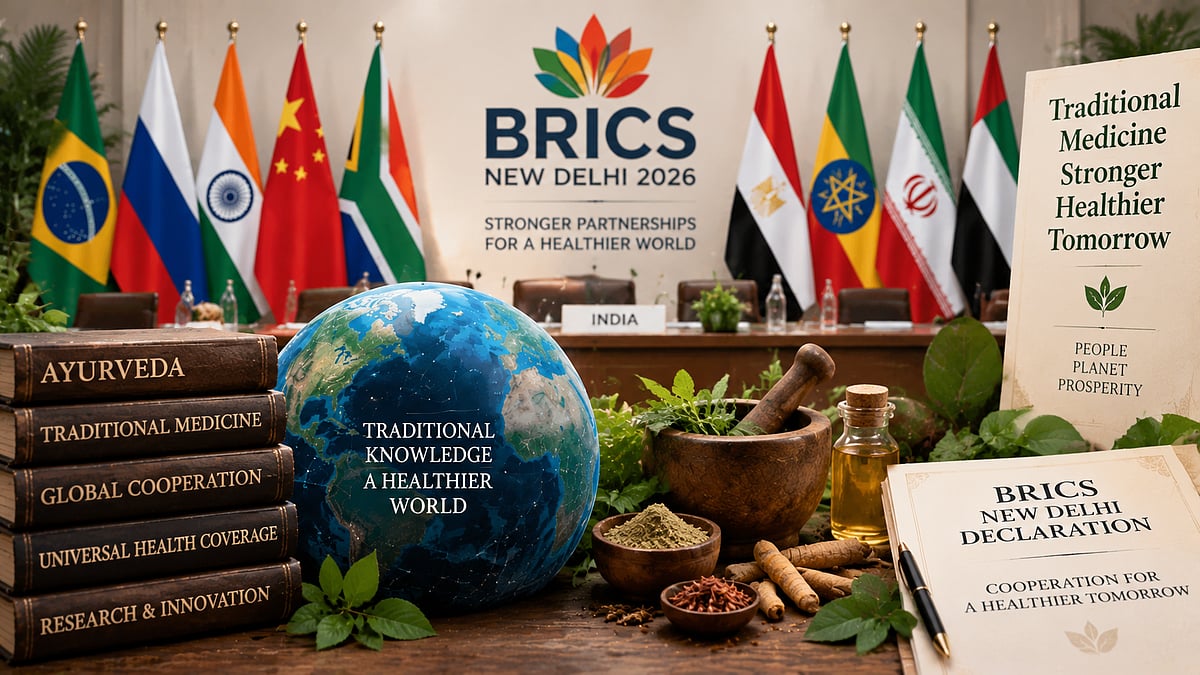
New Delhi, Sep 13: The New Delhi Declaration adopted at the 18th BRICS Summit has given a fresh push to international cooperation in Traditional, Complementary and Integrative Medicine (TCIM), recognising its growing relevance in strengthening health systems and advancing Universal Health Coverage (UHC), the Ayush ministry said.
The key outcome of the declaration is the welcome accorded to the proposed establishment of a BRICS Expert Working Group on TCIM under the BRICS Health Track, the ministry said.
The proposed working group is envisaged as a platform for dialogue, collaboration and exchange among BRICS member states, providing a structured mechanism for advancing cooperation in traditional medicine.
Union Minister of State (Independent Charge), Ministry of Ayush and Minister of State Prataprao Jadhav highlighted, "The recognition of Traditional, Complementary and Integrative Medicine in the New Delhi Declaration is an important step towards strengthening global cooperation in traditional medicine."
Noting that the proposed working group will provide a meaningful platform for member states to share knowledge, strengthen research and advance evidence-based approaches, Jadhav stated that India remains committed to taking forward Ayurveda and other traditional systems of medicine through scientific research, quality assurance and international collaboration, so that their potential can contribute to safe, effective and affordable healthcare.
Secretary, Ministry of Ayush, Vaidya Rajesh Kotecha, stated that the New Delhi Declaration marks an important step in advancing structured cooperation on Traditional, Complementary and Integrative Medicine among BRICS countries.
He emphasised that the proposed working group can provide a focused platform for sharing evidence, strengthening research collaboration and improving quality and regulatory approaches.
"India, through its Ayush ecosystem, is committed to contributing to this cooperation by promoting rigorous research and evidence-informed practices that can support safe, effective and affordable healthcare," Kotecha said.

The declaration specifically calls for greater cooperation in research on medicinal plants and herbal preparations used for therapeutic and preventive purposes. It recognises that the shared traditional pharmacopoeias of BRICS member countries can serve as a foundation for developing safe, effective and affordable therapeutic products.
The emphasis on coordinated research assumes particular significance for countries across the BRICS grouping, where traditional systems of medicine have evolved over generations and medicinal plants and herbal preparations form an important component of healthcare traditions.
Greater cooperation can facilitate research, documentation, knowledge exchange and evidence generation while supporting the responsible development of therapeutic products.
(Except for the headline, this article has not been edited by FPJ's editorial team and auto-generated from an agency feed.)

