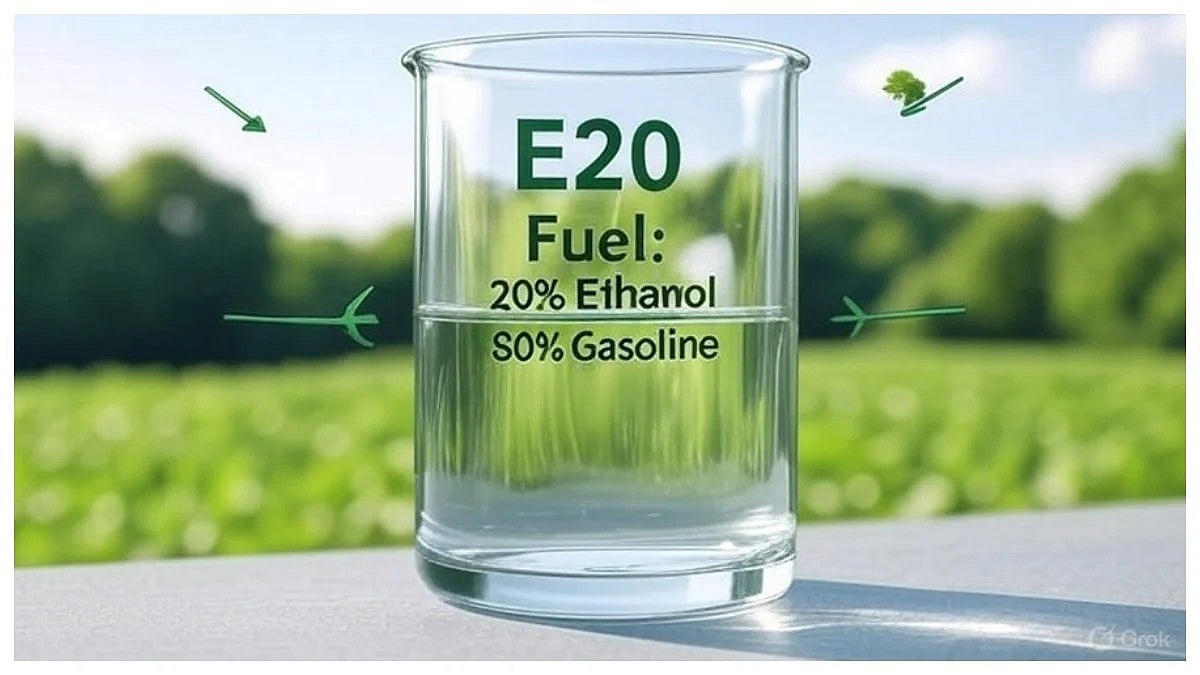
The Attorney General for India has rejected reports claiming that the Centre described its 20% ethanol-blended petrol (E20) programme as an “ongoing experiment” before the Supreme Court, calling such reports “completely false” and a misrepresentation of what was actually submitted in court.
In a clarification issued on June 30, the Office of the Attorney General said several media reports had incorrectly stated that Attorney General R Venkataramani told the Supreme Court that the E20 programme was still in an experimental phase and that its impact would become clearer next year. The office said no such submission was ever made and that the reports did not reflect “anything even close” to the actual arguments presented before the court.
Centre Calls Out ‘False Narrative’
The clarification was issued after reports suggested that the government had admitted before the Supreme Court that its ethanol blending policy was still being tested. The Attorney General’s office categorically denied this, stating that at no stage was the government’s Ethanol Blended Petrol (EBP) Programme or the E20 blending programme described as an “experiment”.
“It is clarified in explicit terms that any suggestion that the Government described the E20 programme before the Hon’ble Supreme Court as an ‘experiment’ is incorrect and does not represent the submissions made on behalf of the Union of India,” the statement said, Live Law and Bar & Bench report.
The clarification related to proceedings before the Supreme Court in a petition filed by Bharat Petroleum Corporation Limited (BPCL), which challenged a Karnataka High Court order directing oil marketing companies to reconsider ethanol allocations for the 2025-26 supply year.
According to the Attorney General's office, Venkataramani informed the court that similar petitions involving ethanol allocation to dedicated ethanol plants are pending before various High Courts. He said the Centre is filing transfer petitions so that all similar matters can be heard together by the Supreme Court, avoiding conflicting judgments and ensuring faster resolution.
The Attorney General also submitted that an early resolution of these cases is necessary to ensure uninterrupted ethanol supplies to oil marketing companies so that the government’s target of maintaining 20% ethanol blending in petrol throughout the year is not affected under the national Ethanol Blended Petrol Programme.
The office also urged media organisations to report judicial proceedings accurately, particularly when they involve important national policy initiatives.
Debate Over E20 Continues Despite Clarification
The clarification comes at a time when E20 fuel continues to generate debate among vehicle owners. Several social media users had questioned whether the government was pushing ethanol-blended petrol without fully understanding its long-term impact after reports claimed the programme was still an experiment.
The Centre also dismissed another claim circulating on social media that petrol pumps across India had installed warning hoardings advising customers against using E20 petrol. It said no such widespread advisories exist.
The government further stated that since the rollout of E20 petrol, there have been no widespread cases of engine failure or vehicle breakdown directly attributable to ethanol blending. It also maintained that E20 fuel supplied by oil marketing companies conforms to Bureau of Indian Standards (BIS) specifications, adding that ethanol and petrol are completely miscible and do not separate when blended according to prescribed standards.
At the same time, concerns among motorists have not entirely disappeared. Owners of vehicles manufactured before 2023 have alleged that higher ethanol blends can affect engines not designed for such fuel. Higher ethanol blends are considered suitable mainly for flex-fuel vehicles.
Another issue raised by vehicle owners is the drop in fuel efficiency. Many have argued that any savings from ethanol-blended petrol are offset by lower mileage, with some users even posting videos on social media claiming to “de-ethanolise” E20 fuel.
The Centre has removed excise duty on E20, E22, E27 and E30 fuels, describing the move as a preparatory step towards higher ethanol blends. However, it clarified that the tax changes do not mean these fuels will be rolled out immediately. According to the government, any future introduction of higher ethanol blends will take place only after extensive testing and consultation.
While the Attorney General’s clarification may have settled the controversy over what was or was not said in court, it has done little to end the larger public debate around ethanol-blended fuel. The government’s push towards cleaner fuel continues, but so do questions from consumers about vehicle compatibility, fuel efficiency and the pace of implementation.
