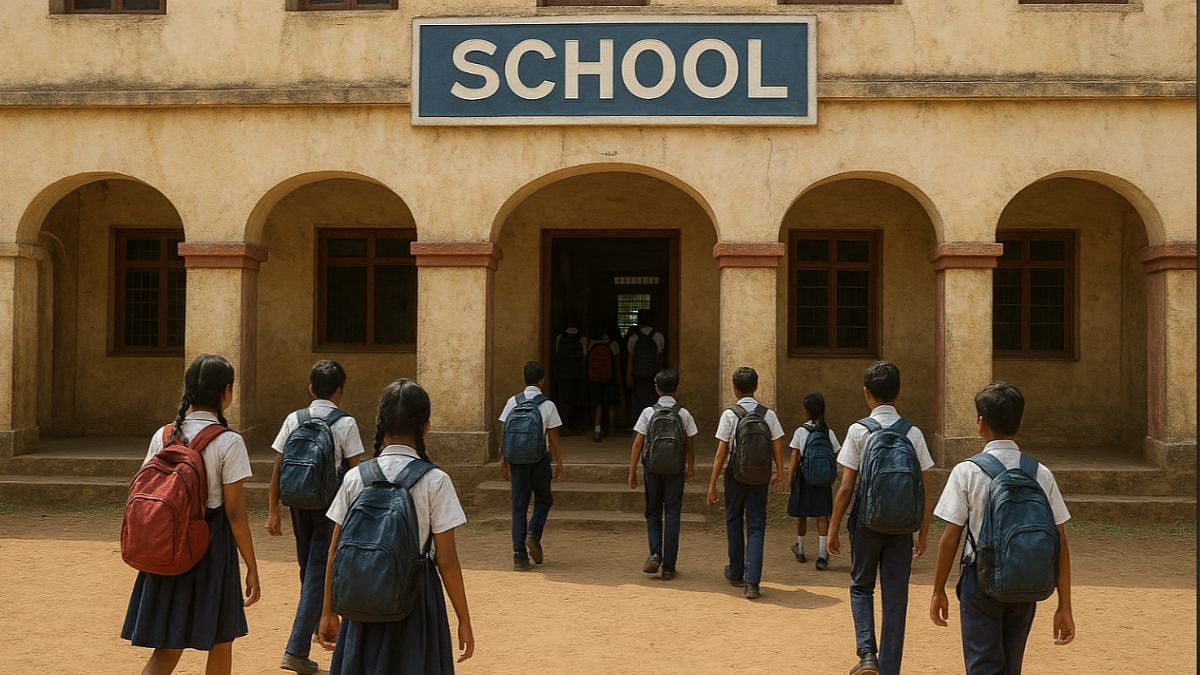
Bhopal (Madhya Pradesh): AI-powered classrooms, upgraded campuses, Excellence Schools and Sandipani Schools have become the flagship claims of the Madhya Pradesh government's education reforms, repeatedly highlighted by the Chief Minister, School Education Minister Rao Uday Pratap Singh and the School Education Department.
However, the UDISE+ 2025-26 report presents a starkly different picture. Thousands of students continue to study in single-teacher schools, only 22% of primary teachers are professionally trained and dropout rates remain high.
The report says 2,269 government schools are run by a single teacher, 6.02% of students drop out between Classes 6 and 8, and nearly 13% leave school between Classes 9 and 10. It also records a decline in the number of schools, from 1,22,120 in 2024-25 to 1,19,694 in 2025-26—a reduction of 2,426 schools in one year.
The findings also highlight gaps in infrastructure, digital education and inclusive learning facilities, raising questions over the pace and effectiveness of the state's education reforms.
2,269 schools run by a single teacher
Madhya Pradesh has 1,19,694 schools with 1.52 crore students and 7.29 lakh teachers. While the overall pupil-teacher ratio is 21:1, teacher distribution remains uneven. As many as 2,269 schools are run by a single teacher, affecting the education of 62,151 students.
The report also highlights a shortage of trained teachers. At the primary level, only 22% of teachers are professionally trained, raising concerns about the quality of foundational learning. The pupil-teacher ratio is 16:1 in primary schools, 13:1 in upper primary, 14:1 in secondary and 15:1 in higher secondary.
Dropout rates remain high
According to the report, 6.02% of students drop out between Classes 6 and 8, while nearly 13% leave school between Classes 9 and 10. Student participation also declines steadily at higher levels. The Gross Enrolment Ratio falls from 77 at the primary level to 75 at upper primary, 67 at secondary and 55 at higher secondary, indicating that many students do not continue beyond elementary education.
Basic infrastructure still missing
Despite repeated announcements on improving school infrastructure, thousands of government schools continue to lack basic facilities.
9,625 schools do not have electricity.
10,371 schools lack functional drinking water.
4,703 schools do not have handwashing facilities.
7,522 schools do not have functional girls' toilets.
Only 15% of schools have toilets accessible to Children With Special Needs (CWSN).
7,718 schools do not have playgrounds.
11,176 schools did not conduct medical check-ups during the previous academic year.
Digital classrooms still a distant dream
Despite the government's emphasis on technology-driven learning, most schools continue to lack the digital infrastructure needed for AI-enabled education.
Only 6,748 schools have functional computers for teaching and learning.
Nearly 90,000 schools do not have internet connectivity.
More than 11,000 schools do not have libraries or reading corners.