Bhopal (Madhya Pradesh): Thou shalt remain, in midst of other woe Than ours, a friend to man, to whom thou say’st, “Beauty is truth, truth beauty, —that is all Ye know on earth, and all ye need to know.”
Ode on a Grecian Urn, John Keats
The Shyamala Hills boulevard, whose both sides are lined up with lush green trees, is a home to quietude, though hundreds of vehicles pass through it round the clock.
One side of the thoroughfare is sloped to the ridge covered with hedges. Dark-green woods reduce the intensity of the noise caused by vehicles. Just above the road stands the state museum.
The upper verge of the wooded hillock forms a line over the crest. The building that houses the treasure-trove of the olden days looks like an arch against the endless blue.
The rustling noise of the dry leaves, beaten off the trees by a late-winter-afternoon breeze, ferrets out the tranquil past in the deafening present.
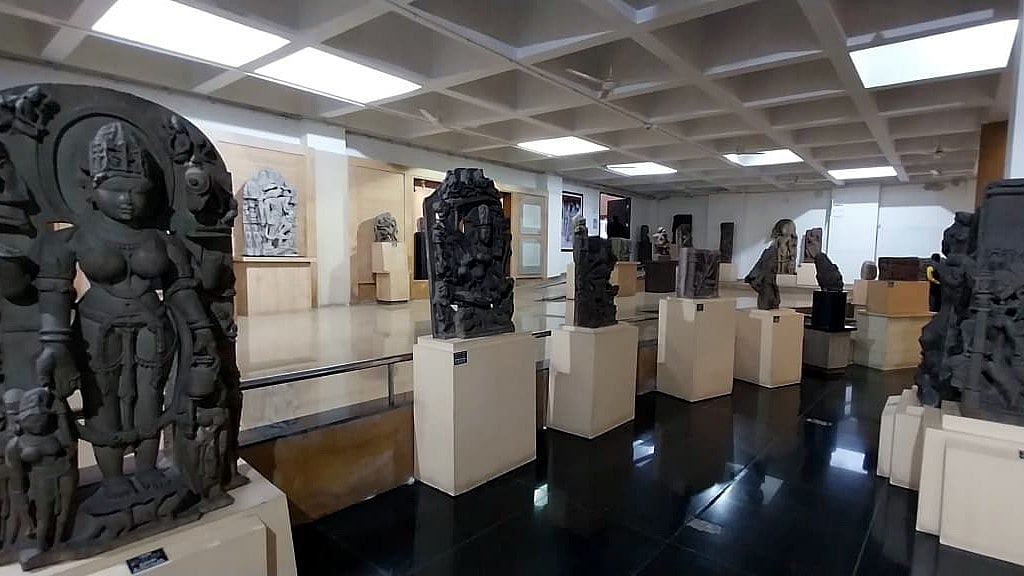
The main hall of the museum evokes a serene silence broken only by the hush of the unfathomable antiquity.
A few steps away from the door stands the five-headed Ganesha idol made of grey sandstone. The idol, belonging to the 11th century CE, is a masterpiece of artwork. It has been brought from the Mandsaur district in Madhya Pradesh.
A Kalash (pitcher) made of stone and kept near the main gate of the hall draws a visitor's attention, telling a flowery tale with rhythms.
It carries the well-honed touches of an unknown artisan whose mortal hands may have toiled round the clock to give it an immortal tone.
A ten-handed icon of Bhairav, with his eternal cohort, a dog or Sunakah in Sanskrit, wearing a skull garland and carrying an axe and a punch bowl, seems to be ready to bless the pure and scare the impure. The belt, or Mekhla, that the idol is shown wearing has small bells, which are so vivacious that they may ring any time, heralding the lord’s arrival.
The face of the idol contains a strange smile, indicating the universe is under his feet, and he is the lord.
There are some small idols around him with musical instruments and a statue of Betal. Perhaps, the lord wants to say, "Know thyself to get rid of this illusory world (maya)."
The statue of a loving couple, brought from Khajuraho, puts a visitor in a dilemma over whether to follow the path of renunciation as Bhairava shows or to remain in the world of illusion. The choice is the essence of Indian philosophy: be with all and be ready to leave all.
Just as a visitor is absorbed in deciphering the essence of Indian philosophy, detached engagement, he finds the statue of Skhalitvasana (a woman with dropping clothes). Each part of the statue is so pulsating that it seems she would speak with the slightest provocation.

The statue of Skandmata seems ready to bless a visitor with eternal bliss. It belongs to the 11th century CE. Then, who can be oblivious of the statue of Gauri waiting for her eternal lover, Shiva?
The ancient artisans also chiselled out the idols of Uma-Maheshwar, the eternal couple. In the statue, Uma has been shown sitting on the lap of the lord as if she were talking about the welfare of the mortal world. The lord’s face wears a mysterious smile. The artist may have had a sense of spiritualism to bring that beam on the face of a stone-made statue.
Another idol shows the birth of Krishna with Maa Yashoda breastfeeding him. Yashoda’s face wears eternal peace, but the baby Krishna’s eyes are as curious as one finds him in today’s calendars.
Then a visitor comes across the idols of Abhisarika (a woman who goes to meet her lover secretly at a prearranged time and place) and Nayika (heroine).
The eyes of both statues sport the look and smile of women who yearn for an intense touch. Then there is Anjana, the beautiful celestial nymph. Such statues may incline a visitor to think otherwise, but then, there are the idols of Buddha and Tirthankar in yogic postures to calm his restlessness. They are the foster-daughters of silence being attired in divine light and the purity of a dream.
Arup Chakraborty

