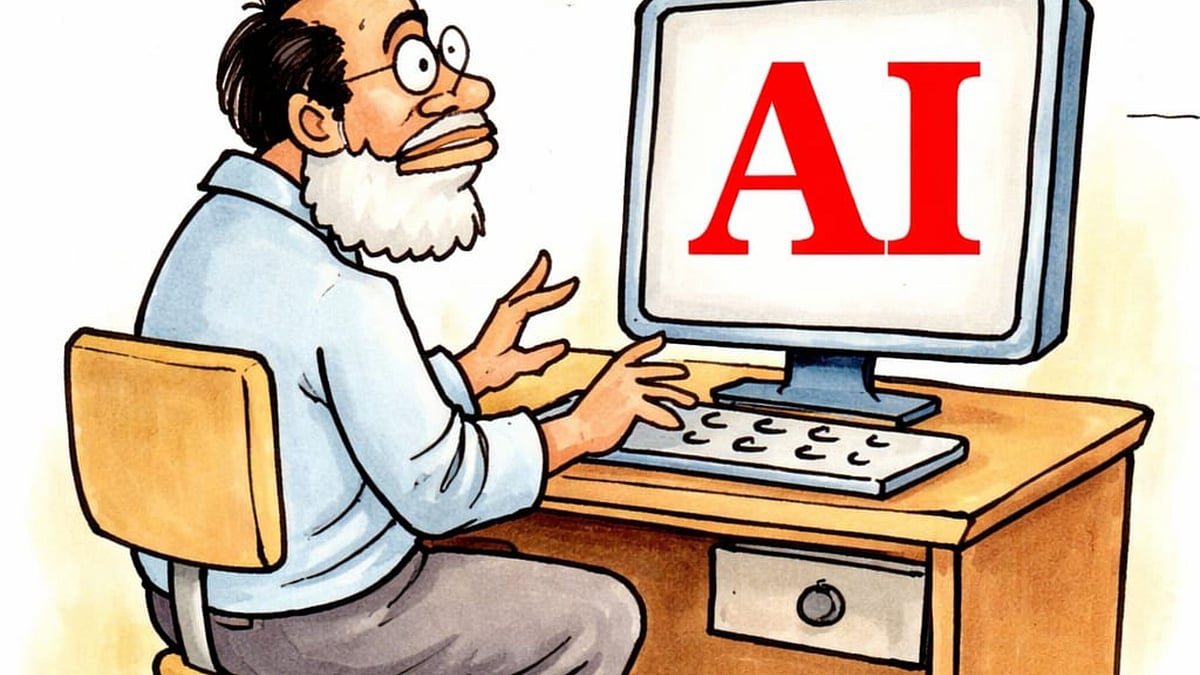
Bhopal (Madhya Pradesh): Writing in English is like throwing mud at a wall – Joseph Conard
An AI grammar checker is like a mire. People helplessly walk into it without knowing the danger. On the surface the system looks fine, but when it goes wrong, it is clueless, as the error is not obvious.
This is the reason why if a paragraph written by the authors like Graham Greene, George Orwell, Winston Churchill, Charles Dickens, or Salman Rushdie is put in the grammar checker, it shows red lines.
Does it mean that they did not know the English grammar? It simply makes a wiseman laugh. Depending on the grammar checker, if someone begins to correct the sentences of these authors whom millions of people across the world follow, they will undo great writings.
The changes suggested by the AI grammar look fine because they are concerned with clauses, words, and sentence structure. But do such changes match the thoughts of a writer? Does it match his style?
The AI grammar checker is based on probabilities and not on exact grammar rules. Let’s check the following sentence from Pride and Prejudice: “It is a truth universally acknowledged, that a single man in possession of a good fortune, must be in want of a wife.”
The AI grammar checker puts red marks on the commas after ‘acknowledged’ and after 'fortune'.
The grammar checker, which can neither think nor feel, discovers the commas used by Jean Austen are improbable. But these two commas have made this sentence memorable.
AI grammar often leads the thought process of an author to futility. Great writing requires the human mind.
AI grammar checkers say, “They often fail to meet expectations because they are statistical and predictive models rather than true understanders of language.”
Although they sometimes ferret out nearly 90% of common errors, they struggle with the tone and context of a story.
An example will justify why AI grammar is improbable and mechanical. AI finds errors in the following oft-quoted sentence from A Tale of Two Cities: “It was the best of times, it was the worst of times, it was the age of wisdom, it was the age of foolishness, it was the epoch of belief, it was the epoch of incredulity, it was the season of Light, it was the season of Darkness, it was the spring of hope, it was the winter of despair, we had everything before us, we had nothing before us, we were all going direct to Heaven, we were all going direct the other way—in short, the period was so far like the present period, that some of its noisiest authorities insisted on its being received, for good or for evil, in the superlative degree of comparison only.”
The grammar checkers point out mistakes in four sentences. QuillBot's grammar is funnier than others. It gives Charles Dickens, the author of A Tale of Two Cities from where the quotation has been culled, only 16 out of 100 for fluency and 39 out of 100 for clarity. Those who love AI grammar checkers may not agree with Dickens, who was gifted with emotional intelligence.
Similarly, AI fails to understand good expressions and idioms containing irony, puns, and sarcasm and often suggests corrections.
It also toils to grasp specialised jargon and colloquialisms, often designating them wrongly. This is why AI treats the natural flow of language as rigid grammar rules.
A recent study says nearly 15% of corrections suggested by AI are barely necessary and style oriented.
It is clear when the grammar checkers give the following sentence from Salman Rushdie’s Quichotte: 97% for grammar, 45% for fluency, 47% for clarity, and 98% for engagement.
“There once lived, at a series of temporary addresses across the United States of America, a travelling man of Indian origin, advancing years and retreating mental powers, who, on account of his love for mindless television, had spent….”
Using AI grammar properly necessitates sound knowledge of the English language, or else, the users are in the burrow of a badger. Ergo, let’s use it with caution.
Arup Chakraborty