Bhopal (Madhya Pradesh): The single biggest problem in communication is the illusion that it has taken place — George Bernard Shaw
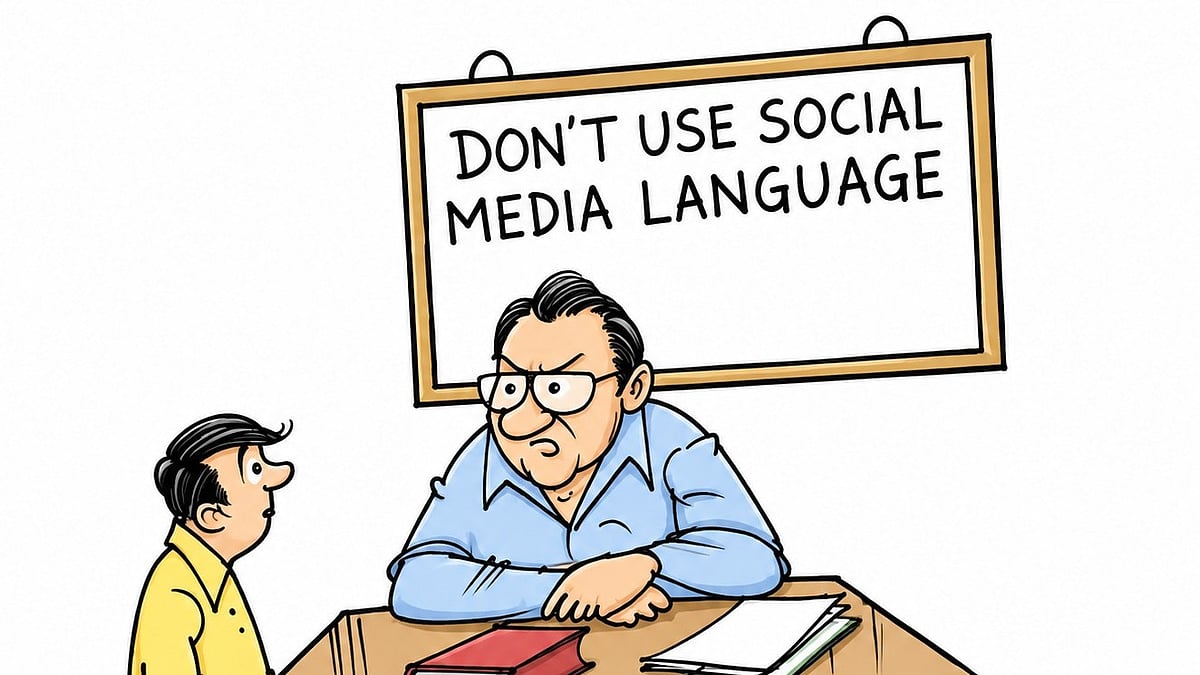
Social media has changed our language. But if parents and teachers of previous generations heard or saw such language, they would create a hue and cry. Similarly, such language would have shocked the editors of English newspapers, too. For example, people of previous generations used ‘lit’ as a shorter form of the word 'literature' or as the past form of 'light'. But on social media, the word means ‘cool’ or 'exciting'. When social media users write, "The party was lit," they mean it remained cool or exciting.
With the advent of the Internet, particularly during the rise of ‘hip’, ‘hop’ and ‘rap’ culture, the meaning of ‘lit’ also changed. It signified excitement and energy. The songs of hip-hop artists, like Travis Scott and A$AP Rocky, featured the expression.
Social media users write 'appear for an examination' or ‘write an examination’. The English language does not permit either. Instead, one takes, sits, and does an examination, says The Shorter Oxford English Dictionary (volume I).
The English dictionaries have already accepted Indian words, ‘Jai Ho’, ‘guru’, and ‘dekko’. But except for ‘guru’, the standard English newspapers have discarded the other expression.
True, language changes its course like a river, but one cannot afford to endure ‘praught’ as the past form of ‘preach’. On social media, trying to correct such wrong English, means an invitation to abuses. The users of ‘praught’ may even call the corrector a ‘language cop’ or 'illiterate'.
But a language cop just does his duty. The social media users’ vocabulary consists of words like ‘low-key’, ‘goated’, and ‘crash out’. These terms kick around online, in classrooms, or in offices. Most of the words come from African American Vernacular English (AAVE). The acronym GOAT, according to the Internet dictionary, stands for ‘Greatest of All Time'. It signifies outstanding, excellent, or the best of all. Rapper LL Cool J used the phrase in his album, GOAT.
The term 'TED Talk' may startle many people, belonging to earlier generations, but it signifies a strong public presentation of 18 minutes.
Another expression, ‘ate and left no crumbs', signifying an excellent performance, remains popular on social media.
Then they have an expression like ‘aura points’ to talk about someone’s charisma. On the contrary, ‘aura farming’ signifies someone going out of their way to show their coolness and confidence.
Another term, 'rage bait', or 'rage-bait', or 'ragebait', gained traction and remained the word of the last year in the Oxford English Dictionary. The word means deliberately crafted views, likes, comments, and shares, which whip up passion and outrage.
Then one cannot afford to set aside the expression ‘Rizz’, the short form of charisma, referring to someone’s ability to attract, charm, or flirt. It also functions as a verb: ‘Richard rizzed up Lucy.’
The term went viral on social media in 2023 when the Oxford English Dictionary included it as ‘word of the year'.
For social media users, ‘rizz’ often refers to the ability to connect confidently or to express oneself with ease in digital and real-world conversations. They also use the term 'crash out' to signify the impulsive conduct without fear or risks.
Today, the people, belonging to earlier generations, may frown upon the terms, like 'trashposting' and ‘shitposting’, but such expressions may soon crop up in the answer books of the coming generation.
However much one hates the social media language or laughs at it, one will hardly cotton on to the realities of the modern world until one understands it.
Still, it is necessary to keep in mind that written language should be as pure as the fragrance of a rose but free from rigid grammar rules.


