Bhopal (Madhya Pradesh): Unfortunately, unlike Greece, Rome or China, ancient India has no history, because the Indians of antiquity did not care to leave written accounts of all their achievements – DC Sircar, Indian Epigraphy
Finding an answer to how our ancestors living in Bhopal and its nearby areas would write the diary of their daily lives and which language they used is an arduous task. The answer, even if found, will be cryptic. However difficult it may be, a visit to the state museum may provide us with some clues.
The primary script our ancestors, especially during the Mauryan era (from 300 BCE to 100 BCE), used in Bhopal and its adjoining areas to scribble the documents was Brahmi, and the language was a blend of Sanskrit and Prakrit. They may also have used Sankh Lipi (shell script), prevalent in different parts of MP in the days of yore.
But the written documents, found in India, are not enough to tell the tales of her antiquity and the daily life of her people, as we start finding such evidence from the Buddha and the Mauryan periods.
Furthermore, the Vedas, around which swivel Indian culture and traditions, are not the written documents, which sages orally transmitted from generation to generation. The Ramayana and the Mahabharata, too, resulted from oral traditions (Smriti) and became written documents in later periods.
The tools used by early men, paintings, remains of temples, shelters, and coins are available to script the saga of the state’s connections with antiquity, but the written documents about early men are absent.
In History of India Elphinstone observed: “No date of a public event can be fixed before the invasion of Alexander and no connected relation of the national transactions can be attempted until up to the Muhammadan conquest.”
An answer to Elphinstone’s observation is available in Indian Philosophy (Volume I) by Sarvepalli Radhakrishnan: “It is the intense spirituality of India, and not any great political structure or social organisation that it has developed, that has enabled it to resist the ravages of time and the accidents of history.”
This is the fact that in search of spirituality, our ancestors left an idea of the world, which is eternal, and it does not require any written evidence.
The Brahmi script of the Mauryan period found in Sanchi throws light on the way the people of that era wrote the documents of their daily lives.
Gradually, the Mauryan script, which almost faded by 185 BCE, flowered into the Gupta script between 400 CE and 500 CE.
The poet-playwright Kalidas, who flourished around this period, composed his belle-letters, which in modern language also mean literary works, in classical Sanskrit, using the Brahmi-derived Gupta script. But the historical evidence is not available about the script Kalidas used to compose his classical works, so the scholars can arrive at a conclusion only on assumptions.
Kalidasa, however, used classical Sanskrit and the language of the masses, Prakrit, to delineate his royal and daily-life characters in his plays, but the Mauryan and Gupta dynasties, especially Ashoka, will remain the father of the Indian scripts until historians decode the language of the Indus Valley Civilisation.
Ashoka told his tales in his own words and inscribed them in imperishable characters on some permanent appliances of nature, but they have gradually come to light, and many such scripts, available in the state museum, indicate how ancient scripts have evolved into modern Indian letters.
Historians found a strange inscription engraved on a rectangular stone in the Udayesvara temple in Udaypur, Vidisha, Madhya Pradesh. The letters are in Sanskrit and feature a serpent-knotted body with grammatical endings of nouns and verbs.
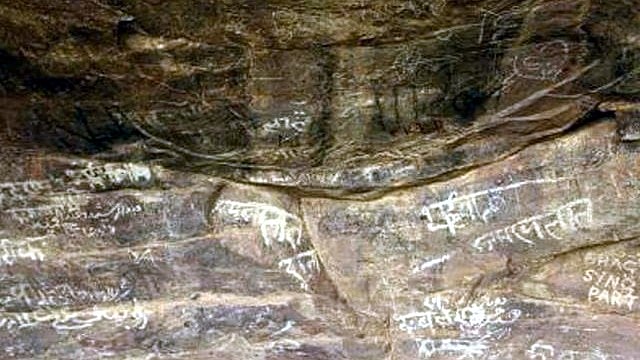
The script consists of five lines on one side of the stone, which refers to a diagram as 'varnnanagakrpanika' (a serpentine scimitar of letters). Another strange script found in MP is Sankh Lipi (shell script), which was prevalent during the Gupta period and post-Gupta period. Historians discovered the 1,500-year-old Sankh Lipi in the rock shelters of Manua Bhan ki Tekri (Bhopal), which visitors have damaged over the years.
But one finds such scripts in secluded and forested areas of Madhya Pradesh, which were the centres of population in the days of yore, but now, these locations are far from the madding crowd. The state museum houses innumerable scripts of different periods.
Arup Chakraborty


