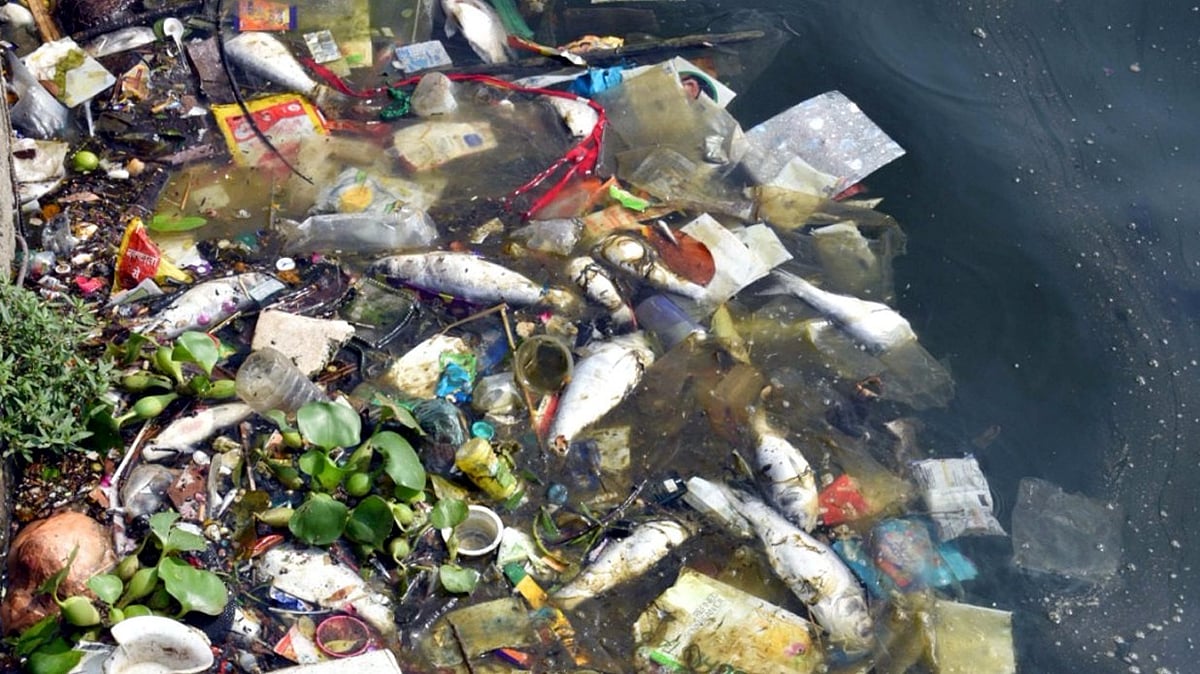
Bhopal (Madhya Pradesh): A massive fish die-off has raised questions over the Bhopal Municipal Corporation's (BMC) Lake Conservation Cell, with more than 5 lakh fish reported dead across Bhopal's water bodies in the last 48 hours.
While experts said the fish died due to sewage dumping, the corporation cited it as a natural phenomenon caused by a sudden change in temperature.
The worst-hit is the Lower Lake (Chhota Talab), where lakhs of dead fish have accumulated along the banks, spreading a foul stench and prompting an emergency response from civic authorities.
The Bhopal Municipal Corporation (BMC) began a clean-up drive on Monday to remove the carcasses, while the Madhya Pradesh Pollution Control Board (MPPCB) initiated an investigation into the cause of the incident.
Water samples will be collected to assess dissolved oxygen (DO) levels, sewage contamination and other chemical parameters.
The MPPCB said annual monitoring of the city's water bodies includes measuring Biological Oxygen Demand (BOD) and other indicators affecting aquatic ecosystems.
The exact cause of the fish deaths will be confirmed after laboratory analysis of the collected water samples.
Oxygen depletion under scanner
According to officials from the Bhopal Municipal Corporation's Lake Conservation Cell, preliminary findings suggest a sudden drop in dissolved oxygen levels may have caused the mass fish deaths.
However, authorities are also investigating whether sewage inflow and pollution have made the lake water toxic.
Experts cite monsoon 'turnover' effect
Speaking with Free Press, senior scientist Sunil Kumar Meena of the Central Pollution Control Board said fish deaths after heavy rainfall often occur due to 'pond turnover', a phenomenon in which cooler rainwater mixes oxygen-deficient bottom water with surface water.
Rainwater runoff carrying organic waste and pollutants can also trigger bacterial growth that rapidly consumes dissolved oxygen, leaving aquatic life unable to survive.
Official statement
Superintendent engineer of BMC's Lake Cell Santosh Gupta denied sewage dumping and said that while oxygen depletion is common during extreme summer heat, such a large-scale fish kill during the monsoon is unusual. A similar incident was reported in the Lower Lake nearly seven years ago.