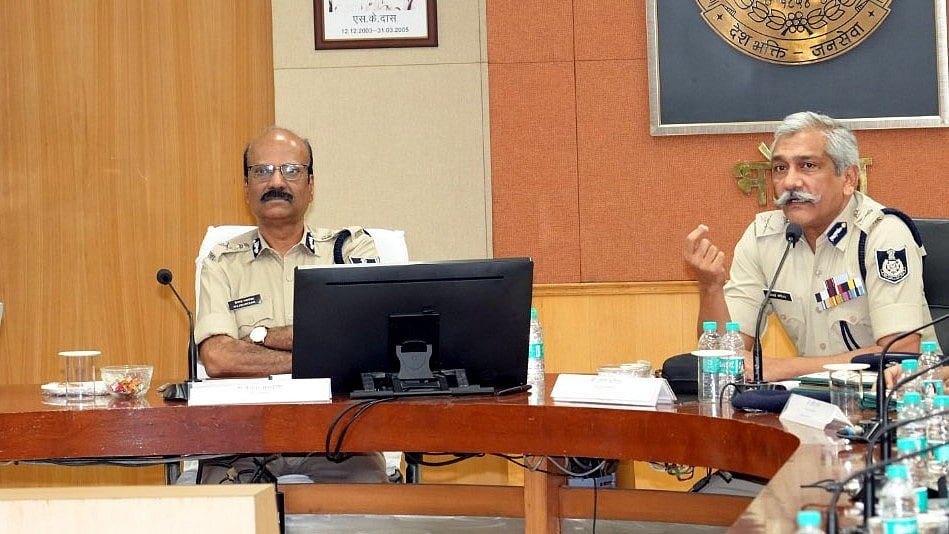
Bhopal (Madhya Pradesh): The two-day quarterly review meeting of Zonal Additional Directors General of Police/Inspectors General of Police and Special Armed Force (SAF) Zones held at the Police Headquarters ended on Sunday.
DGP Kailash Makwana issued directives aimed at ensuring better policing, administrative efficiency and accountability across the state.
Issuing the directives at the meeting, Makwana said a 15-day campaign against the drug menace, Nashe Se Doori Hai Zaroori 2.0, would begin on July 15 and end on July 31.
He asked officials to resolve cases regarding officials and personnel designated for officiating charge of higher posts in a time-bound manner and responsibilities assigned.
This will accelerate administrative work and boost the morale of the personnel.
The e-Office
Placing special emphasis on 100% implementation of the e-Office system within the police department, DGP directed that office operations be conducted digitally to the maximum extent possible.
He also instructed that the process of relieving transferred officers and personnel with immediate effect be completed within the prescribed time limits.
CCTV network, Safeguard scheme, resource management
The DGP directed that all CCTV cameras installed across the state remain operational at all times and that their regular monitoring be ensured.
He stated that telecom and police station CCTV schemes should be effectively utilised for crime control and the identification of criminals.
Priority should be given to expanding the CCTV network in the newly formed districts of Maihar, Mauganj, and Pandhurna.
Under the Safeguard scheme, a network of approximately one lakh Artificial Intelligence (AI)-based cameras should be deployed for use in various areas, including law and order, women's safety, traffic management, and crime control.
Emphasising the proper and scientific management of available human resources, the DGP directed a review of postings at the Constable and Head Constable levels and the reallocation of resources based on requirements.
He directed all districts to ensure the systematic, district-wise management of police land and assets, the construction of boundary walls to secure police land, and the implementation of tree plantation drives.
Monthly meeting
The DGP directed that SP in every district should hold monthly meetings with the Civil Surgeon to ensure the prompt resolution of health-related issues concerning police personnel and their families.
A nodal officer should be appointed for this purpose and MoUs should be signed with designated hospitals to streamline and expedite the processes of treatment and hospitalisation.
Goal: Drug-Free Madhya Pradesh in 3 years
DGP Makwana said that as the state had become free from the Naxal problem, the next goal was to achieve a Drug-Free Madhya Pradesh in the next three years.
This campaign will be conducted in alignment with the priorities of the Central Government, the Union Home Minister, and the Chief Minister.