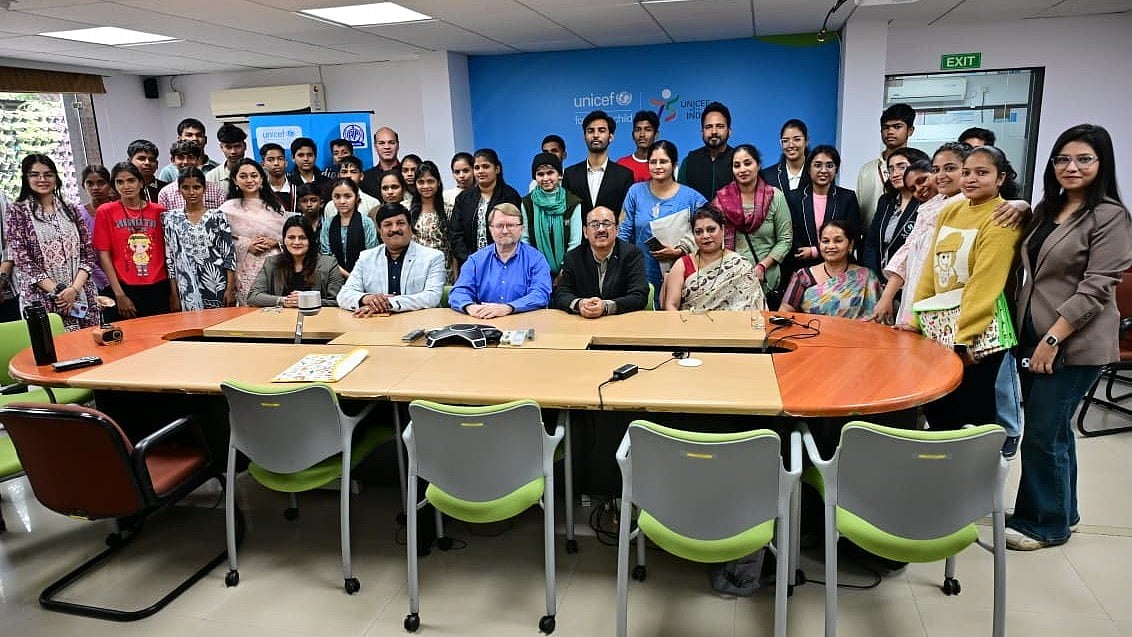
Bhopal (Madhya Pradesh): UNICEF Madhya Pradesh, in collaboration with All India Radio (AIR), celebrated World Radio Day 2026 on 11 February under the global theme “AI & Radio: Voice of Children.” Students, AIR presenters, media professionals, and communication experts participated in a dialogue on the relevance of radio in the age of Artificial Intelligence.
The audience included children from Bhopal, Dhar, and Jhabua, along with radio professionals from All India Radio, Bhopal, and RJs of Lakecity Live, Jagran LakeCity University. The event was a precursor to the upcoming World Radio Day on February 13.
William Hanlon, Chief of Field Office, UNICEF Madhya Pradesh, highlighted radio’s enduring role in promoting child rights in Madhya Pradesh. He noted how “Radio has stood by communities during disasters and public health crises as a trusted and accessible source of information,” adding that while AI is evolving rapidly, responsible communication still depends on human judgment and accountability.
Programme Director, AIR Bhopal, Rajesh Bhatt reflected on AIR’s nearly 90-year legacy. Despite competition from print, television, social media, and now AI, radio has continued to evolve. “Each challenge has become an opportunity for us to innovate,” he said, emphasizing continuity, ethical responsibility, and reliability as radio’s defining strengths.

UNICEF MP’s Communication Specialist, Anil Gulati, said that radio is the theatre of the mind and is a trustworthy medium of communication. He said that they saw the positive role of radio during the COVID-19 pandemic. “Even during this digital age, radio has continued to adapt its forms while retaining its essence.” UNICEF and All India Radio have worked together on many areas of child rights, like promoting breastfeeding, immunization, the use of ORS, and practices for child health.
Experts like Nidhi Kaushik, podcaster, radio anchors of All India Radio like Shikha, Juhi Rao, Pehal, Sadhna Jain, RJs of Radio Lakecity Live, the radio station of Jagran LakeCity, and youth agreed that although AI can support scripting and production, it cannot replace the emotional depth, credibility, and human connection of radio broadcasting.

Students raised questions on AI-generated misinformation and the relevance of radio in the era of podcasts and streaming platforms. Speakers emphasized that AI outputs depend on source data and lack the editorial diligence exercised by trained presenters. Participants also noted that radio promotes imagination, balanced news consumption, language development, and listening skills. The event concluded with a clear message: while technology continues to evolve, the trust, ethics, and human connection embedded in radio remain irreplaceable.

