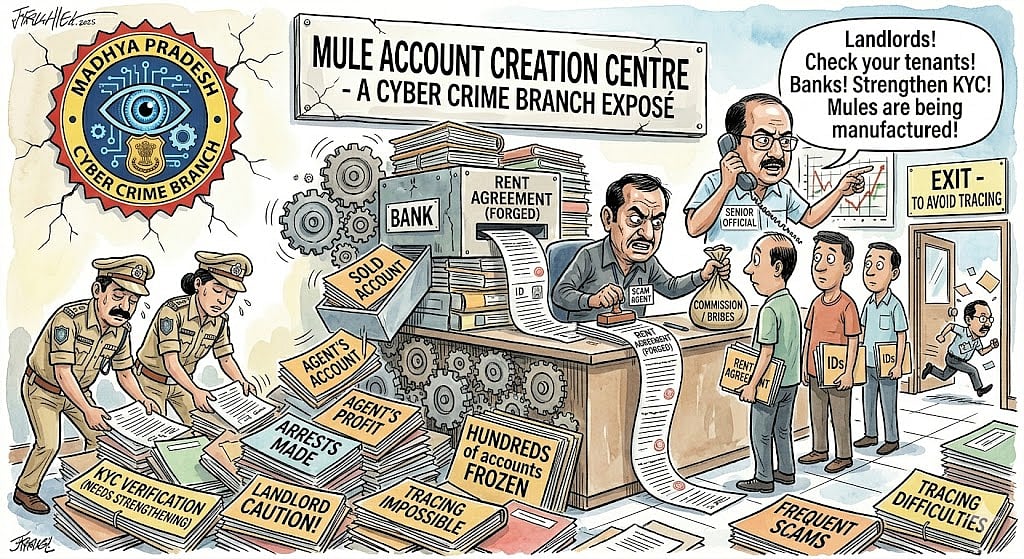
Bhopal (Madhya Pradesh): A major modus operandi of cyber fraud networks has come to light during investigations by the Cyber Crime Branch, revealing that fraudsters are using rent agreements to open mule bank accounts later used in scams.
According to cyber crime officials, agents linked to fraud syndicates deliberately rent accommodations in cities like Bhopal and other parts of Madhya Pradesh. They often use forged identity documents, including fake Aadhaar cards, to secure homes. Once the rental agreement is prepared, it is used as a valid address proof to open bank accounts.
These accounts, commonly referred to as “mule accounts”, are then either sold to cyber fraudsters or operated on a commission basis to facilitate illegal transactions. Investigators found that these agents are well-versed in banking loopholes and frequently manage to bypass standard verification processes. The Cyber Crime Branch has been running a crackdown over the past few years against such accounts. Hundreds of mule bank accounts have been identified and frozen, and several agents involved in the racket have been arrested.
Additional DCP Shailendra Singh Chauhan stated that in the last two years, a focused drive led to the closure of numerous mule accounts. He also highlighted that in several cases, lapses on the part of banks—particularly inadequate ground verification—have contributed to the problem.
Officials have now directed banks to tighten their verification systems to prevent fraudsters from exploiting gaps. Chauhan emphasised the need for stricter KYC checks and physical verification of addresses to curb the misuse of the banking system. He added that landlords should also be cautious while issuing such agreements.

Agents leave city after opening accounts Once an account is opened, the agents leave the city, making it difficult to trace them even if the account is identified. Cyber Crime officials said that in many instances, police reached the addresses mentioned in bank records, but the holder was not found. In some cases, tenants had left the premises years ago, but the mule account remained functional.
