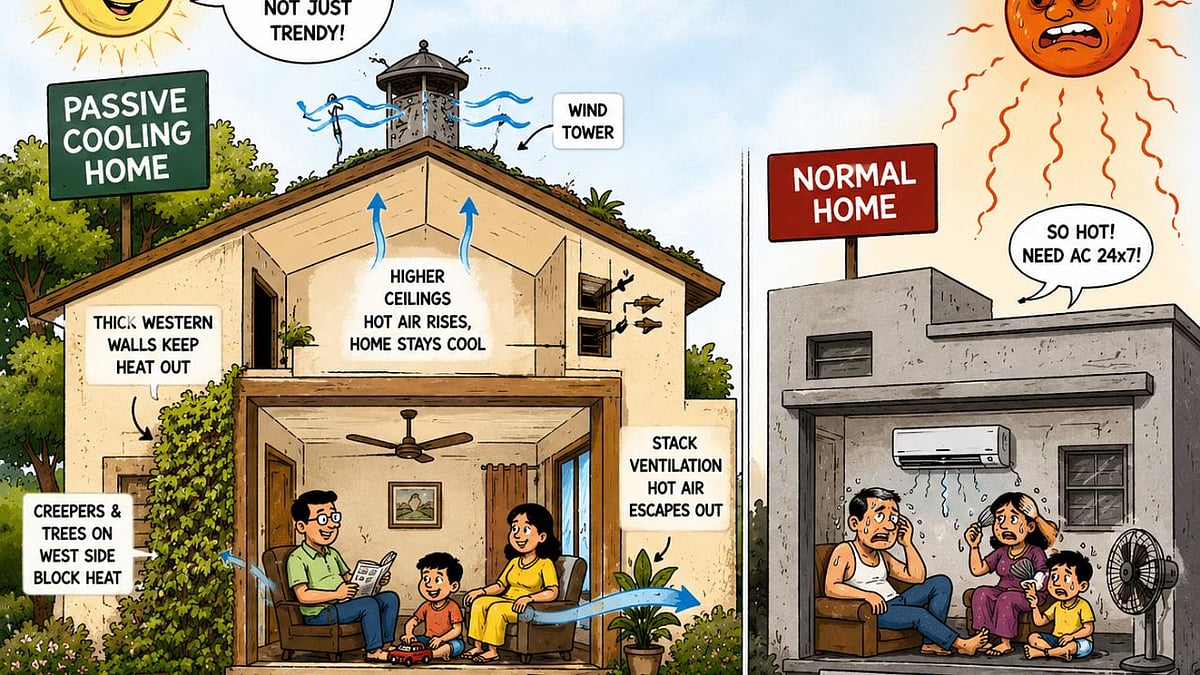
Bhopal (Madhya Pradesh): With summer season getting hotter every year, about 50% of city residents are opting for passive cooling in their houses. Passive cooling involves changes in the design and architecture of houses that help keep them naturally cool.
Passive cooling not only keeps houses cool and comfortable even when outdoor temperatures are high, but also reduces the need for air conditioners and water coolers, saving the one-time investment on such cooling devices. Power bills also decline by 25% to 40%.
“People are going for passive cooling in a big way. At least 50% people are opting for it, if not completely, at least partially,” architect Sandhya Jain said.
In houses designed for passive cooling, the living area, the part of the house where residents spend most of the day, is located in the north or north-east direction. The southern and western walls are made one-and-a-half to two times thicker than normal. These barrier walls keep heat away. Planting creepers or trees close to west-facing walls is another component of the design of such houses.
According to associate professor of architecture and planning, MANIT, Supriya Vyas, planting fast-growing plants like bamboo is one option people are increasingly adopting. “Passive cooling houses are not only good for the people living in them but also for environment,” she said.
The ceilings in houses designed for passive cooling are higher so that hot air rises above the dwelling area, keeping it cool. Stack ventilation is also used in such homes. It involves providing grilled openings high up on the walls close to the ceiling, allowing hot air to escape.
Walls are plastered with clay tiles to keep heat away and arrangements are made for cross ventilation. Evaporative cooling and wind towers are also used. The temperature in houses designed for passive cooling remains about four to five degrees lower than normal houses. “The cost of houses designed for passive cooling is about 1.5 times higher than normal houses. But the extra investment is recovered within 10 years because of lower energy bills,” Jain added.