Bhopal (Madhya Pradesh): A combination of micro-level academic tracking, targeted remedial teaching and direct monitoring by collectors has led to an improvement in board results across several districts of Madhya Pradesh this year.
Officials attribute this rise to a multi-layered strategy driven by collectors, district education officers (DEOs) and school-level staff, focusing on continuous assessment and strict monitoring. The strategy focused on identifying weak students early, providing targeted support and tracking progress.
The Directorate of Public Instruction (DPI) also played a vital role. HN Nema, deputy director of the DPI, told Free Press that students were divided into five categories - A, B, C, D and E -with special emphasis on those in categories D and E, particularly in Class 10. “The assessment cell of the DPI organised quarterly workshops for teachers, improving classroom strategies and evaluation methods,” Nema said.
Anuppur: Name-wise tracking
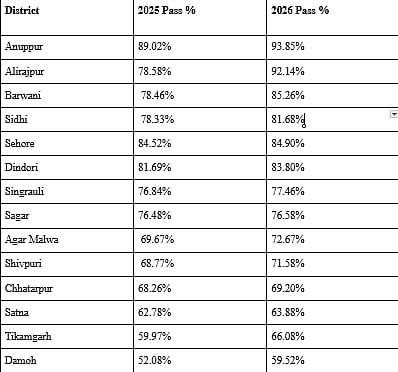
In Anuppur, where the pass percentage of high school rose from 89.02% in 2025 to 93.85% in 2026, authorities focused on student-wise performance analysis after every test. Here, under the Collector’s direction, special focus was given on D and E category students. A name-wise tracking system was created, model teachers were assigned, and study material along with past three years’ question papers was used for focused preparation. DEO, Tularam Armo said that Collector and DEO ensured regular follow-ups through video calls, especially in remote areas. Additionally, officials conducted a special examination mid-session under the Collector’s supervision to assess progress.
The findings were used to redesign teaching strategies, while nodal teachers ensured attendance of students from rural areas.
Alirajpur: Highest turnaround
The highest turnaround was recorded in Alirajpur, where results improved from 78.58% to 92.14%, a jump of 13.56%. Teachers identified how many questions each student attempted and where they struggled, following which objective-type one-liner questions were introduced to strengthen concept retention.
Students falling in weaker categories were given extra classes both online and offline, along with repeated testing and feedback.
Barwani: Quarterly teacher workshops
Similarly, Barwani saw its results climb from 78.46% to 85.26%, driven by quarterly teacher workshops organised by the assessment cell and continuous monitoring by district authorities. Students who showed minimal improvement after initial remedial classes were re-analysed and given customised guidance, ensuring no one was left behind.
Damoh: Remedial classes
In Damoh, which recorded a sharp rise from 52.08% to 59.52% remedial classes along with solving previous year question paper was done to improve the result.
Tikamgarh : Focus on pre-board exams
A similar approach was adopted in Tikamgarh, where results improved from 59.97% to 66.08% with a strong emphasis on pre-board exams, comparative analysis, and repeated interventions for weaker students.

