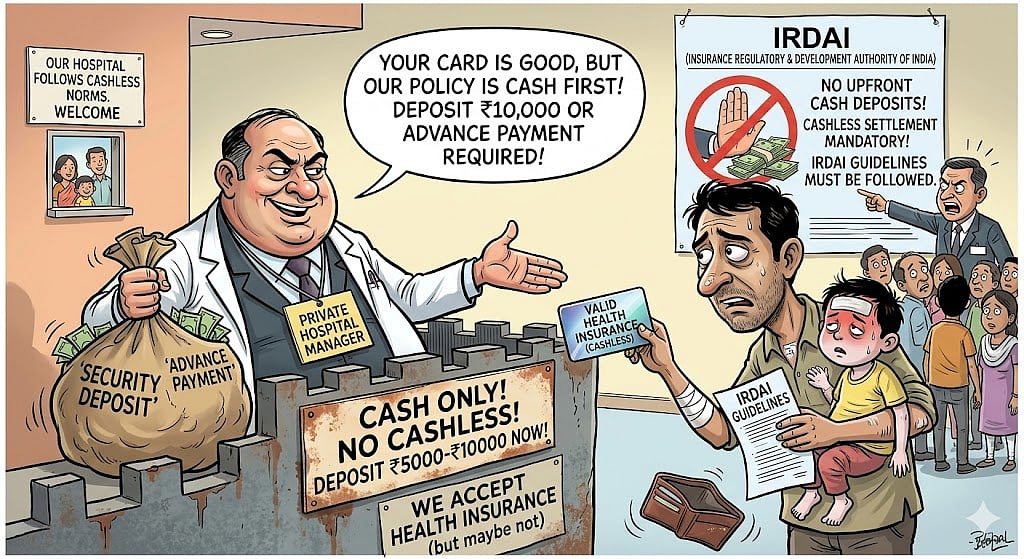
Bhopal (Madhya Pradesh): Cashless treatment, designed to alleviate the financial burden on patients during hospitalisation, is under scrutiny as several private hospitals are allegedly demanding large upfront payments.
Under the cashless health insurance system, eligible patients are not required to pay for covered treatment at the time of admission. The hospital is required to coordinate directly with the insurance company or Third Party Administrator (TPA) for claim settlement.
The process mandates that the hospital send the patient’s medical reports, diagnosis and estimated expenses to the insurer for pre-authorisation. Once approved, treatment proceeds. After discharge, a final or post-authorisation is issued based on the actual bill, and the insurer settles the admissible amount directly with the hospital. Patients are only expected to bear non-admissible expenses.
When contacted, officials from Tata AIG General Insurance Company Limited said that under the cashless policy, patients are not required to deposit any money before treatment. They added that if hospitals demand payment, patients should ask them to send the pre-enhancement letter to the registered insurance company.
However, this mechanism appears to be faltering on the ground. To verify the situation, The Free Press visited multiple private hospitals posing as patients. It was found that most hospitals demanded a security deposit, while some went further, asking for full payment of the remaining estimated cost immediately after pre-authorisation.
Deposit compulsory at SMH
At the Sagar Multispeciality Hospital (SMH) TPA counter, staff demanded a mandatory Rs 5,000 security deposit for a fully cashless Tata AIG policy. Despite confirming the policy’s nature, officials insisted the payment was compulsory for admission, promising a refund only after post-authorisation. “This is our hospital policy. If you don’t want to pay, you can go to another hospital,” the staff said, flouting standard cashless norms.
No surgery sans advance at ASG Eye Hosp
During an inquiry for cataract surgery at ASG Eye Hospital, the TPA desk demanded Rs 10,000 while scheduling the procedure. Staff stated any remaining estimated cost must be paid upfront after pre-authorisation. Despite promising later refunds, officials clarified treatment would not proceed without this advance payment, even suggesting cheques if cash was unavailable.
Security deposit a must at Saklecha Hospital
At BHRC Saklecha Hospital, Vedant Gupta stated that while emergency accident victims are stabilised, others must pay a security deposit despite being eligible for cashless treatment.
Gupta added that the hospital mandates this deposit unless the patient is personally known to the facility. If attendants are present, the hospital routinely inquires about insurance and demands upfront payment.
Only Apollo Sage follows cashless norms
Among the private facilities surveyed, Apollo Sage Hospital was the only one that did not demand any upfront payment. TPA officials stated that if a policy is fully cashless, no advance is required. They clarified that patients are only required to sign a consent form before surgery, agreeing to bear any non-admissible expenses identified after post-authorisation.

Security deposits flout IRDAI norms: IMF official
Mahesh Omrey, an official of the Insurance Managers Federation (IMF), which is registered under the Insurance Regulatory and Development Authority of India (IRDAI), stated that under a fully cashless policy, patients are not required to make any payment towards treatment covered by insurance.
“Even asking for a security deposit is not in line with norms if the policy is completely cashless without caps,” Omrey said, adding that while terms vary across policies, fully cashless coverage should not involve upfront payments.

