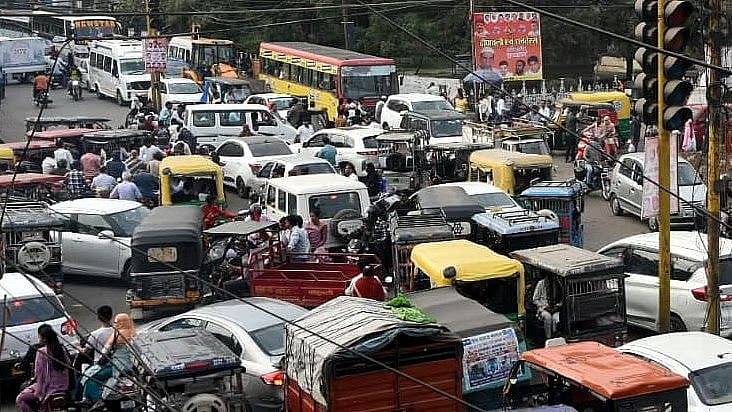
Bhopal (Madhya Pradesh): Forty-seven out of 69 city’s road intersections recorded Leq values exceeding the applicable ambient noise standard and 22 out of 69 intersections recorded Leq values within the applicable ambient noise standard in Bhopal.
The applicable standard is 65 dB for commercial and mixed areas, while for residential areas, it is 55 dB.
The comparative assessment of 69 monitored intersections included the nature of activity, public announcement (PA) system status, applicable standard, monitoring results and status of noise levels monitored with reference to the noise standards.
As per the report, 25 out of 47 are in commercial areas, while five are in residential areas and the remaining are mixed in nature. Five residential areas, Chinar City Chouraha, Trilanga, UCIL, Titli (Arjun Nagar) and KoheFiza Ahemdabad Palace Tiraha, recorded Leq values above the applicable limit.
The recorded noise levels at locations with and without operation of the PA system were broadly comparable, indicating that vehicular movement and other surrounding activities were also significant contributors to the ambient noise levels.
The sound level measured at the edge or boundary of the public space cannot surpass the local ambient standard by more than 10 dB(A), with an absolute ceiling of 75 dB(A).
Advocate Harshvardhan Tiwari said, “MPPCB has submitted its report to NGT with categories of residential, commercial and mixed areas, but it has not mentioned noise level at Silence Zone.
Areas within a radius of at least 100 meters around hospitals, educational institutions (schools and colleges) and courts are supposed to be silence zones.”