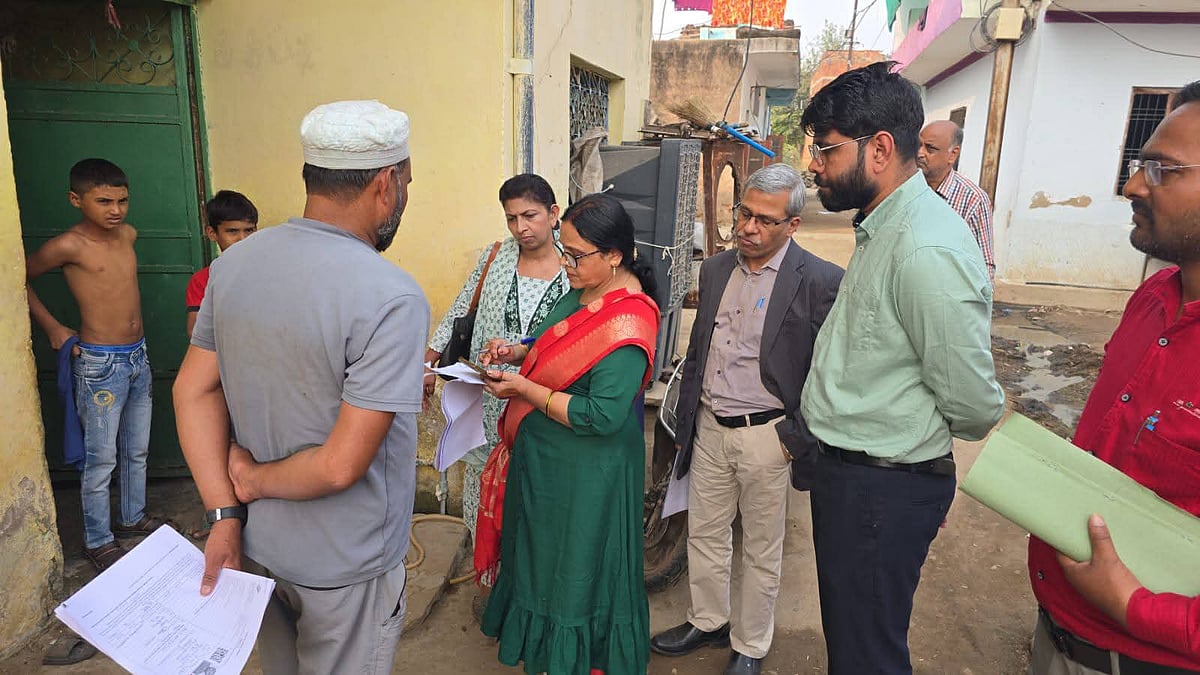
Bhopal (Madhya Pradesh): A pilot digital Census was recently conducted in Gwalior as part of the centre's first technology-driven enumeration exercise, with similar trials held in Ratlam and Seoni ahead of Census 2027.
The trial, conducted during the house-listing phase, tested the shift from traditional paper-based enumeration to a mobile app-based data collection system.
During an interaction, an official shared key insights from the ground, explaining how the pilot Census was executed and the challenges that emerged. The official said the Census process has two parts: house listing and population enumeration.
“The house-listing work, scheduled nationwide in May, was carried out in wards five, 63 and 64 in Gwalior as part of the pilot,” he said, adding that the wards were selected randomly.
Data on household facilities is recorded as part of the process. Alongside housing details, information about families is gathered, including the total number of members, name and gender of the head of the household, and their social category. Details such as ownership status of the house, number of rooms, and number of married couples in the household are also included.
The survey captures data on basic amenities and living conditions, including sources and availability of drinking water, electricity, type and accessibility of toilets, drainage systems, bathrooms, and kitchen facilities, including LPG or PNG connections and cooking fuel used.
The entire process is carried out through a mobile application, marking a shift from the earlier paper-based system. This enables real-time data upload to servers, significantly reducing processing time and allowing results to be compiled within a few months.
The pilot exercise also helped identify technical issues such as portal speed, glitches, and language-related problems, which have since been addressed to ensure smoother implementation during the full-scale Census.
Anil Banwariya, census in-charge of Gwalior, said the entire process was conducted through a mobile application. “Earlier, the Census was paper-based and forms had to be sent to Delhi for processing, which took over a year. Now, data is uploaded directly to servers, so results can be compiled within four to five months,” he said. He noted that the primary objective of the pilot was to identify technical and operational gaps. “We faced some issues with the portal, including glitches, slow speed, and problems in the Hindi-English interface. These were reported and have now been corrected.” He clarified that the pilot was conducted as a sample exercise and the same areas will be covered again during the actual Census as per the government’s schedule.
Quote:
Bhopal district comprises three tehsils, one Municipal Corporation with 21 zones, and one municipality. In total, there are 26 charges. One house-listing block will be created for every 200 houses or 800 people. For the exercise, around 4,000 enumerators and 670 supervisors will be required. From May, the house-listing phase will begin.
Bhuwan Gupta,Census Officer of Bhopal
House-listing phase
From toilets to TVs: What Census teams will record
Building number and census house number
Material used in floor, walls, and roof
Use and condition of the house
Family number and total members
Name and gender of head of household
SC/ST/other category status
Ownership status of the house
Number of rooms and married couples
Source and availability of drinking water
Source of lighting (electricity, etc.)
Toilet availability and type
Drainage system and bathroom availability
Kitchen and LPG/PNG connection
Cooking fuel used
Assets: TV, radio, internet, laptop/computer, mobile phone
Vehicles: bicycle, two-wheeler, car/jeep/van
Food consumption pattern (main grains)
Mobile number (for census-related communication)
Bullets
Mobile app replaces paper-based forms
Real-time data upload to servers
Results timeline cut to four-five months
Why the pilot is important
Prepares for Census 2027
Identifies technical gaps early
Improves speed and accuracy
Reduces manual errors
Enables faster policy planning


