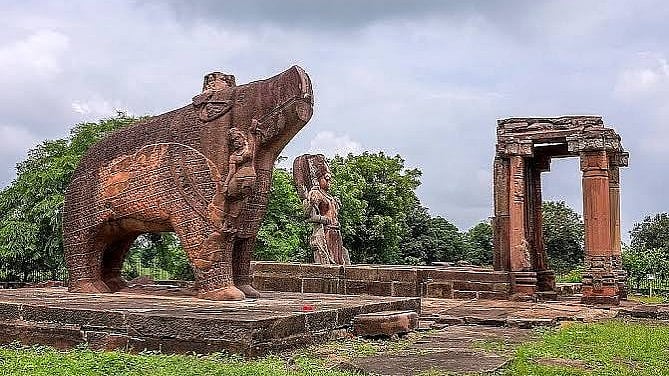
Bhopal (Madhya Pradesh): An elaborate plan to develop Eran - an ancient archaeological site in the Sagar district of Madhya Pradesh - as an international tourist destination is in the works at the Union Culture Ministry.
Eran has been picked as one of the 15 archaeological sites in the country to be developed as a 'Living Cultural Space' under the DESH (Development of Excavation Sites and Heritage Complex) scheme of the Government of India.
Located about 75 kilometres from Sagar, Eran is surrounded on three sides by the Bina River - a tributary of the Betwa - making it an island of sorts. It is an almost 1,500-year-old town, dating back to the time when the Gupta dynasty ruled over vast parts of northern and central India from its capital in Pataliputra (modern Patna). It is believed that Emperor Samudragupta spent the last years of his life at Eran.
Eran was discovered in 1838 by TS Bert and its archaeological survey was conducted in 1874 by General Alexander Cunningham, the first director-general of the Archaeological Survey of India (ASI).
Cunningham got a 1,700-year-old inscription of Emperor Samudragupta, excavated from the site, shifted to Calcutta, where it is preserved in the Indian Museum.
Some of the artefacts excavated from the site are also said to be in museums in London. Attempts will be made to bring them back to Eran.
The Gupta kings were worshippers of Lord Vishnu, and as such, the site has an ancient temple housing a 13-foot-tall idol of Chaturbhuj Vishnu and an 11-foot-tall and 13-foot-long idol of Varaha, the third incarnation of Vishnu.
Eran is a place of great archaeological significance, dating back to the Golden Age of India. Unfortunately, it is little known. We hope that equipping it with proper infrastructure and ensuring connectivity can make it a major tourist attraction, a senior official of the ASI said.