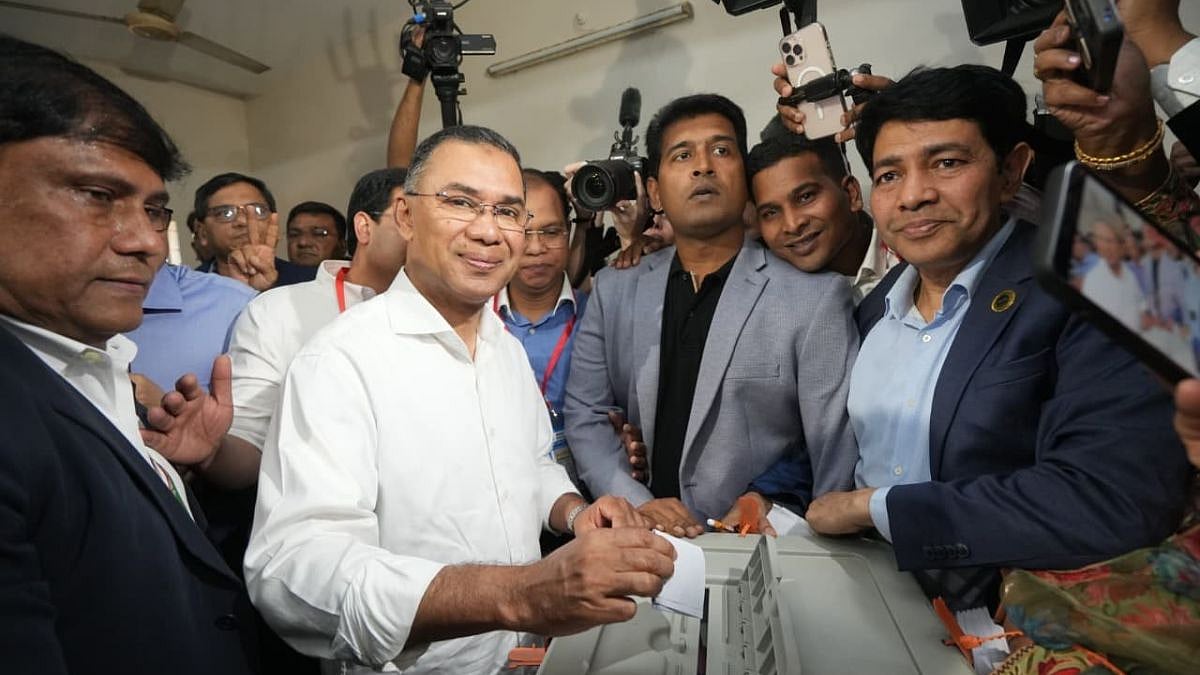
After eighteen months of political turbulence, Bangladesh has conducted a more or less peaceful national election and produced a new government. This is a welcome step towards a more peaceful and prosperous South Asia. The vote was marked by lower-than-usual turnout, familiar accusations of irregularities, and scattered violence. Yet, in a country whose political transitions have often been defined by rupture rather than routine, the mere completion of an electoral process carries significance.
For many Bangladeshis, there is a palpable sense of relief. The prolonged period of what appeared like mob rule, factional intimidation, and institutional paralysis that followed the fall of former prime minister Sheikh Hasina left deep scars which saw competing claims to legitimacy, paralysed governance, a sharp decline in investor confidence, and a cooling of relations with Bangladesh’s largest neighbour—India.
Now a new leadership, headed by Tarique Rahman, appears poised to assume responsibility. The early signals from Dhaka suggest a desire for reconciliation rather than confrontation. Rahman has publicly promised to avoid politics of revenge as well as to carry people from all sections of society, irrespective of religion, with him, a notable pledge in a nation where changes of power have frequently triggered retaliatory cycles of violence.
However, challenges remain in cooling tempers, burying old bitterness, and creating an atmosphere of reconciliation with not just those who inherit power but others also, understanding the need for political space, even for rivals. India, whose ties with Bangladesh had almost gone into a deep freeze during the 18-month interregnum, has moved quickly. Prime Minister Narendra Modi telephoned Rahman, signalling New Delhi’s readiness to engage with the incoming government, and the signals from Dhaka similarly show a willingness to do business with New Delhi.
Such outreach reflects strategic realities on both sides: while Bangladesh depends on India for trade access, transit connectivity, and cooperation over shared rivers, India, for its part, has strong interests in stability along its eastern frontier and a desire to keep the Bay of Bengal outside the sphere of big power rivalry. Still, optimism should be measured by ground realities. Lingering concerns about the institutional robustness and administrative capabilities of the state, weak at the best of times and weaker after prolonged paralysis, persist. And while the incoming government does not embrace militant or extreme-right ideologies, the broader political ecosystem remains volatile.

Bangladesh’s political history too offers cautionary lessons. Since its independence in 1971, the country has experienced assassinations, coups, emergency rule, and bitter partisan rivalry. Democratic forms have endured, but democratic trust has often frayed. The challenge before the new government is, therefore, not merely to govern but also to reassure its citizenry and the wider world by demonstrating that political competition need not mean existential conflict. Economic stability, job creation, and regional cooperation, along with restraint, will be the key to the South Asian nation’s future trajectory.

