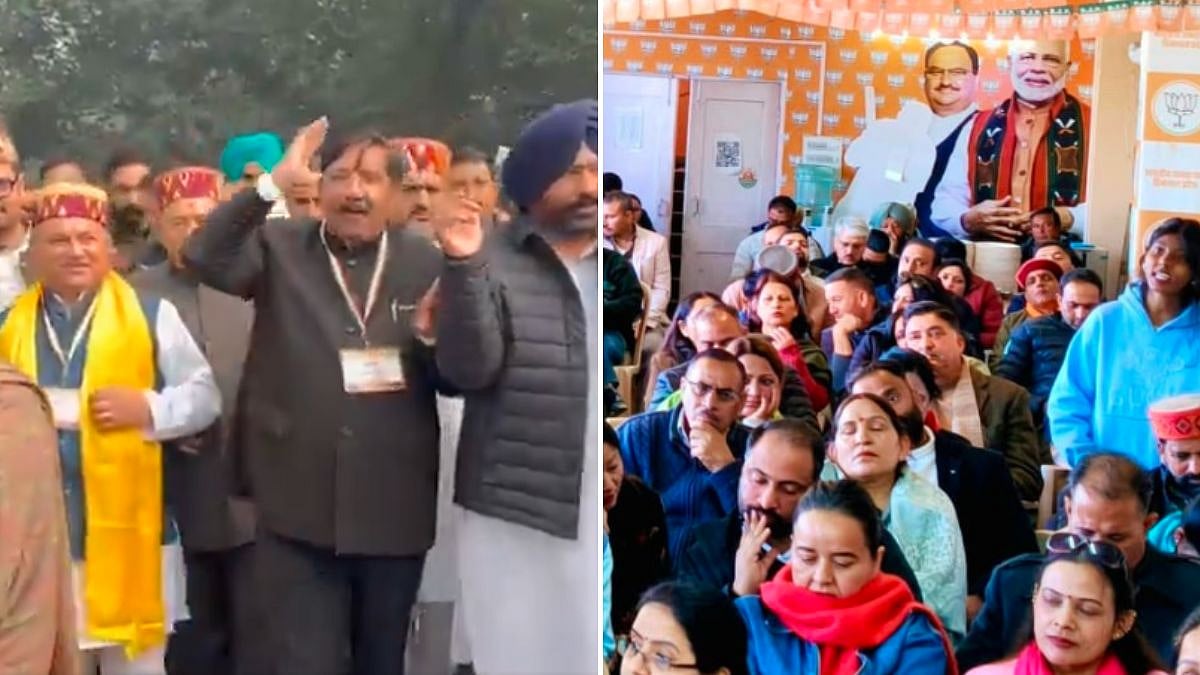
Two major political shows held within a short span in Himachal Pradesh turned out to be far more than routine gatherings. They revealed shifting ambitions, sharpened messaging and an increasingly competitive turf war as both the Congress and the BJP quietly begin preparing for the 2027 assembly contest. Where the Congress used its rally in Mandi to project renewal and organisational muscle, the BJP’s programme in Shimla attempted to push back, reassert central authority and position itself as the moral counterpoint to the ruling Sukhu administration.
Mandi Rally: Not Celebration — A Bid to Reclaim Lost Ground
The Sukhu government’s event in Mandi, branded as a “Sankalp Rally,” was conceived as a demonstration of resolve rather than an anniversary function. The choice of venue was deeply symbolic. In 2022, Mandi had delivered a humiliating verdict to the Congress, denying it nine of ten seats and reinforcing the standing of former chief minister Jai Ram Thakur. Returning to the district was therefore an open declaration that the party intends to challenge the BJP’s fortress and force a rethink of its caste, regional and electoral equations before the next election.
Organisation First — And Little Dependence on Delhi
The turnout owed much to meticulous mobilisation by ministers, legislators and grassroots workers. The absence of top national leaders — occupied by Parliament — did not dilute the event. Instead, it strengthened the impression that the party and government wanted to speak in their own voice, without constantly invoking the high command.
Mukesh Agnihotri Strikes a Chord — And Lifts the Curtain
A defining moment came when AICC in-charge ,Rajani Patil, using a cricket analogy, termed Deputy Chief Minister ,Mukesh Agnihotri the “man of the match.” The phrase resonated largely because his speech was raw, emotional and aimed as much at his own party as at the opposition. He pressed the leadership to reward committed workers, warned against delays in appointments and hinted that time was slipping away. His remarks also revealed friction within the ruling camp, including claims that a few individuals close to the chief minister were trying to undermine him — and criticism of bureaucrats allegedly hobnobbing with BJP leaders.
Sukhu Escalates the Fight — From Defections to Delhi
Chief Minister ,Sukhvinder Singh Sukhu spoke with an aggressive political tone. He accused the BJP of engineering defections in repeated attempts to topple his government and insisted voters had already punished those who switched sides. He further charged that the Centre was blocking legitimate financial dues to Himachal, questioning the status of the ₹1,500-crore relief announcement made after the 2025 disaster. Seeking to reconnect with party ranks, Sukhu listed fulfilled guarantees and promised that outstanding commitments would soon be met.
A Missing Photograph — And An Old Debate Resurfaces
Amid the enthusiasm, controversy crept in. Posters at the rally lacked the image of six-time chief minister Virbhadra Singh. Former PCC ,chief Kuldeep Singh Rathore openly criticised the omission and sought an apology. The episode reopened suspicions over whether the present leadership is intentionally shrinking the space for the Virbhadra legacy. His son, Vikarmaditya Singh, a cabinet minister, responded by saying the late leader’s memory remains anchored in the hearts of Himachalis and cannot be erased.
Holly Lodge vs. The New Centre of Power
Speculation intensified with cabinet minister Vikramaditya Singh’s absence — he was in London to receive an international certificate of honour — and Pratibha Singh being in Delhi. For critics, the episode revived the question of whether the influence of the “Holly Lodge” family has been edged out by a new political centre around Sukhuwhich may not be an easy task. Virbhadra versus Sukhu having an adversarial history — once marked by open confrontation — is well known, and many see Sukhu’s rise after 2022 as the culmination of that rivalry embedded in his revengeful attitude and actions.
BJP Answers From Shimla — A Counter-Narrative Takes Shape
The BJP responded quickly. Its rally at the historic Peterhoff, led by party president J.P. Nadda, served as a rebuttal rather than a routine programme. Nadda targeted the Sukhu government over finances, governance lapses and unfinished promises, while signalling to the cadre that the national leadership remains fully invested in retaking the state.
Framing The Congress as Inept — And Delhi as the Anchor
The BJP sought to dismantle the Congress narrative on relief and development, insisting the state had mismanaged resources and misused central support. Senior leaders — including Anurag Thakur, Jai Ram Thakur and Dr Rajiv Bindal — pressed hard on the theme of corruption, unkept guarantees and administrative drift. Nadda argued that “double-engine governance” — alignment between Centre and state — is crucial if Himachal is to effectively use funds and accelerate projects.
He also cited unutilised central allocations, accusing the government of mishandling disaster relief and development schemes. Quiet discussions in political circles have already begun about whether Nadda could eventually return to state politics to lead the campaign in 2027.
Dharamshala: A Second Show of Force
The BJP followed this up with a strong mobilisation in Dharamshala during the winter session. The timing was deliberate. By raising questions about relief for victims of the 2025 calamity, the party contrasted the Congress’s celebratory rally in Mandi with the continuing pain of affected families. The underlying message was simple: the government is rejoicing while survivors still wait for adequate help.
The Contest Begins Long Before the Polls
Taken together, the two rallies were rehearsals for the battles ahead. The Congress sought to project revival in difficult territory while wrestling with internal tensions. The BJP aimed to remind voters of its organisational discipline, national backing and readiness to capitalise on Congress divisions. These early moves suggest that the race to 2027 has already begun — where symbols, unity and credibility may matter as much as programmes and performance.
(Writer is a senior political analyst and strategic affairs columnist based in Shimla)

