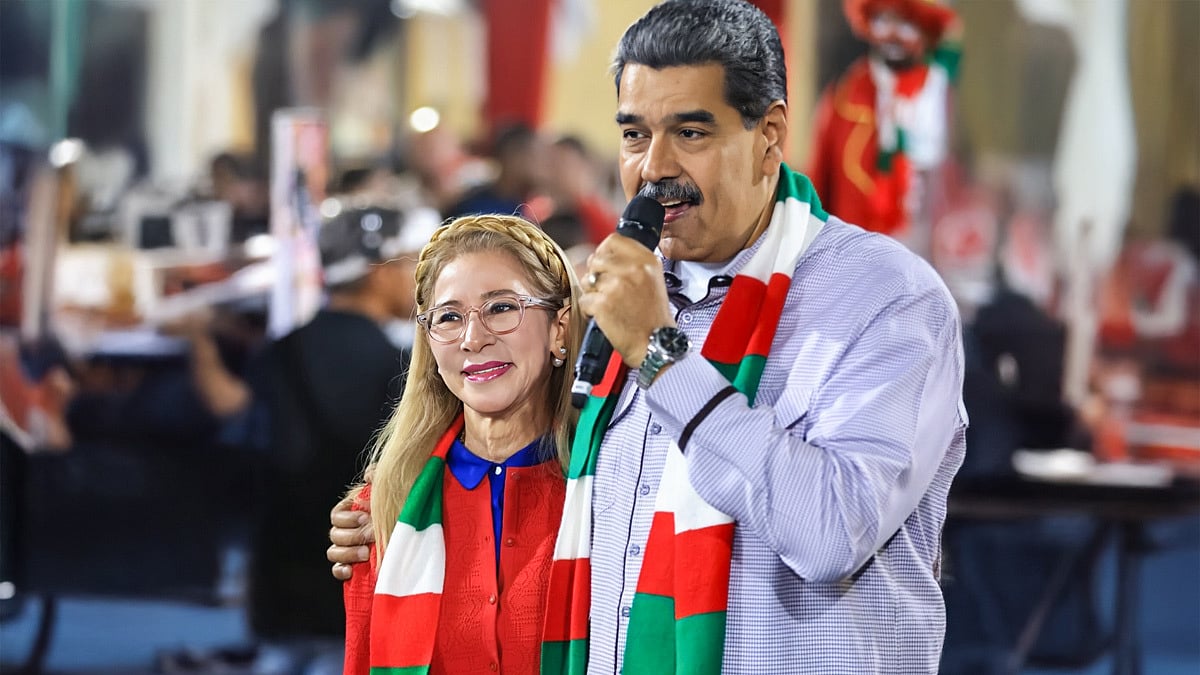
In the dark hours of January 2, 2026, following months of preparation and rehearsal, the US military, on the order of President Donald J. Trump, carried out a direct, precise, and extraordinary attack on Venezuela. The operation culminated not only in widespread destruction but also in the kidnapping of its president, Nicolás Maduro, who has now been deposed and replaced by Vice President Delcy Rodríguez, along with his wife, Cilia Flores.
The operation was carried out by Delta Force, the US military’s top special mission unit. President Maduro and the First Lady were then brought to New York for trial on charges of narco-terrorism and ruining American lives through it.
According to The New York Times, at least 40 people, including military personnel and civilians, lost their lives in the US strike on Venezuela.
At least seven explosions were reported, and low-flying choppers were seen in La Guairá, Higuerote, Meseta de Mamo, Baruta, El Hatillo, Charallave, and Carmen de Uria, areas mostly inside or near the capital city, Caracas. The strike reportedly followed multiple attacks on Venezuelan boats, which were accused by the US of smuggling narcotics for drug cartels. Visuals of those explosions have gone viral on social media, showcasing the havoc caused by the US military.
While talking about the military operation, US Joint Chiefs of Staff Chairman Gen. Dan Caine confirmed that more than 150 aircraft, bombers, and assets from 20 different land and sea bases were involved in the operation.
According to Gen. Caine, the Delta Force came under fire during the operation, and one aircraft was even hit, but nothing significant occurred that could hamper the mission. President Maduro and his wife were taken into custody without any US fatalities.
In terms of preparedness, Operation Absolute Resolve was a brilliant military operation that showcased the sheer professionalism, coordination, and courage of the US military, for which they have been widely praised. However, it also shed light on America’s hypocrisy, its disregard for international law, and its double standards on the topic of national security.
An Act of War or Just a Law Enforcement Operation?
After the invasion of Venezuela on January 2, 2026, the Trump administration countered criticism of its military action, arguing that the arrest of President Nicolas Maduro was a targeted law-enforcement action rather than the opening of a new war or military occupation.
“There’s not a war,” US Secretary of State Rubio said, adding that Washington is “at war against drug trafficking organizations—not at war against Venezuela.” “This was not an invasion but a law enforcement operation,” he said. Rubio also stated that US forces were on the ground only briefly to execute the arrest and then withdrew. He emphasized that the mission relied on court warrants and sanctions enforcement rather than congressional authorisation for combat.
The Trump administration justified its actions in Venezuela, but invading a sovereign country and kidnapping not only its leader but also his wife in the darkness of night is not just normal business, is it? What if the situation were reversed? If Venezuela was to invade US territory and kidnap a former US president along with his wife on charges of crimes committed against Venezuela and its people, would the USA still consider that an act of war or merely a “law enforcement operation”? The answer becomes evident, doesn’t it?
The invasion of Venezuela was not just a law-enforcement operation but also an act of war against Venezuela, because it was not targeted at an ordinary criminal but at the sitting head of state of a sovereign nation.
The US does not want the world to see it as an act of war because the objective it set out to achieve under Operation Absolute Resolve has already been accomplished. Had the same action been carried out by the Russian military against Ukraine and its president, Volodymyr Zelenskyy, it would certainly have been considered an act of war against Ukraine by the Trump administration. However, since the US itself is involved, it continues to push the narrative that the operation was merely a law-enforcement action.
Netizens on social media platform X have reacted with sharp division to the Trump administration’s actions. Some Venezuelans and Trump supporters expressed euphoria, thanking him for “delivering justice” and for “freeing Venezuela,” while others condemned the operation as an “illegal invasion,” an “imperialist kidnapping,” and a “war crime for oil.”
A Military Operation Against Narco-Terrorism or an Invasion for Oil?
Venezuela is an extremely oil-rich nation, with reserves worth billions - perhaps even trillions - of dollars. Canada has some, Russia has some, but Venezuela, according to reports, has around 304 billion barrels of oil sitting underground, which fetches enormous sums once sold. The US, being a capitalist country, and President Trump, being the businessman that he is, know this well.
The Trump administration has claimed that the military operation in Venezuela was against narco-terrorism and the damage it was causing to American lives. But is that really the case? Only time, and the steps taken by the US government, will tell.
An interesting video has surfaced on social media in which, aboard Air Force One, a reporter asks the US president, “Did you speak with the oil companies before the operation? Did you tip them off?” The president replies in the affirmative, saying, “Yes. Before and after. They want to go in, and they’re going to do a great job.”
Interesting, isn’t it? If the operation were truly about narco-terrorism, wouldn’t officials focus on controlling that issue within Venezuela? There has been no mention by any US government official about such efforts, but there has been mention of oil companies moving in. President Donald Trump himself has stated that oil companies will be moving in and that they will sell large amounts of oil to other countries, while also announcing that the USA will run Venezuela until a proper transition takes place. Yet, there has been no word on how the US plans to curb narco-terrorism in Venezuela.
If the operation was about narco-terrorism and not oil, then why are oil companies among the first entities expected to move in rather than those tasked with combating drug trafficking? President Trump and his administration have yet to address this question.
Disregard for International Law & National Security Concerns
When Russia launched its “special military operation” in Ukraine, European leaders called it an invasion of a sovereign nation. As people died and infrastructure was destroyed, Russian President Vladimir Putin was labeled a murderer and a destroyer of a sovereign nation. Russia’s invasion of Ukraine was called a war by European leaders and the American government and was condemned outright.
Russia shares vast borders with several countries on its western front, many of which are part of the NATO alliance. Countries that share borders with Russia while being NATO members include Norway, Finland, Estonia, Latvia, Lithuania, and Poland. In reality, Russia has already compromised significantly on its national security by having its rival, the USA, effectively on its borders. Talks of Ukraine joining NATO posed an even greater perceived threat, which President Putin saw coming and acted upon by invading Ukraine.
After the invasion began, there was no dialogue from European leaders or the US government acknowledging that Russia acted out of national security concerns rather than a desire to start a war.
Around 40 people lost their lives in the USA’s invasion of Venezuela, yet no European leader or American journalist is calling US President Donald Trump a murderer. The Trump administration is hell-bent on pushing the narrative that its invasion of Venezuela was a “law enforcement operation” and not a war, just as it insisted in 2022 that Russia’s “special military operation” in Ukraine was an invasion of a sovereign nation.
If the USA’s invasion of Venezuela is acceptable to the American government and European leaders because it was carried out for “national security concerns,” then Russia’s invasion of Ukraine should also be considered acceptable, as it was driven by similar concerns. By that logic, the same would apply to China if it were to invade Taiwan.
This is where the contradiction lies. The American government and European leaders are not concerned about other nations defending their national security because doing so challenges their dominance - something they cannot afford.
If acting out of national security concerns is justified for one country, then it should be justified for others as well. The hypocrisy of the USA and European leaders has once again been exposed through the invasion and kidnapping of Venezuela’s president, Nicolás Maduro. It clearly shows that the USA is willing to go to great lengths to protect its own national security but becomes outraged when other nations do the same.
If the USA’s invasion and kidnapping of Venezuela and its sitting president can be called a “law enforcement operation” rather than a war against a sovereign nation, then Russia’s invasion of Ukraine can just as easily be termed “Russia’s temporary special military operation in Ukraine.” If the USA walks away from this without major consequences - as it most likely will, given that the European Union often aligns with it - then the US has no right to preach or restrain other countries from going to similar lengths to protect their national security concerns.

