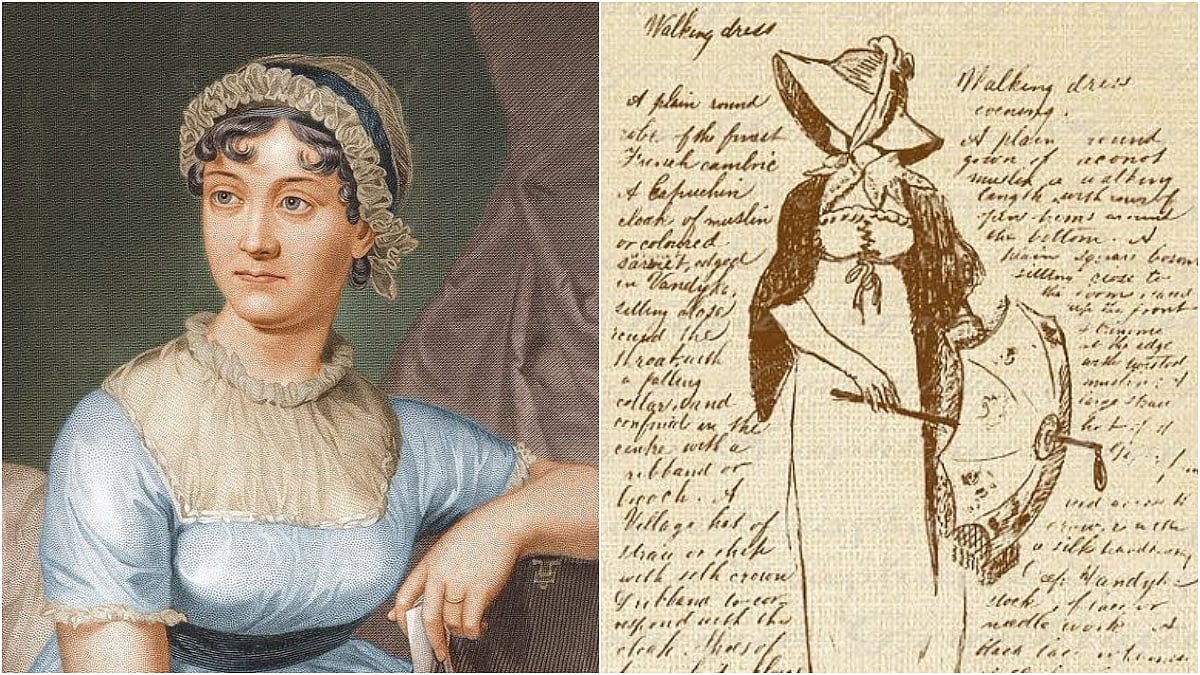
The world of book lovers is celebrating the 250th birth anniversary of Jane Austen, one of the most influential writers of all time—she was born on December 16, 1775, in Steventon, Hampshire, the seventh of eight children.
There are Jane Austen Festivals and other events worldwide, featuring talks, performances, and exhibitions. Fans and scholars gather to celebrate Austen's life, works, and enduring impact on literature and culture. New publications, adaptations, and scholarly works continue to emerge, ensuring Austen's legacy remains vibrant (according to information on the net). This kind of love and admiration is rare for any writer to receive over two centuries later.
She expressed the thoughts, emotions and rebellions of women at a time when feminism was a blip on a distant horizon. Her reputation rests on six novels—Sense and Sensibility (1811), Pride and Prejudice (1813), Mansfield Park (1814), Emma (1816), Northanger Abbey (1816) and Persuasion (1818)— though she also wrote some more stories. These six were such astute and empathetic portrayals of British society of her time that they resonate with readers till today; and audiences too, if the multiple film, TV, and stage adaptations of her novels are considered too. Not to mention the works of writers like Helen Fielding and Sophie Kinsella, inspired by her.
Austen's writing often explored themes of love, family, and social status, with strong, complex female characters. At a time when women’s social status rested on making a good marriage, with no other opportunities available to them, Austen's novels critiqued the patriarchal society of the time.
When women were expected to be docile, she created heroines, like Elizabeth Bennet and Emma Woodhouse, who were intelligent, witty, and independent. Her heroines often defied the strict social norms of the time, choosing personal happiness over material security. Her novels also feature strong female relationships, showcasing the power of female bonds and sisterhood.
Sarah Lyall, who travelled to England where the Austen celebrations were in full swing, writes in The New York Times, “The books can be read on multiple levels: for their romantic plots and insights into the lives of the landed gentry in Regency England, for their revolutionary narrative techniques, for their sly humour. They reward rereading—close readers say they discover something new each time—and the universality and pliability of their plots make them ripe for cinematic adaptation.
“Austen’s most ardent fans are known as Janeites, a word coined by the British writer George Saintsbury in 1894 and used by Rudyard Kipling in his 1924 short story The Janeites about British soldiers reading Austen in World War I. The Jane Austen Society UK and the Jane Austen Society of North America were founded in 1940 and 1979, respectively, but the modern era of fandom is universally acknowledged to have begun the moment a thrillingly dishevelled Colin Firth appeared in his wet shirt in the 1995 BBC adaptation of Pride and Prejudice.”
The website janeaustens.house analyses the writer’s enduring appeal: "Jane Austen’s novels are not feminist in the way we mean it today. But they do hint at the need for equality between the sexes. Her heroines defy gender norms, and push for more agency in their own lives. The overarching theme that runs throughout all her novels is the inequality faced by women in Regency society. At the time when she was writing, women had very few legal, social or economic rights. Very few upper- and middle-class women could own their own property. Women had little formal education, could not enter university or the professions, and great stigma attached to the idea of a middle-class woman working for an income: think of the way Jane Fairfax is pitied in Emma because she has no choice but to work. Legally, an unmarried woman was the responsibility of her father, but once married she was completely under her husband’s control, as were her children and any property. Yet for most women marriage was the only option for respectable survival.
“So while Jane Austen’s novels do revolve around marriage, we must remember how immensely important the question of marriage was to most women. At one end of the scale, it was a question of wealth and status; but at the other it was simply about securing a home, securing oneself from poverty, and avoiding the destitution of an ‘old maid’. But whilst Jane Austen makes clear the hard economic facts of marriage, she also offers, in the examples of her heroines, another possibility: marriage for mutual love and esteem. If a husband effectively ‘owns’ his wife, then marriage to a man who does not care about you is not a safe or secure place to be. The hope was that you might marry a man who loved and respected you, and would treat you as an equal even if the law did not demand it. While her novels show unhappy marriages (like that of the Bennets in Pride and Prejudice) and marriages of economic necessity (like that of Charlotte Lucas to Mr Collins in the same novel), she is optimistic (or romantic) enough to suggest that it may be possible to find equality inside marriage.”
These are concerns of contemporary women too, which is why her stories fit into any age, as modern adaptations like Clueless (1995), Bride and Prejudice (2004) and the Indian film Aisha (2010) show.
The fascination with Jane Austen and her books just refuses to die down. In the works is a screen adaptation of Janice Hadlow’s book, The Other Bennet Sister, in which Mary Bennet emerges from the shadows of her sisters in Pride and Prejudice and becomes her own person.
Sir Walter Scott, a great novelist of her time, anonymously wrote a review praising Emma in 1815: "the art of copying from nature as she really exists in the common walks of life, and presenting to the reader, instead of the splendid scenes from an imaginary world, a correct and striking representation of that which is daily taking place around him."
An author who wrote, a dialogue spoken by Marianne Dashwood, Sense and Sensibility, “It is not time or opportunity that is to determine intimacy; it is disposition alone. Seven years would be insufficient to make some people acquainted with each other, and seven days are more than enough for others,” deserves her posthumous longevity.
Deepa Gahlot is a Mumbai-based columnist, critic and author.

